

6.2 Effects of Tsunami on Soils
“Tsunami” is a Japanese word that literally means harbor wave. A tsunami forms as
the result of a conveyance of a sudden movement of the seafloor, an earthquake, to a
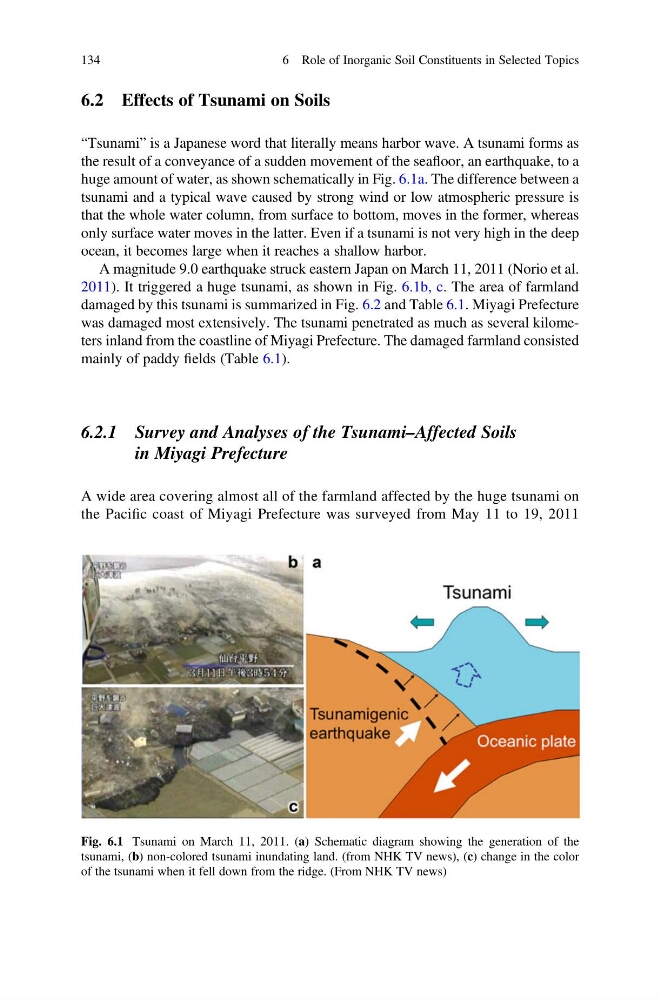
huge amount of water, as shown schematically in Fig. 6.1a. The difference between a
tsunami and a typical wave caused by strong wind or low atmospheric pressure is
that the whole water column, from surface to bottom, moves in the former, whereas
only surface water moves in the latter. Even if a tsunami is not very high in the deep
ocean, it becomes large when it reaches a shallow harbor.
A magnitude 9.0 earthquake struck eastern Japan on March 11, 2011 (Norio et al.
2011). It triggered a huge tsunami, as shown in Fig. 6.1b, c. The area of farmland
damaged by this tsunami is summarized in Fig. 6.2 and Table 6.1. Miyagi Prefecture
was damaged most extensively. The tsunami penetrated as much as several kilometers inland from the coastline of Miyagi Prefecture. The damaged farmland consisted
mainly of paddy fields (Table 6.1).
6.2.1 Survey and Analyses of the Tsunami–Affected Soils
in Miyagi Prefecture
A wide area covering almost all of the farmland affected by the huge tsunami on
the Pacific coast of Miyagi Prefecture was surveyed from May 11 to 19, 2011
Fig. 6.1 Tsunami on March 11, 2011. (a) Schematic diagram showing the generation of the
tsunami, (b) non-colored tsunami inundating land. (from NHK TV news), (c) change in the color
of the tsunami when it fell down from the ridge. (From NHK TV news)
134
6 Role of Inorganic Soil Constituents in Selected Topics
“Tsunami” is a Japanese word that literally means harbor wave. A tsunami forms as
the result of a conveyance of a sudden movement of the seafloor, an earthquake, to a
huge amount of water, as shown schematically in Fig. 6.1a. The difference between a
tsunami and a typical wave caused by strong wind or low atmospheric pressure is
that the whole water column, from surface to bottom, moves in the former, whereas
only surface water moves in the latter. Even if a tsunami is not very high in the deep
ocean, it becomes large when it reaches a shallow harbor.
A magnitude 9.0 earthquake struck eastern Japan on March 11, 2011 (Norio et al.
2011). It triggered a huge tsunami, as shown in Fig. 6.1b, c. The area of farmland
damaged by this tsunami is summarized in Fig. 6.2 and Table 6.1. Miyagi Prefecture
was damaged most extensively. The tsunami penetrated as much as several kilometers inland from the coastline of Miyagi Prefecture. The damaged farmland consisted
mainly of paddy fields (Table 6.1).
6.2.1 Survey and Analyses of the Tsunami–Affected Soils
in Miyagi Prefecture
A wide area covering almost all of the farmland affected by the huge tsunami on
the Pacific coast of Miyagi Prefecture was surveyed from May 11 to 19, 2011
Fig. 6.1 Tsunami on March 11, 2011. (a) Schematic diagram showing the generation of the
tsunami, (b) non-colored tsunami inundating land. (from NHK TV news), (c) change in the color
of the tsunami when it fell down from the ridge. (From NHK TV news)
134
6 Role of Inorganic Soil Constituents in Selected Topics