

roots turns brown. This brown color is due to diffusion and concentration of ferrous
iron, followed by oxidation of the ferrous iron by oxygen diffusion through the rice
roots (Ando et al. 1983; Sadana and Claassen 1996), and precipitation of ferric iron
(iron(III)), resulting in the formation of iron plaque (Kahn et al. 2016). Thus, the
main redox interface sites in paddy field soil are located between the oxidative soil
layer and underlying reduced soil, and between the rice roots and reduced soil. The
other redox interface in paddy field soil is between the reduced soil and the
underlying oxidative subsoil. Reducing conditions can be found most clearly using
the dipyridyl test, which detects the presence of Fe
2+ .
The color change of a soil profile with an increase in reducing conditions may
depend on soil properties. Since the color of the Ap horizon in Andisols is dark,
where the dark color is due to high content of highly-humified humus, the color
change with an increase in reducing conditions, such as in Fig. 5.1, may be masked
even when Fe
2+ is detected with the dipyridyl test. Fading of the light brown color of
goethite aggregates in an incubated soil under submergence is slow, possibly due to
the high stability of goethite crystals.
5.1.2 Redox Reactions in Soil
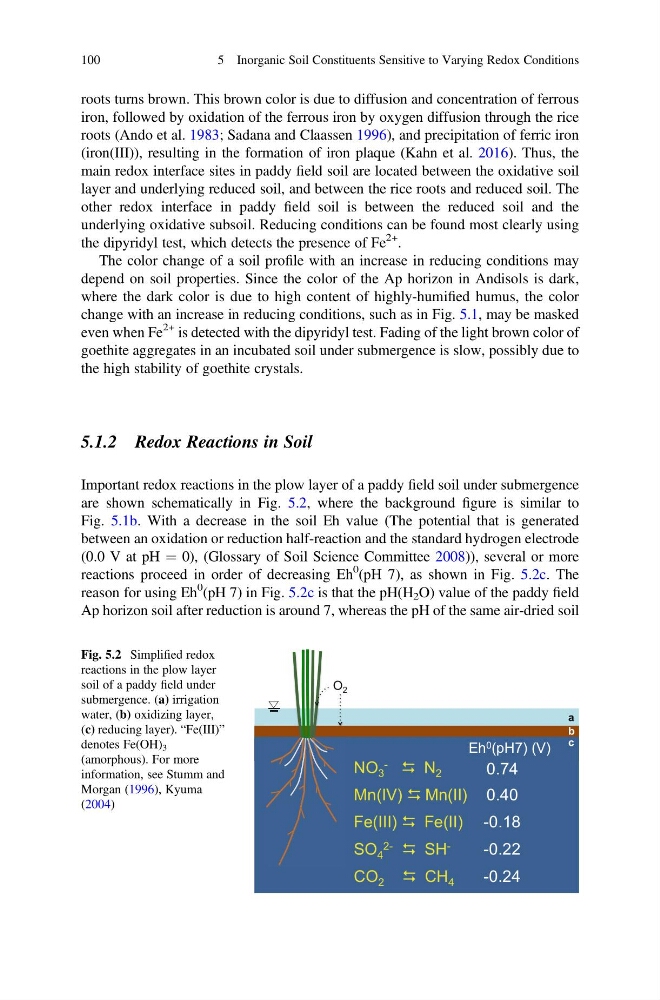
Important redox reactions in the plow layer of a paddy field soil under submergence
are shown schematically in Fig. 5.2, where the background figure is similar to
Fig. 5.1b. With a decrease in the soil Eh value (The potential that is generated
between an oxidation or reduction half-reaction and the standard hydrogen electrode
(0.0 V at pH ¼ 0), (Glossary of Soil Science Committee 2008)), several or more
reactions proceed in order of decreasing Eh
0 (pH 7), as shown in Fig. 5.2c. The
reason for using Eh
0 (pH 7) in Fig. 5.2c is that the pH(H 2 O) value of the paddy field
Ap horizon soil after reduction is around 7, whereas the pH of the same air-dried soil
NO 3
- N 2
0.74
Mn(IV) Mn(II) 0.40
Fe(III) Fe(II) -0.18
SO 4
2- SH -
-0.22
CO 2 CH 4
-0.24
Eh 0 (pH7) (V)
a
b
c
O 2
O 2
Fig. 5.2 Simplified redox
reactions in the plow layer
soil of a paddy field under
submergence. (a) irrigation
water, (b) oxidizing layer,
(c) reducing layer). “Fe(III)”
denotes Fe(OH) 3
(amorphous). For more
information, see Stumm and
Morgan (1996), Kyuma
(2004)
100
5 Inorganic Soil Constituents Sensitive to Varying Redox Conditions
iron, followed by oxidation of the ferrous iron by oxygen diffusion through the rice
roots (Ando et al. 1983; Sadana and Claassen 1996), and precipitation of ferric iron
(iron(III)), resulting in the formation of iron plaque (Kahn et al. 2016). Thus, the
main redox interface sites in paddy field soil are located between the oxidative soil
layer and underlying reduced soil, and between the rice roots and reduced soil. The
other redox interface in paddy field soil is between the reduced soil and the
underlying oxidative subsoil. Reducing conditions can be found most clearly using
the dipyridyl test, which detects the presence of Fe
2+ .
The color change of a soil profile with an increase in reducing conditions may
depend on soil properties. Since the color of the Ap horizon in Andisols is dark,
where the dark color is due to high content of highly-humified humus, the color
change with an increase in reducing conditions, such as in Fig. 5.1, may be masked
even when Fe
2+ is detected with the dipyridyl test. Fading of the light brown color of
goethite aggregates in an incubated soil under submergence is slow, possibly due to
the high stability of goethite crystals.
5.1.2 Redox Reactions in Soil
Important redox reactions in the plow layer of a paddy field soil under submergence
are shown schematically in Fig. 5.2, where the background figure is similar to
Fig. 5.1b. With a decrease in the soil Eh value (The potential that is generated
between an oxidation or reduction half-reaction and the standard hydrogen electrode
(0.0 V at pH ¼ 0), (Glossary of Soil Science Committee 2008)), several or more
reactions proceed in order of decreasing Eh
0 (pH 7), as shown in Fig. 5.2c. The
reason for using Eh
0 (pH 7) in Fig. 5.2c is that the pH(H 2 O) value of the paddy field
Ap horizon soil after reduction is around 7, whereas the pH of the same air-dried soil
NO 3
- N 2
0.74
Mn(IV) Mn(II) 0.40
Fe(III) Fe(II) -0.18
SO 4
2- SH -
-0.22
CO 2 CH 4
-0.24
Eh 0 (pH7) (V)
a
b
c
O 2
O 2
Fig. 5.2 Simplified redox
reactions in the plow layer
soil of a paddy field under
submergence. (a) irrigation
water, (b) oxidizing layer,
(c) reducing layer). “Fe(III)”
denotes Fe(OH) 3
(amorphous). For more
information, see Stumm and
Morgan (1996), Kyuma
(2004)
100
5 Inorganic Soil Constituents Sensitive to Varying Redox Conditions