

oxalate-extractable Al (Al o ), total organic carbon (TOC), and cation exchange
capacity (CEC) values are 8.6, 1.2, 23.0 g kg
À1
, and 23.6 cmol c kg
À1
, respectively
(Kusunoki et al. 2015). The major iron mineral in the paddy field soil appears to be
poorly crystalline ferrihydrite (Childs et al. 1991; Hansel et al. 2001; Fu et al. 2016).
These chemical properties are common to the plow layer of lowland paddy field
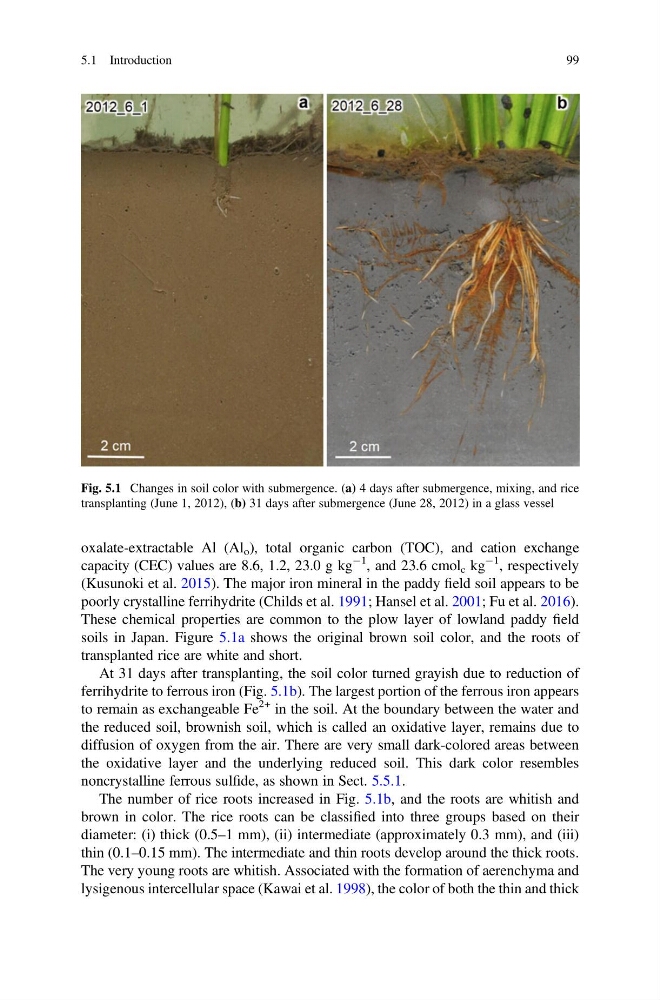
soils in Japan. Figure 5.1a shows the original brown soil color, and the roots of
transplanted rice are white and short.
At 31 days after transplanting, the soil color turned grayish due to reduction of
ferrihydrite to ferrous iron (Fig. 5.1b). The largest portion of the ferrous iron appears
to remain as exchangeable Fe
2+ in the soil. At the boundary between the water and
the reduced soil, brownish soil, which is called an oxidative layer, remains due to
diffusion of oxygen from the air. There are very small dark-colored areas between
the oxidative layer and the underlying reduced soil. This dark color resembles
noncrystalline ferrous sulfide, as shown in Sect. 5.5.1.
The number of rice roots increased in Fig. 5.1b, and the roots are whitish and
brown in color. The rice roots can be classified into three groups based on their
diameter: (i) thick (0.5–1 mm), (ii) intermediate (approximately 0.3 mm), and (iii)
thin (0.1–0.15 mm). The intermediate and thin roots develop around the thick roots.
The very young roots are whitish. Associated with the formation of aerenchyma and
lysigenous intercellular space (Kawai et al. 1998), the color of both the thin and thick
Fig. 5.1 Changes in soil color with submergence. (a) 4 days after submergence, mixing, and rice
transplanting (June 1, 2012), (b) 31 days after submergence (June 28, 2012) in a glass vessel
5.1 Introduction
99
capacity (CEC) values are 8.6, 1.2, 23.0 g kg
À1
, and 23.6 cmol c kg
À1
, respectively
(Kusunoki et al. 2015). The major iron mineral in the paddy field soil appears to be
poorly crystalline ferrihydrite (Childs et al. 1991; Hansel et al. 2001; Fu et al. 2016).
These chemical properties are common to the plow layer of lowland paddy field
soils in Japan. Figure 5.1a shows the original brown soil color, and the roots of
transplanted rice are white and short.
At 31 days after transplanting, the soil color turned grayish due to reduction of
ferrihydrite to ferrous iron (Fig. 5.1b). The largest portion of the ferrous iron appears
to remain as exchangeable Fe
2+ in the soil. At the boundary between the water and
the reduced soil, brownish soil, which is called an oxidative layer, remains due to
diffusion of oxygen from the air. There are very small dark-colored areas between
the oxidative layer and the underlying reduced soil. This dark color resembles
noncrystalline ferrous sulfide, as shown in Sect. 5.5.1.
The number of rice roots increased in Fig. 5.1b, and the roots are whitish and
brown in color. The rice roots can be classified into three groups based on their
diameter: (i) thick (0.5–1 mm), (ii) intermediate (approximately 0.3 mm), and (iii)
thin (0.1–0.15 mm). The intermediate and thin roots develop around the thick roots.
The very young roots are whitish. Associated with the formation of aerenchyma and
lysigenous intercellular space (Kawai et al. 1998), the color of both the thin and thick
Fig. 5.1 Changes in soil color with submergence. (a) 4 days after submergence, mixing, and rice
transplanting (June 1, 2012), (b) 31 days after submergence (June 28, 2012) in a glass vessel
5.1 Introduction
99