

10.3 Solutions
591
However, for ν e +e
−
→ ν e +e
− , there are two diagrams shown in Fig. 10.13b
and Fig. 10.13c.
Thus the reaction can be described by neutral or charged current and therefore does not constitute an unequivocal evidence for neutral current.
10.94 If N ν is the number of neutrino types in the sequence ν e , ν μ , ν τ and assuming that there are only three charged leptons e, μ and τ , the balance equation
for the decay rate can be written as
Γ z (total) = Γ(Z
0
→ hadrons) + 3 Γ(Z
0
→ l
+ l
− ) + N ν Γ(Z
0
→ ν l ν l )
The factor 3 is for the three charged leptons. Substituting the given data
2.534 = 1.797 + 3 × 0.084 + 0.166N ν
and solving, we get N ν = 2.92 or 3.
10.95 (a) W
± and Z
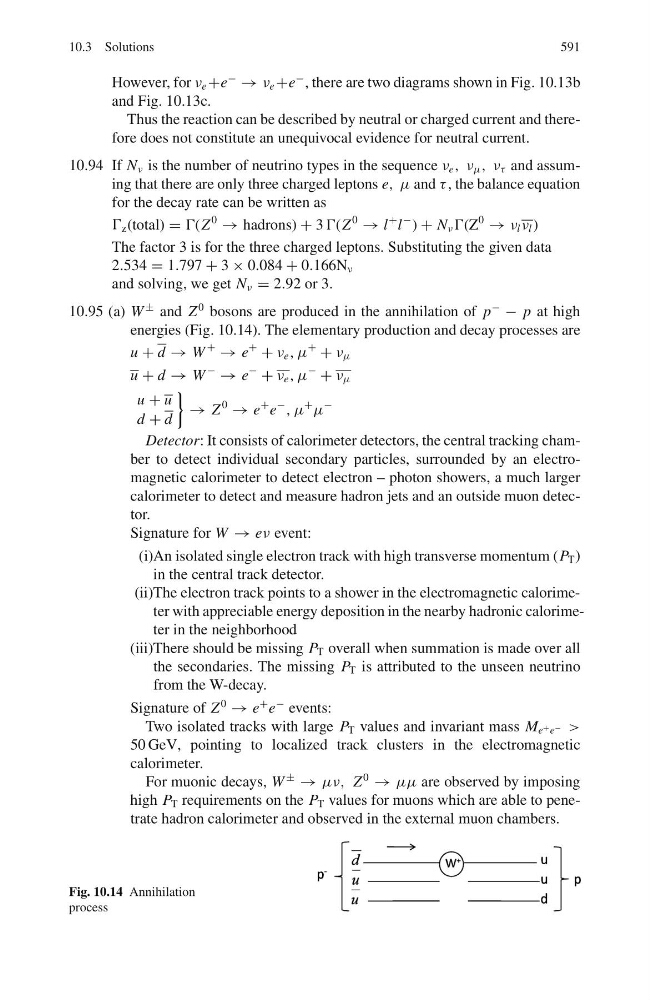
0 bosons are produced in the annihilation of p
−
− p at high
energies (Fig. 10.14). The elementary production and decay processes are
u + d → W
+
→ e
+
+ ν e , μ
+
+ ν μ
u + d → W
−
→ e
−
+ ν e , μ
−
+ ν μ
u + u
d + d
→ Z
0
→ e
+ e
−
, μ
+
μ
−
Detector: It consists of calorimeter detectors, the central tracking chamber to detect individual secondary particles, surrounded by an electromagnetic calorimeter to detect electron – photon showers, a much larger
calorimeter to detect and measure hadron jets and an outside muon detector.
Signature for W → eν event:
(i)An isolated single electron track with high transverse momentum (P T )
in the central track detector.
(ii)The electron track points to a shower in the electromagnetic calorimeter with appreciable energy deposition in the nearby hadronic calorimeter in the neighborhood
(iii)There should be missing P T overall when summation is made over all
the secondaries. The missing P T is attributed to the unseen neutrino
from the W-decay.
Signature of Z
0
→ e
+ e
− events:
Two isolated tracks with large P T values and invariant mass M e + e − >
50 GeV, pointing to localized track clusters in the electromagnetic
calorimeter.
For muonic decays, W
±
→ μν, Z
0
→ μμ are observed by imposing
high P T requirements on the P T values for muons which are able to penetrate hadron calorimeter and observed in the external muon chambers.
Fig. 10.14 Annihilation
process