

10.3 Solutions
581
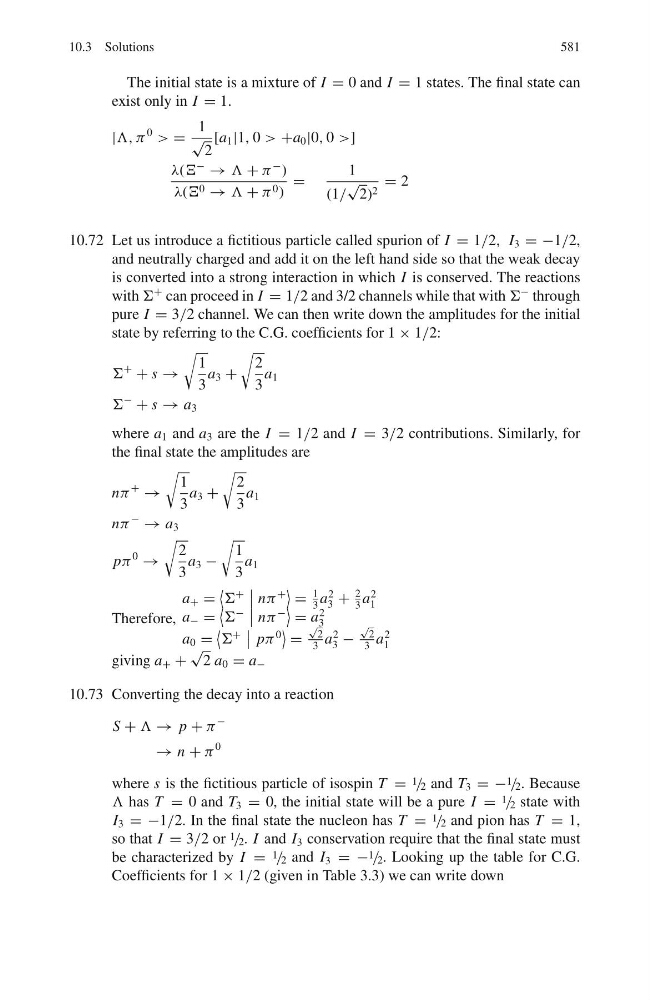
The initial state is a mixture of I = 0 and I = 1 states. The final state can
exist only in I = 1.
|Λ, π
0
> =
1
√
2
[a 1 |1, 0 > +a 0 |0, 0 >]
λ(Ξ
−
→ Λ + π
− )
λ(Ξ 0 → Λ + π 0 )
=
1
(1/
√
2) 2
= 2
10.72 Let us introduce a fictitious particle called spurion of I = 1/2, I 3 = −1/2,
and neutrally charged and add it on the left hand side so that the weak decay
is converted into a strong interaction in which I is conserved. The reactions
with Σ
+ can proceed in I = 1/2 and 3/2 channels while that with Σ
− through
pure I = 3/2 channel. We can then write down the amplitudes for the initial
state by referring to the C.G. coefficients for 1 × 1/2:
Σ
+
+ s →
1
3
a 3 +
2
3
a 1
Σ
−
+ s → a 3
where a 1 and a 3 are the I = 1/2 and I = 3/2 contributions. Similarly, for
the final state the amplitudes are
nπ
+
→
1
3
a 3 +
2
3
a 1
nπ
−
→ a 3
pπ
0
→
2
3
a 3 −
1
3
a 1
Therefore,
a + =
Σ
+
nπ
+
=
1
3
a
2
3 +
2
3
a
2
1
a − =
Σ
−
nπ
−
= a
2
3
a 0 =
Σ
+
pπ
0
=
√
2
3
a
2
3 −
√
2
3
a
2
1
giving a + +
√
2 a 0 = a −
10.73 Converting the decay into a reaction
S + Λ → p + π
−
→ n + π
0
where s is the fictitious particle of isospin T = 1 / 2 and T 3 = − 1 / 2 . Because
Λ has T = 0 and T 3 = 0, the initial state will be a pure I = 1 / 2 state with
I 3 = −1/2. In the final state the nucleon has T = 1 / 2 and pion has T = 1,
so that I = 3/2 or 1 / 2 . I and I 3 conservation require that the final state must
be characterized by I = 1 / 2 and I 3 = − 1 / 2 . Looking up the table for C.G.
Coefficients for 1 × 1/2 (given in Table 3.3) we can write down