

580
10 Particle Physics – II
Reaction (3) has relative weightage of 3 because of three colours. Thus
the branching fraction of (1) is predicted to be 1/5 or 0.2, a value which is in
agreement with the experimental value of 0.18.
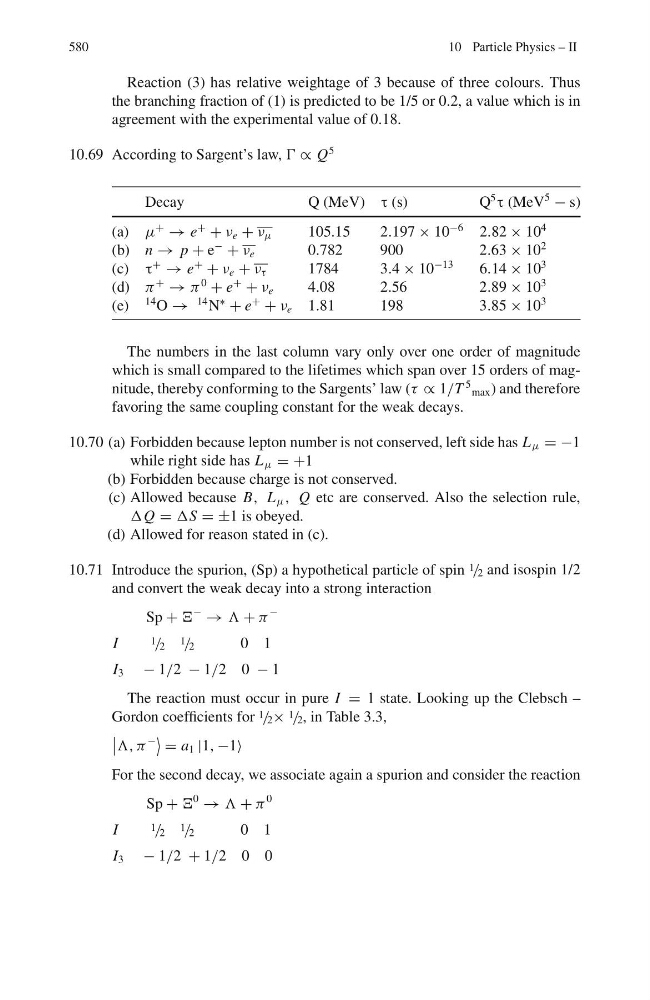
10.69 According to Sargent’s law, Γ ∝ Q
5
Decay
Q (MeV) τ (s)
Q
5
τ (MeV
5
− s)
(a) μ
+
→ e
+
+ ν e + ν μ
105.15
2.197 × 10
−6
2.82 × 10
4
(b) n → p + e
−
+ ν e
0.782
900
2.63 × 10
2
(c) τ
+
→ e
+
+ ν e + ν τ
1784
3.4 × 10
−13
6.14 × 10
3
(d) π
+
→ π
0
+ e
+
+ ν e
4.08
2.56
2.89 × 10
3
(e)
14 O →
14 N
∗
+ e
+
+ ν e 1.81
198
3.85 × 10
3
The numbers in the last column vary only over one order of magnitude
which is small compared to the lifetimes which span over 15 orders of magnitude, thereby conforming to the Sargents’ law (τ ∝ 1/T
5
max ) and therefore
favoring the same coupling constant for the weak decays.
10.70 (a) Forbidden because lepton number is not conserved, left side has L μ = −1
while right side has L μ = +1
(b) Forbidden because charge is not conserved.
(c) Allowed because B, L μ , Q etc are conserved. Also the selection rule,
ΔQ = ΔS = ±1 is obeyed.
(d) Allowed for reason stated in (c).
10.71 Introduce the spurion, (Sp) a hypothetical particle of spin 1 / 2 and isospin 1/2
and convert the weak decay into a strong interaction
Sp + Ξ
−
→ Λ + π
−
I
1 / 2 1 / 2
0 1
I 3 − 1/2 − 1/2 0 − 1
The reaction must occur in pure I = 1 state. Looking up the Clebsch –
Gordon coefficients for 1 / 2 × 1 / 2 , in Table 3.3,
Λ, π
−
= a 1 |1, −1
For the second decay, we associate again a spurion and consider the reaction
Sp + Ξ
0
→ Λ + π
0
I
1 / 2 1 / 2
0 1
I 3 − 1/2 + 1/2 0 0