

10.3 Solutions
569
Assuming that the decay proceeds via strong interaction, the parity
P B = P ω P π = (−1)(−1)(−1)
0
= +1
J ω = 1 + 0 = 1 (because l = 0)
I = 0 + 1 = 1
For the B
+ meson, J
p
= 1
+ and I = 1
In case of weak decay, the spin would still be 1 but it would not be meaningful to talk about I or P.
10.33 The nucleon has T = 1/2 and pion T = 1. The Δ
0 has T = 3/2 and
T 3 = −1/2. Using Clebsch – Gordon coefficients (C.G.C) for 1 × 1/2
(Table 3.3 of Chap. 3), we have
3
2
, −
1
2
=
2
3
|1, 0
1
2
, −
1
2
+
1
3
|1, −1
1
2
,
1
2
Δ
0
π
0
n
π
−
p
The ratio of the amplitudes for the decays Δ
0
→ π
− p and Δ
0
→ π
0 n
is given by the ratio of the corresponding C.G.C. and the ratio of the cross
sections by the squares of the C.G.C. Thus, the branching ratio would be
2
3
2
1
3
2
= 2
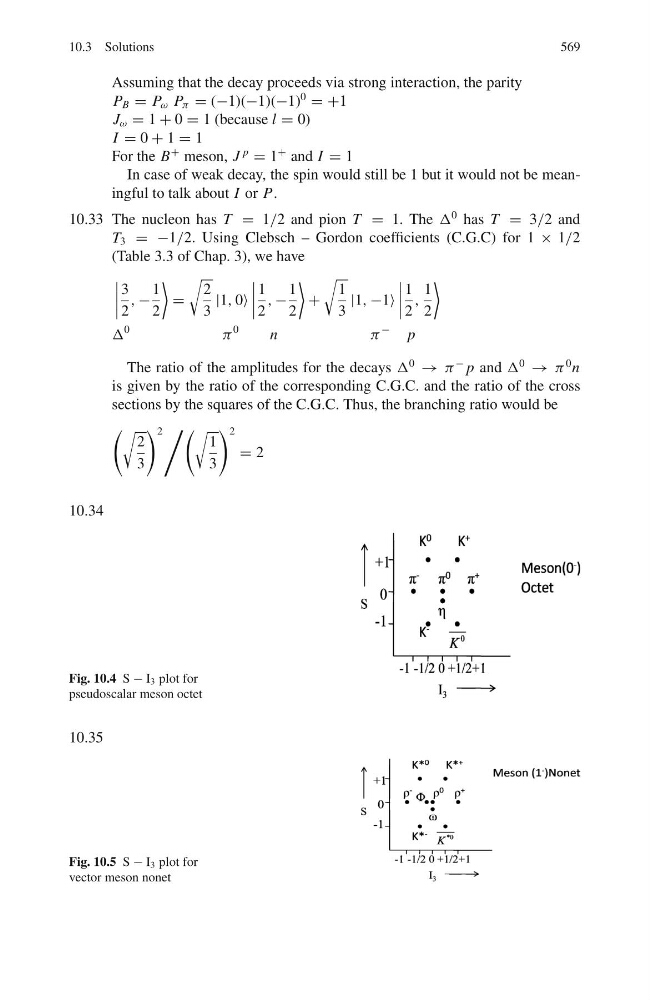
10.34
Fig. 10.4 S − I 3 plot for
pseudoscalar meson octet
10.35
Fig. 10.5 S − I 3 plot for
vector meson nonet