

568
10 Particle Physics – II
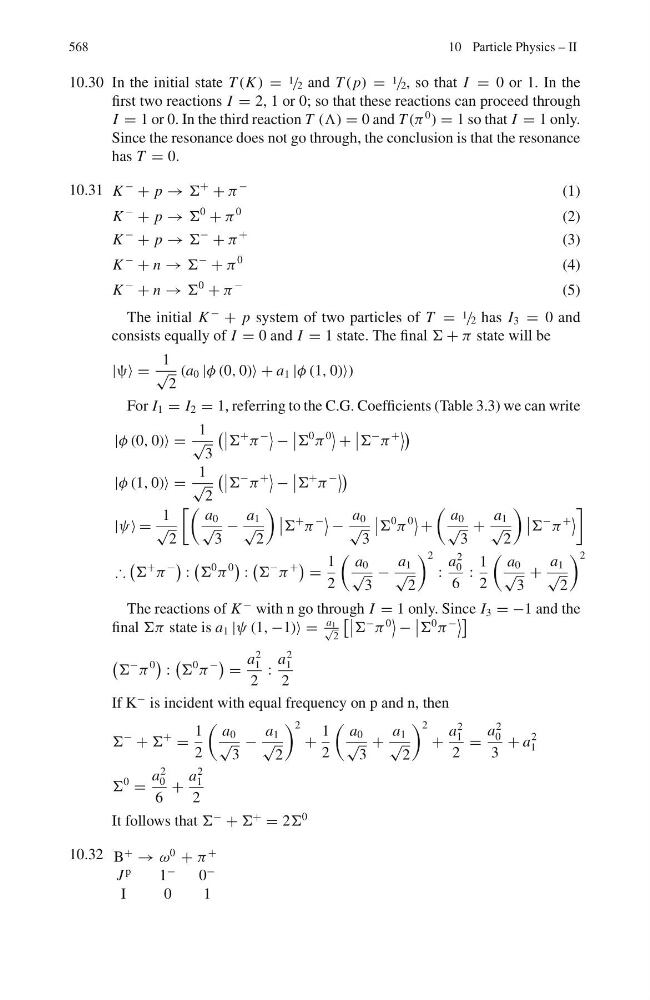
10.30 In the initial state T (K ) = 1 / 2 and T ( p) = 1 / 2 , so that I = 0 or 1. In the
first two reactions I = 2, 1 or 0; so that these reactions can proceed through
I = 1 or 0. In the third reaction T (Λ) = 0 and T (π
0 ) = 1 so that I = 1 only.
Since the resonance does not go through, the conclusion is that the resonance
has T = 0.
10.31 K
−
+ p → Σ
+
+ π
−
(1)
K
−
+ p → Σ
0
+ π
0
(2)
K
−
+ p → Σ
−
+ π
+
(3)
K
−
+ n → Σ
−
+ π
0
(4)
K
−
+ n → Σ
0
+ π
−
(5)
The initial K
−
+ p system of two particles of T = 1 / 2 has I 3 = 0 and
consists equally of I = 0 and I = 1 state. The final Σ + π state will be
|ψ =
1
√
2
(a 0 |φ (0, 0) + a 1 |φ (1, 0))
For I 1 = I 2 = 1, referring to the C.G. Coefficients (Table 3.3) we can write
|φ (0, 0) =
1
√
3
Σ
+
π
−
−
Σ
0
π
0
+
Σ
−
π
+
|φ (1, 0) =
1
√
2
Σ
−
π
+
−
Σ
+
π
−
|ψ =
1
√
2
a 0
√
3
−
a 1
√
2
Σ
+
π
−
−
a 0
√
3
Σ
0
π
0
+
a 0
√
3
+
a 1
√
2
Σ
−
π
+
∴
Σ
+
π
−
:
Σ
0
π
0
:
Σ
−
π
+
=
1
2
a 0
√
3
−
a 1
√
2
2
:
a
2
0
6
:
1
2
a 0
√
3
+
a 1
√
2
2
The reactions of K
− with n go through I = 1 only. Since I 3 = −1 and the
final Σπ state is a 1 |ψ (1, −1) =
a1
√
2
Σ
−
π
0
−
Σ
0
π
−
Σ
−
π
0
:
Σ
0
π
−
=
a
2
1
2
:
a
2
1
2
If K
− is incident with equal frequency on p and n, then
Σ
−
+ Σ
+
=
1
2
a 0
√
3
−
a 1
√
2
2
+
1
2
a 0
√
3
+
a 1
√
2
2
+
a
2
1
2
=
a
2
0
3
+ a
2
1
Σ
0
=
a
2
0
6
+
a
2
1
2
It follows that Σ
−
+ Σ
+
= 2Σ
0
10.32 B
+
→ ω
0
+ π
+
J
p
1
−
0
−
I
0
1