

538
10 Particle Physics – II
Strangeness and strange particles: Heavy unstable particles such as kaons and
hyperons which are produced copiously but decay slowly are named as strange
particles. A new quantum number S, strangeness is introduced to distinguish them
from other particles. Gellmann’s formula
Q
e
= T 3 +
S + B
2
(10.2)
where B is the baryon number. K
+ and K
0 are assigned S = +1, while K
− and K 0
have S = −1. The Σ hyperons and Λ hyperons have S = −1, Ξ
− and Ξ
0 have
S = −2, Ω
− has S = −3. The ordinary particles, n, p, π
+
, π
0
, π
− have S = 0.
The anti particles have opposite strangeness. Strangeness S is an additive quantum
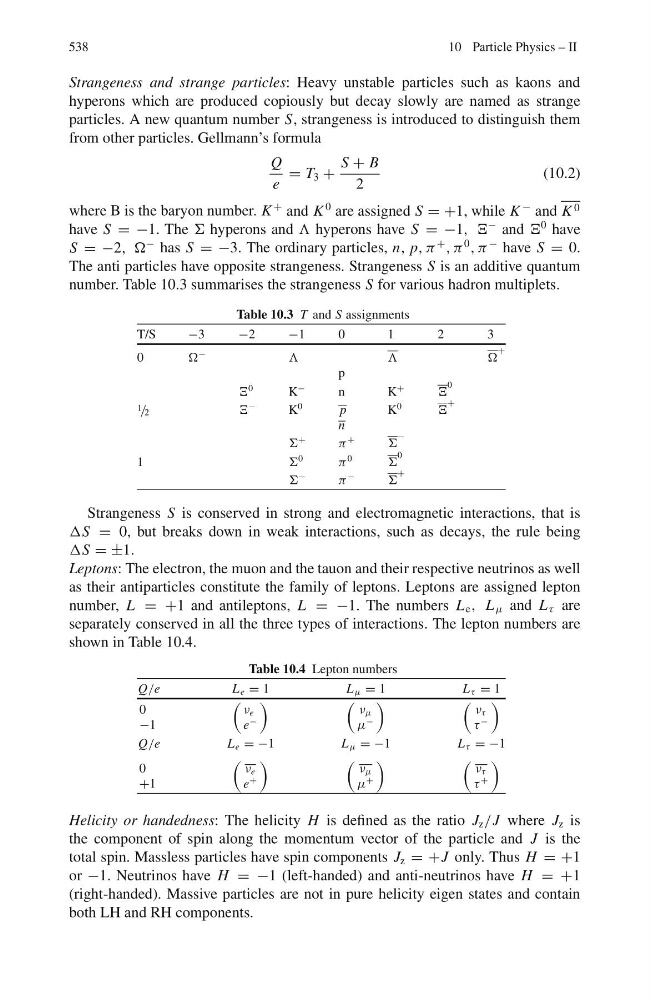
number. Table 10.3 summarises the strangeness S for various hadron multiplets.
Table 10.3 T and S assignments
T/S
−3
−2
−1
0
1
2
3
0
Ω
−
Λ
Λ
Ω
+
p
Ξ
0
K
−
n
K
+
Ξ
0
1 /2
Ξ
−
K
0
p
K
0
Ξ
+
n
Σ
+
π
+
Σ
−
1
Σ
0
π
0
Σ
0
Σ
−
π
−
Σ
+
Strangeness S is conserved in strong and electromagnetic interactions, that is
ΔS = 0, but breaks down in weak interactions, such as decays, the rule being
ΔS = ±1.
Leptons: The electron, the muon and the tauon and their respective neutrinos as well
as their antiparticles constitute the family of leptons. Leptons are assigned lepton
number, L = +1 and antileptons, L = −1. The numbers L e , L μ and L τ are
separately conserved in all the three types of interactions. The lepton numbers are
shown in Table 10.4.
Table 10.4 Lepton numbers
Q/e
L e = 1
L μ = 1
L τ = 1
0
−1
ν e
e
−
ν μ
μ
−
ν τ
τ
−
Q/e
L e = −1
L μ = −1
L τ = −1
0
+1
ν e
e
+
ν μ
μ
+
ν τ
τ
+
Helicity or handedness: The helicity H is defined as the ratio J z /J where J z is
the component of spin along the momentum vector of the particle and J is the
total spin. Massless particles have spin components J z = +J only. Thus H = +1
or −1. Neutrinos have H = −1 (left-handed) and anti-neutrinos have H = +1
(right-handed). Massive particles are not in pure helicity eigen states and contain
both LH and RH components.
10 Particle Physics – II
Strangeness and strange particles: Heavy unstable particles such as kaons and
hyperons which are produced copiously but decay slowly are named as strange
particles. A new quantum number S, strangeness is introduced to distinguish them
from other particles. Gellmann’s formula
Q
e
= T 3 +
S + B
2
(10.2)
where B is the baryon number. K
+ and K
0 are assigned S = +1, while K
− and K 0
have S = −1. The Σ hyperons and Λ hyperons have S = −1, Ξ
− and Ξ
0 have
S = −2, Ω
− has S = −3. The ordinary particles, n, p, π
+
, π
0
, π
− have S = 0.
The anti particles have opposite strangeness. Strangeness S is an additive quantum
number. Table 10.3 summarises the strangeness S for various hadron multiplets.
Table 10.3 T and S assignments
T/S
−3
−2
−1
0
1
2
3
0
Ω
−
Λ
Λ
Ω
+
p
Ξ
0
K
−
n
K
+
Ξ
0
1 /2
Ξ
−
K
0
p
K
0
Ξ
+
n
Σ
+
π
+
Σ
−
1
Σ
0
π
0
Σ
0
Σ
−
π
−
Σ
+
Strangeness S is conserved in strong and electromagnetic interactions, that is
ΔS = 0, but breaks down in weak interactions, such as decays, the rule being
ΔS = ±1.
Leptons: The electron, the muon and the tauon and their respective neutrinos as well
as their antiparticles constitute the family of leptons. Leptons are assigned lepton
number, L = +1 and antileptons, L = −1. The numbers L e , L μ and L τ are
separately conserved in all the three types of interactions. The lepton numbers are
shown in Table 10.4.
Table 10.4 Lepton numbers
Q/e
L e = 1
L μ = 1
L τ = 1
0
−1
ν e
e
−
ν μ
μ
−
ν τ
τ
−
Q/e
L e = −1
L μ = −1
L τ = −1
0
+1
ν e
e
+
ν μ
μ
+
ν τ
τ
+
Helicity or handedness: The helicity H is defined as the ratio J z /J where J z is
the component of spin along the momentum vector of the particle and J is the
total spin. Massless particles have spin components J z = +J only. Thus H = +1
or −1. Neutrinos have H = −1 (left-handed) and anti-neutrinos have H = +1
(right-handed). Massive particles are not in pure helicity eigen states and contain
both LH and RH components.