

10.1 Basic Concepts and Formulae
537
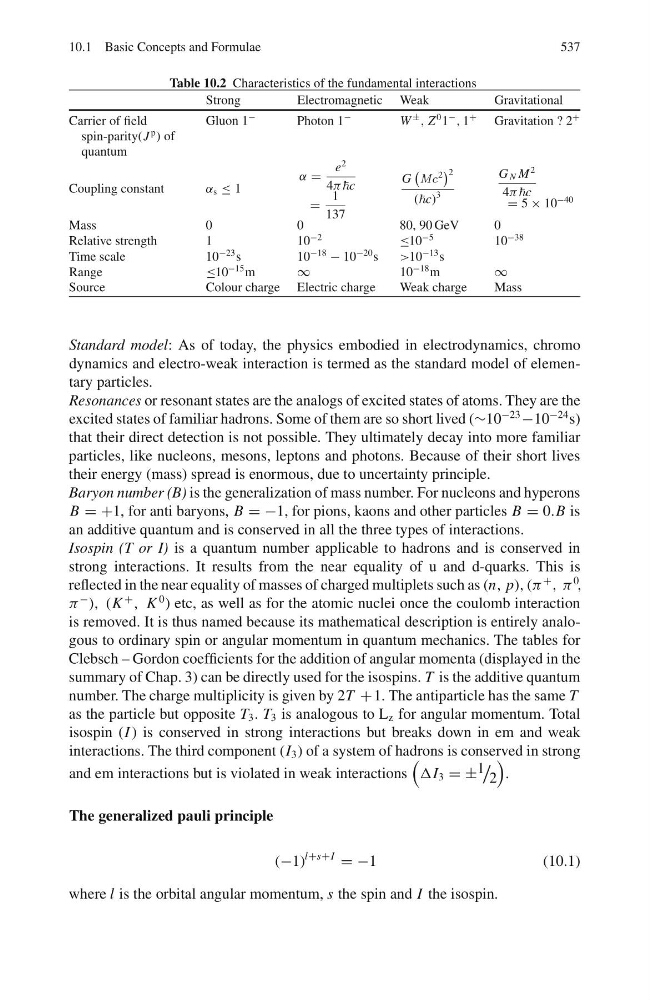
Table 10.2 Characteristics of the fundamental interactions
Strong
Electromagnetic Weak
Gravitational
Carrier of field
spin-parity(J
p ) of
quantum
Gluon 1
−
Photon 1
−
W
± , Z
0 1
− , 1
+
Gravitation ? 2
+
Coupling constant
α s ≤ 1
α =
e
2
4πc
=
1
137
G
Mc
2
2
(c)
3
G N M
2
4π c
= 5 × 10
−40
Mass
0
0
80, 90 GeV
0
Relative strength
1
10
−2
≤10
−5
10
−38
Time scale
10
−23 s
1 0
−18 − 10
−20 s
>10
−13 s
Range
≤10
−15 m
∞
10
−18 m
∞
Source
Colour charge Electric charge
Weak charge
Mass
Standard model: As of today, the physics embodied in electrodynamics, chromo
dynamics and electro-weak interaction is termed as the standard model of elementary particles.
Resonances or resonant states are the analogs of excited states of atoms. They are the
excited states of familiar hadrons. Some of them are so short lived (∼10
−23
−10
−24 s)
that their direct detection is not possible. They ultimately decay into more familiar
particles, like nucleons, mesons, leptons and photons. Because of their short lives
their energy (mass) spread is enormous, due to uncertainty principle.
Baryon number (B) is the generalization of mass number. For nucleons and hyperons
B = +1, for anti baryons, B = −1, for pions, kaons and other particles B = 0.B is
an additive quantum and is conserved in all the three types of interactions.
Isospin (T or I) is a quantum number applicable to hadrons and is conserved in
strong interactions. It results from the near equality of u and d-quarks. This is
reflected in the near equality of masses of charged multiplets such as (n, p), (π
+
, π
0
,
π
− ), (K
+
, K
0 ) etc, as well as for the atomic nuclei once the coulomb interaction
is removed. It is thus named because its mathematical description is entirely analogous to ordinary spin or angular momentum in quantum mechanics. The tables for
Clebsch – Gordon coefficients for the addition of angular momenta (displayed in the
summary of Chap. 3) can be directly used for the isospins. T is the additive quantum
number. The charge multiplicity is given by 2T +1. The antiparticle has the same T
as the particle but opposite T 3 . T 3 is analogous to L z for angular momentum. Total
isospin (I ) is conserved in strong interactions but breaks down in em and weak
interactions. The third component (I 3 ) of a system of hadrons is conserved in strong
and em interactions but is violated in weak interactions
ΔI 3 = ± 1
2
.
The generalized pauli principle
(−1)
l+s+I
= −1
(10.1)
where l is the orbital angular momentum, s the spin and I the isospin.
537
Table 10.2 Characteristics of the fundamental interactions
Strong
Electromagnetic Weak
Gravitational
Carrier of field
spin-parity(J
p ) of
quantum
Gluon 1
−
Photon 1
−
W
± , Z
0 1
− , 1
+
Gravitation ? 2
+
Coupling constant
α s ≤ 1
α =
e
2
4πc
=
1
137
G
Mc
2
2
(c)
3
G N M
2
4π c
= 5 × 10
−40
Mass
0
0
80, 90 GeV
0
Relative strength
1
10
−2
≤10
−5
10
−38
Time scale
10
−23 s
1 0
−18 − 10
−20 s
>10
−13 s
Range
≤10
−15 m
∞
10
−18 m
∞
Source
Colour charge Electric charge
Weak charge
Mass
Standard model: As of today, the physics embodied in electrodynamics, chromo
dynamics and electro-weak interaction is termed as the standard model of elementary particles.
Resonances or resonant states are the analogs of excited states of atoms. They are the
excited states of familiar hadrons. Some of them are so short lived (∼10
−23
−10
−24 s)
that their direct detection is not possible. They ultimately decay into more familiar
particles, like nucleons, mesons, leptons and photons. Because of their short lives
their energy (mass) spread is enormous, due to uncertainty principle.
Baryon number (B) is the generalization of mass number. For nucleons and hyperons
B = +1, for anti baryons, B = −1, for pions, kaons and other particles B = 0.B is
an additive quantum and is conserved in all the three types of interactions.
Isospin (T or I) is a quantum number applicable to hadrons and is conserved in
strong interactions. It results from the near equality of u and d-quarks. This is
reflected in the near equality of masses of charged multiplets such as (n, p), (π
+
, π
0
,
π
− ), (K
+
, K
0 ) etc, as well as for the atomic nuclei once the coulomb interaction
is removed. It is thus named because its mathematical description is entirely analogous to ordinary spin or angular momentum in quantum mechanics. The tables for
Clebsch – Gordon coefficients for the addition of angular momenta (displayed in the
summary of Chap. 3) can be directly used for the isospins. T is the additive quantum
number. The charge multiplicity is given by 2T +1. The antiparticle has the same T
as the particle but opposite T 3 . T 3 is analogous to L z for angular momentum. Total
isospin (I ) is conserved in strong interactions but breaks down in em and weak
interactions. The third component (I 3 ) of a system of hadrons is conserved in strong
and em interactions but is violated in weak interactions
ΔI 3 = ± 1
2
.
The generalized pauli principle
(−1)
l+s+I
= −1
(10.1)
where l is the orbital angular momentum, s the spin and I the isospin.