

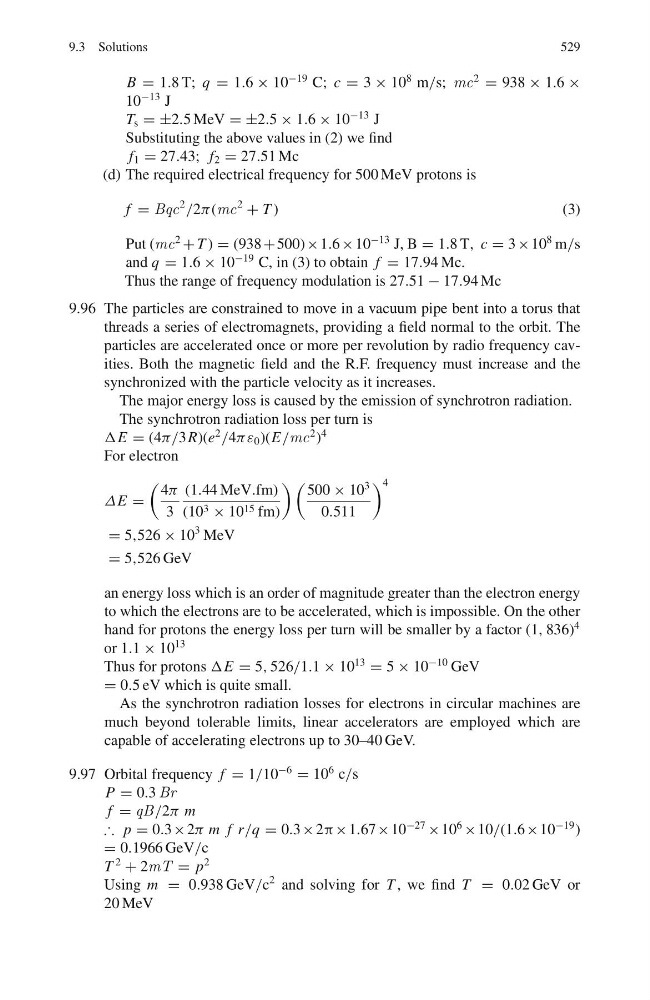
9.3 Solutions
529
B = 1.8 T; q = 1.6 × 10
−19 C; c = 3 × 10
8 m/s; mc
2
= 938 × 1.6 ×
10
−13 J
T s = ±2.5 MeV = ±2.5 × 1.6 × 10
−13 J
Substituting the above values in (2) we find
f 1 = 27.43; f 2 = 27.51 Mc
(d) The required electrical frequency for 500 MeV protons is
f = Bqc
2
/2π(mc
2
+ T )
( 3 )
Put (mc
2
+ T ) = (938 + 500) × 1.6 × 10
−13 J, B = 1.8 T, c = 3 × 10
8 m/s
and q = 1.6 × 10
−19 C, in (3) to obtain f = 17.94 Mc.
Thus the range of frequency modulation is 27.51 − 17.94 Mc
9.96 The particles are constrained to move in a vacuum pipe bent into a torus that
threads a series of electromagnets, providing a field normal to the orbit. The
particles are accelerated once or more per revolution by radio frequency cavities. Both the magnetic field and the R.F. frequency must increase and the
synchronized with the particle velocity as it increases.
The major energy loss is caused by the emission of synchrotron radiation.
The synchrotron radiation loss per turn is
ΔE = (4π/3R)(e
2
/4πε 0 )(E/mc
2 )
4
For electron
ΔE =
4π
3
(1.44 MeV.fm)
(10 3 × 10 15 fm)
500 × 10
3
0.511
4
= 5,526 × 10
3 MeV
= 5,526 GeV
an energy loss which is an order of magnitude greater than the electron energy
to which the electrons are to be accelerated, which is impossible. On the other
hand for protons the energy loss per turn will be smaller by a factor (1, 836)
4
or 1.1 × 10
13
Thus for protons ΔE = 5, 526/1.1 × 10
13
= 5 × 10
−10 GeV
= 0.5 eV which is quite small.
As the synchrotron radiation losses for electrons in circular machines are
much beyond tolerable limits, linear accelerators are employed which are
capable of accelerating electrons up to 30–40 GeV.
9.97 Orbital frequency f = 1/10
−6
= 10
6 c/s
P = 0.3 Br
f = qB /2π m
∴ p = 0.3×2π m f r/q = 0.3×2π×1.67×10
−27
×10
6
×10/(1.6×10
−19 )
= 0.1966 GeV/c
T
2
+ 2mT = p
2
Using m = 0.938 GeV/c
2 and solving for T , we find T = 0.02 GeV or
20 MeV
529
B = 1.8 T; q = 1.6 × 10
−19 C; c = 3 × 10
8 m/s; mc
2
= 938 × 1.6 ×
10
−13 J
T s = ±2.5 MeV = ±2.5 × 1.6 × 10
−13 J
Substituting the above values in (2) we find
f 1 = 27.43; f 2 = 27.51 Mc
(d) The required electrical frequency for 500 MeV protons is
f = Bqc
2
/2π(mc
2
+ T )
( 3 )
Put (mc
2
+ T ) = (938 + 500) × 1.6 × 10
−13 J, B = 1.8 T, c = 3 × 10
8 m/s
and q = 1.6 × 10
−19 C, in (3) to obtain f = 17.94 Mc.
Thus the range of frequency modulation is 27.51 − 17.94 Mc
9.96 The particles are constrained to move in a vacuum pipe bent into a torus that
threads a series of electromagnets, providing a field normal to the orbit. The
particles are accelerated once or more per revolution by radio frequency cavities. Both the magnetic field and the R.F. frequency must increase and the
synchronized with the particle velocity as it increases.
The major energy loss is caused by the emission of synchrotron radiation.
The synchrotron radiation loss per turn is
ΔE = (4π/3R)(e
2
/4πε 0 )(E/mc
2 )
4
For electron
ΔE =
4π
3
(1.44 MeV.fm)
(10 3 × 10 15 fm)
500 × 10
3
0.511
4
= 5,526 × 10
3 MeV
= 5,526 GeV
an energy loss which is an order of magnitude greater than the electron energy
to which the electrons are to be accelerated, which is impossible. On the other
hand for protons the energy loss per turn will be smaller by a factor (1, 836)
4
or 1.1 × 10
13
Thus for protons ΔE = 5, 526/1.1 × 10
13
= 5 × 10
−10 GeV
= 0.5 eV which is quite small.
As the synchrotron radiation losses for electrons in circular machines are
much beyond tolerable limits, linear accelerators are employed which are
capable of accelerating electrons up to 30–40 GeV.
9.97 Orbital frequency f = 1/10
−6
= 10
6 c/s
P = 0.3 Br
f = qB /2π m
∴ p = 0.3×2π m f r/q = 0.3×2π×1.67×10
−27
×10
6
×10/(1.6×10
−19 )
= 0.1966 GeV/c
T
2
+ 2mT = p
2
Using m = 0.938 GeV/c
2 and solving for T , we find T = 0.02 GeV or
20 MeV