

528
9 Particle Physics – I
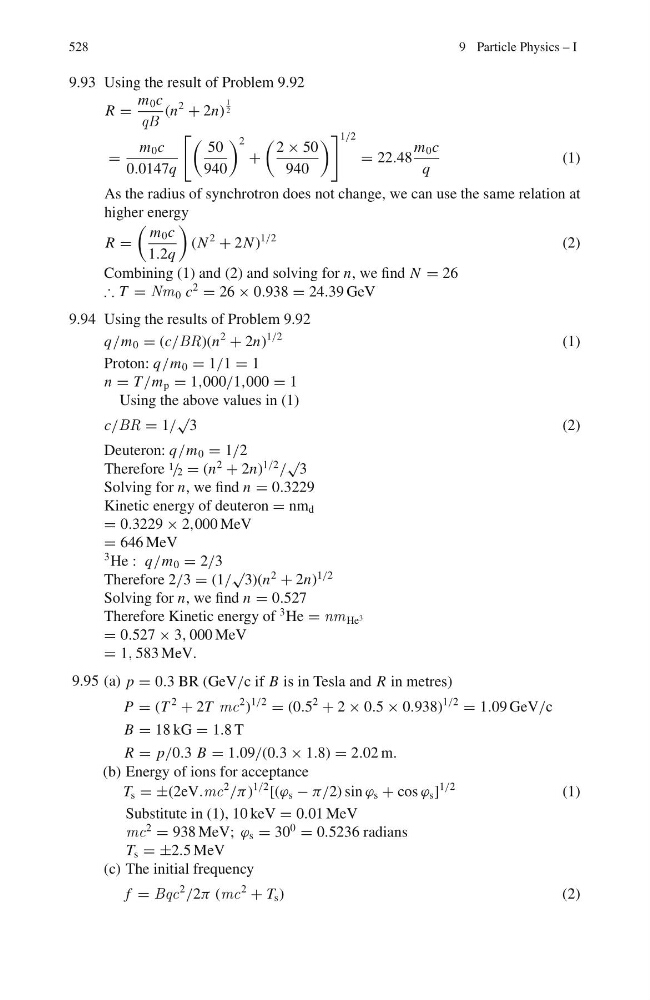
9.93 Using the result of Problem 9.92
R =
m 0 c
qB
(n
2
+ 2n)
1
2
=
m 0 c
0.0147q
50
940
2
+
2 × 50
940
1/2
= 22.48
m 0 c
q
(1)
As the radius of synchrotron does not change, we can use the same relation at
higher energy
R =
m 0 c
1.2q
(N
2
+ 2N )
1/2
(2)
Combining (1) and (2) and solving for n, we find N = 26
∴ T = Nm 0 c
2
= 26 × 0.938 = 24.39 GeV
9.94 Using the results of Problem 9.92
q/m 0 = (c/BR)(n
2
+ 2n)
1/2
(1)
Proton: q/m 0 = 1/1 = 1
n = T /m p = 1,000/1,000 = 1
Using the above values in (1)
c/BR = 1/
√
3
( 2 )
Deuteron: q/m 0 = 1/2
Therefore 1 / 2 = (n
2
+ 2n)
1/2
/
√
3
Solving for n, we find n = 0.3229
Kinetic energy of deuteron = nm d
= 0.3229 × 2,000 MeV
= 646 MeV
3 He : q/m 0 = 2/3
Therefore 2/3 = (1/
√
3)(n
2
+ 2n)
1/2
Solving for n, we find n = 0.527
Therefore Kinetic energy of
3 He = nm He 3
= 0.527 × 3, 000 MeV
= 1, 583 MeV.
9.95 (a) p = 0.3 BR (GeV/c if B is in Tesla and R in metres)
P = (T
2
+ 2T mc
2 )
1/2
= (0.5
2
+ 2 × 0.5 × 0.938)
1/2
= 1.09 GeV/c
B = 18 kG = 1.8 T
R = p/0.3 B = 1.09/(0.3 × 1.8) = 2.02 m.
(b) Energy of ions for acceptance
T s = ±(2eV.mc
2
/π )
1/2 [(ϕ s − π/2) sin ϕ s + cos ϕ s ]
1/2
(1)
Substitute in (1), 10 keV = 0.01 MeV
mc
2
= 938 MeV; ϕ s = 30
0
= 0.5236 radians
T s = ±2.5 MeV
(c) The initial frequency
f = Bqc
2
/2π (mc
2
+ T s )
( 2 )
9 Particle Physics – I
9.93 Using the result of Problem 9.92
R =
m 0 c
qB
(n
2
+ 2n)
1
2
=
m 0 c
0.0147q
50
940
2
+
2 × 50
940
1/2
= 22.48
m 0 c
q
(1)
As the radius of synchrotron does not change, we can use the same relation at
higher energy
R =
m 0 c
1.2q
(N
2
+ 2N )
1/2
(2)
Combining (1) and (2) and solving for n, we find N = 26
∴ T = Nm 0 c
2
= 26 × 0.938 = 24.39 GeV
9.94 Using the results of Problem 9.92
q/m 0 = (c/BR)(n
2
+ 2n)
1/2
(1)
Proton: q/m 0 = 1/1 = 1
n = T /m p = 1,000/1,000 = 1
Using the above values in (1)
c/BR = 1/
√
3
( 2 )
Deuteron: q/m 0 = 1/2
Therefore 1 / 2 = (n
2
+ 2n)
1/2
/
√
3
Solving for n, we find n = 0.3229
Kinetic energy of deuteron = nm d
= 0.3229 × 2,000 MeV
= 646 MeV
3 He : q/m 0 = 2/3
Therefore 2/3 = (1/
√
3)(n
2
+ 2n)
1/2
Solving for n, we find n = 0.527
Therefore Kinetic energy of
3 He = nm He 3
= 0.527 × 3, 000 MeV
= 1, 583 MeV.
9.95 (a) p = 0.3 BR (GeV/c if B is in Tesla and R in metres)
P = (T
2
+ 2T mc
2 )
1/2
= (0.5
2
+ 2 × 0.5 × 0.938)
1/2
= 1.09 GeV/c
B = 18 kG = 1.8 T
R = p/0.3 B = 1.09/(0.3 × 1.8) = 2.02 m.
(b) Energy of ions for acceptance
T s = ±(2eV.mc
2
/π )
1/2 [(ϕ s − π/2) sin ϕ s + cos ϕ s ]
1/2
(1)
Substitute in (1), 10 keV = 0.01 MeV
mc
2
= 938 MeV; ϕ s = 30
0
= 0.5236 radians
T s = ±2.5 MeV
(c) The initial frequency
f = Bqc
2
/2π (mc
2
+ T s )
( 2 )