

526
9 Particle Physics – I
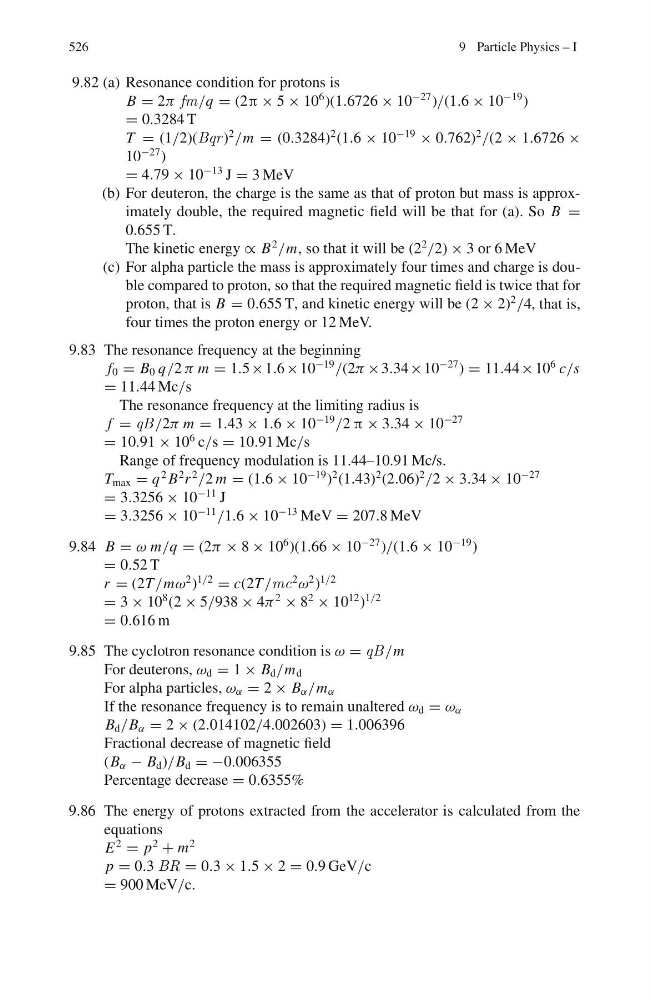
9.82 (a) Resonance condition for protons is
B = 2π fm/q = (2π × 5 × 10
6 )(1.6726 × 10
−27 )/(1.6 × 10
−19 )
= 0.3284 T
T = (1/2)(Bqr )
2
/m = (0.3284)
2 (1.6 × 10
−19
× 0.762)
2
/(2 × 1.6726 ×
10
−27 )
= 4.79 × 10
−13 J = 3 MeV
(b) For deuteron, the charge is the same as that of proton but mass is approximately double, the required magnetic field will be that for (a). So B =
0.655 T.
The kinetic energy ∝ B
2
/m, so that it will be (2
2
/2) × 3 or 6 MeV
(c) For alpha particle the mass is approximately four times and charge is double compared to proton, so that the required magnetic field is twice that for
proton, that is B = 0.655 T, and kinetic energy will be (2 × 2)
2
/4, that is,
four times the proton energy or 12 MeV.
9.83 The resonance frequency at the beginning
f 0 = B 0 q/2 π m = 1.5 × 1.6 × 10
−19
/(2π × 3.34 × 10
−27 ) = 11.44 × 10
6 c/s
= 11.44 Mc/s
The resonance frequency at the limiting radius is
f = qB /2π m = 1.43 × 1.6 × 10
−19
/2 π × 3.34 × 10
−27
= 10.91 × 10
6 c/s = 10.91 Mc/s
Range of frequency modulation is 11.44–10.91 Mc/s.
T max = q
2 B
2 r
2
/2 m = (1.6 × 10
−19 )
2 (1.43)
2 (2.06)
2
/2 × 3.34 × 10
−27
= 3.3256 × 10
−11 J
= 3.3256 × 10
−11
/1.6 × 10
−13 MeV = 207.8 MeV
9.84 B = ω m/q = (2π × 8 × 10
6 )(1.66 × 10
−27 )/(1.6 × 10
−19 )
= 0.52 T
r = (2T /mω
2 )
1/2
= c(2T /mc
2
ω
2 )
1/2
= 3 × 10
8 (2 × 5/938 × 4π
2
× 8
2
× 10
12 )
1/2
= 0.616 m
9.85 The cyclotron resonance condition is ω = qB /m
For deuterons, ω d = 1 × B d /m d
For alpha particles, ω α = 2 × B α /m α
If the resonance frequency is to remain unaltered ω d = ω α
B d /B α = 2 × (2.014102/4.002603) = 1.006396
Fractional decrease of magnetic field
(B α − B d )/B d = −0.006355
Percentage decrease = 0.6355%
9.86 The energy of protons extracted from the accelerator is calculated from the
equations
E
2
= p
2
+ m
2
p = 0.3 BR = 0.3 × 1.5 × 2 = 0.9 GeV/c
= 900 MeV/c.
9 Particle Physics – I
9.82 (a) Resonance condition for protons is
B = 2π fm/q = (2π × 5 × 10
6 )(1.6726 × 10
−27 )/(1.6 × 10
−19 )
= 0.3284 T
T = (1/2)(Bqr )
2
/m = (0.3284)
2 (1.6 × 10
−19
× 0.762)
2
/(2 × 1.6726 ×
10
−27 )
= 4.79 × 10
−13 J = 3 MeV
(b) For deuteron, the charge is the same as that of proton but mass is approximately double, the required magnetic field will be that for (a). So B =
0.655 T.
The kinetic energy ∝ B
2
/m, so that it will be (2
2
/2) × 3 or 6 MeV
(c) For alpha particle the mass is approximately four times and charge is double compared to proton, so that the required magnetic field is twice that for
proton, that is B = 0.655 T, and kinetic energy will be (2 × 2)
2
/4, that is,
four times the proton energy or 12 MeV.
9.83 The resonance frequency at the beginning
f 0 = B 0 q/2 π m = 1.5 × 1.6 × 10
−19
/(2π × 3.34 × 10
−27 ) = 11.44 × 10
6 c/s
= 11.44 Mc/s
The resonance frequency at the limiting radius is
f = qB /2π m = 1.43 × 1.6 × 10
−19
/2 π × 3.34 × 10
−27
= 10.91 × 10
6 c/s = 10.91 Mc/s
Range of frequency modulation is 11.44–10.91 Mc/s.
T max = q
2 B
2 r
2
/2 m = (1.6 × 10
−19 )
2 (1.43)
2 (2.06)
2
/2 × 3.34 × 10
−27
= 3.3256 × 10
−11 J
= 3.3256 × 10
−11
/1.6 × 10
−13 MeV = 207.8 MeV
9.84 B = ω m/q = (2π × 8 × 10
6 )(1.66 × 10
−27 )/(1.6 × 10
−19 )
= 0.52 T
r = (2T /mω
2 )
1/2
= c(2T /mc
2
ω
2 )
1/2
= 3 × 10
8 (2 × 5/938 × 4π
2
× 8
2
× 10
12 )
1/2
= 0.616 m
9.85 The cyclotron resonance condition is ω = qB /m
For deuterons, ω d = 1 × B d /m d
For alpha particles, ω α = 2 × B α /m α
If the resonance frequency is to remain unaltered ω d = ω α
B d /B α = 2 × (2.014102/4.002603) = 1.006396
Fractional decrease of magnetic field
(B α − B d )/B d = −0.006355
Percentage decrease = 0.6355%
9.86 The energy of protons extracted from the accelerator is calculated from the
equations
E
2
= p
2
+ m
2
p = 0.3 BR = 0.3 × 1.5 × 2 = 0.9 GeV/c
= 900 MeV/c.