

9.3 Solutions
525
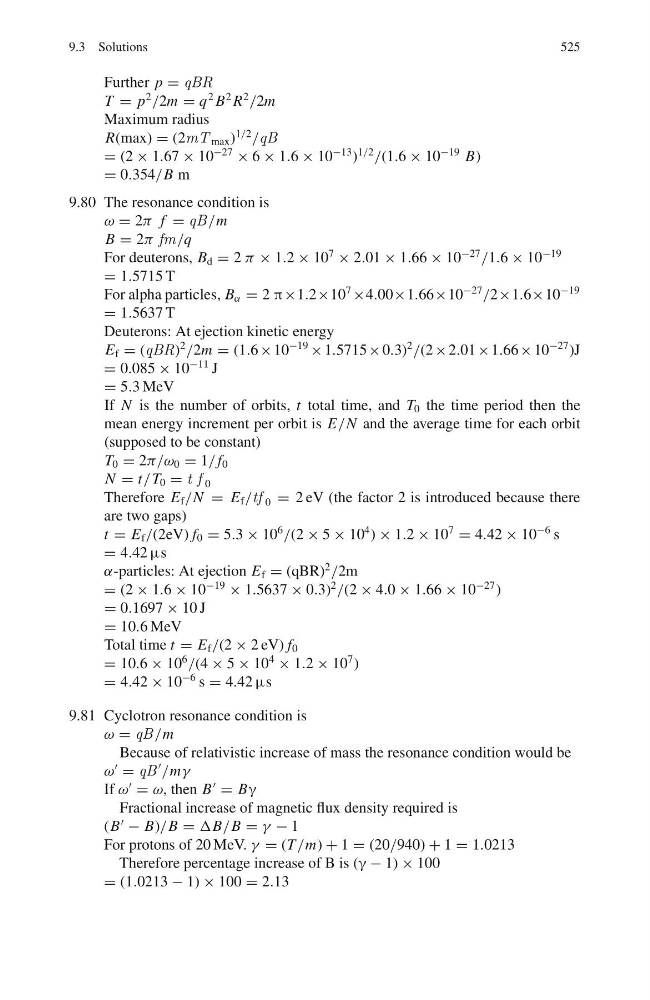
Further p = qBR
T = p
2
/2m = q
2 B
2 R
2
/2m
Maximum radius
R(max) = (2mT max )
1/2
/qB
= (2 × 1.67 × 10
−27
× 6 × 1.6 × 10
−13 )
1/2
/(1.6 × 10
−19 B)
= 0.354/B m
9.80 The resonance condition is
ω = 2π f = qB /m
B = 2π fm/q
For deuterons, B d = 2 π × 1.2 × 10
7
× 2.01 × 1.66 × 10
−27
/1.6 × 10
−19
= 1.5715 T
For alpha particles, B α = 2 π×1.2×10
7
×4.00×1.66×10
−27
/2×1.6×10
−19
= 1.5637 T
Deuterons: At ejection kinetic energy
E f = (qBR)
2
/2m = (1.6 × 10
−19
× 1.5715 × 0.3)
2
/(2 × 2.01 × 1.66 × 10
−27 )J
= 0.085 × 10
−11 J
= 5.3 MeV
If N is the number of orbits, t total time, and T 0 the time period then the
mean energy increment per orbit is E/N and the average time for each orbit
(supposed to be constant)
T 0 = 2π/ω 0 = 1/ f 0
N = t/T 0 = t f 0
Therefore E f /N = E f /tf 0 = 2 eV (the factor 2 is introduced because there
are two gaps)
t = E f /(2eV) f 0 = 5.3 × 10
6
/(2 × 5 × 10
4 ) × 1.2 × 10
7
= 4.42 × 10
−6 s
= 4.42 μs
α-particles: At ejection E f = (qBR)
2
/2m
= (2 × 1.6 × 10
−19
× 1.5637 × 0.3)
2
/(2 × 4.0 × 1.66 × 10
−27 )
= 0.1697 × 10 J
= 10.6 MeV
Total time t = E f /(2 × 2 eV) f 0
= 10.6 × 10
6
/(4 × 5 × 10
4
× 1.2 × 10
7 )
= 4.42 × 10
−6 s = 4.42 μs
9.81 Cyclotron resonance condition is
ω = qB /m
Because of relativistic increase of mass the resonance condition would be
ω
= qB
/mγ
If ω
= ω, then B
= Bγ
Fractional increase of magnetic flux density required is
(B
− B)/B = ΔB/B = γ − 1
For protons of 20 MeV. γ = (T /m) + 1 = (20/940) + 1 = 1.0213
Therefore percentage increase of B is (γ − 1) × 100
= (1.0213 − 1) × 100 = 2.13
525
Further p = qBR
T = p
2
/2m = q
2 B
2 R
2
/2m
Maximum radius
R(max) = (2mT max )
1/2
/qB
= (2 × 1.67 × 10
−27
× 6 × 1.6 × 10
−13 )
1/2
/(1.6 × 10
−19 B)
= 0.354/B m
9.80 The resonance condition is
ω = 2π f = qB /m
B = 2π fm/q
For deuterons, B d = 2 π × 1.2 × 10
7
× 2.01 × 1.66 × 10
−27
/1.6 × 10
−19
= 1.5715 T
For alpha particles, B α = 2 π×1.2×10
7
×4.00×1.66×10
−27
/2×1.6×10
−19
= 1.5637 T
Deuterons: At ejection kinetic energy
E f = (qBR)
2
/2m = (1.6 × 10
−19
× 1.5715 × 0.3)
2
/(2 × 2.01 × 1.66 × 10
−27 )J
= 0.085 × 10
−11 J
= 5.3 MeV
If N is the number of orbits, t total time, and T 0 the time period then the
mean energy increment per orbit is E/N and the average time for each orbit
(supposed to be constant)
T 0 = 2π/ω 0 = 1/ f 0
N = t/T 0 = t f 0
Therefore E f /N = E f /tf 0 = 2 eV (the factor 2 is introduced because there
are two gaps)
t = E f /(2eV) f 0 = 5.3 × 10
6
/(2 × 5 × 10
4 ) × 1.2 × 10
7
= 4.42 × 10
−6 s
= 4.42 μs
α-particles: At ejection E f = (qBR)
2
/2m
= (2 × 1.6 × 10
−19
× 1.5637 × 0.3)
2
/(2 × 4.0 × 1.66 × 10
−27 )
= 0.1697 × 10 J
= 10.6 MeV
Total time t = E f /(2 × 2 eV) f 0
= 10.6 × 10
6
/(4 × 5 × 10
4
× 1.2 × 10
7 )
= 4.42 × 10
−6 s = 4.42 μs
9.81 Cyclotron resonance condition is
ω = qB /m
Because of relativistic increase of mass the resonance condition would be
ω
= qB
/mγ
If ω
= ω, then B
= Bγ
Fractional increase of magnetic flux density required is
(B
− B)/B = ΔB/B = γ − 1
For protons of 20 MeV. γ = (T /m) + 1 = (20/940) + 1 = 1.0213
Therefore percentage increase of B is (γ − 1) × 100
= (1.0213 − 1) × 100 = 2.13