

9.3 Solutions
519
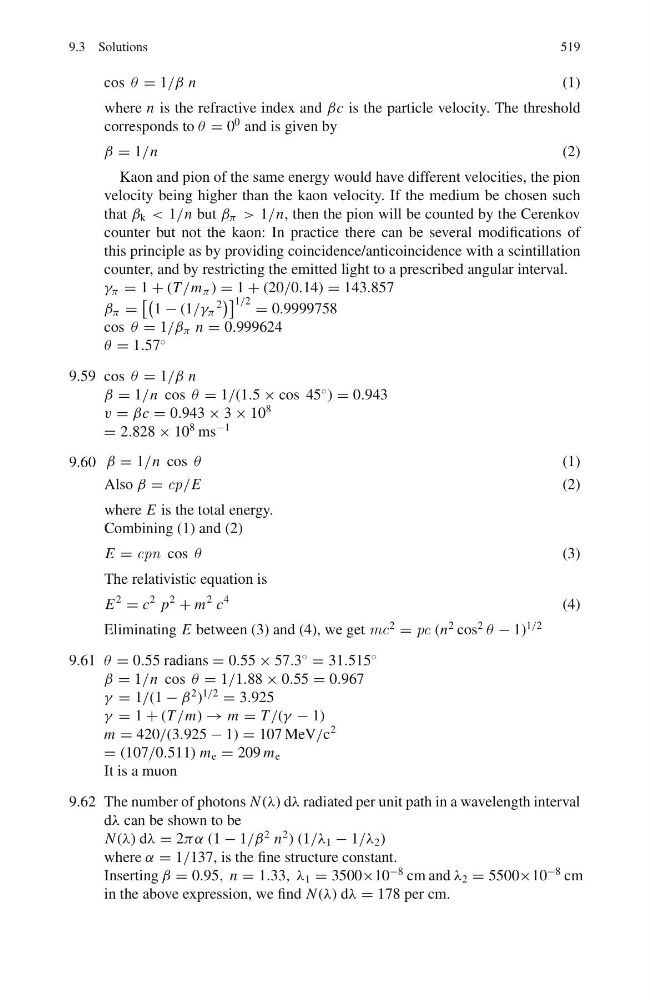
cos θ = 1/β n
(1)
where n is the refractive index and βc is the particle velocity. The threshold
corresponds to θ = 0
0 and is given by
β = 1/n
(2)
Kaon and pion of the same energy would have different velocities, the pion
velocity being higher than the kaon velocity. If the medium be chosen such
that β k < 1/n but β π > 1/n, then the pion will be counted by the Cerenkov
counter but not the kaon: In practice there can be several modifications of
this principle as by providing coincidence/anticoincidence with a scintillation
counter, and by restricting the emitted light to a prescribed angular interval.
γ π = 1 + (T /m π ) = 1 + (20/0.14) = 143.857
β π =
1 − (1/γ π
2
1/2 = 0.9999758
cos θ = 1/β π n = 0.999624
θ = 1.57
◦
9.59 cos θ = 1/β n
β = 1/n cos θ = 1/(1.5 × cos 45
◦ ) = 0.943
v = βc = 0.943 × 3 × 10
8
= 2.828 × 10
8 ms
−1
9.60 β = 1/n cos θ
(1)
Also β = cp/E
(2)
where E is the total energy.
Combining (1) and (2)
E = cpn cos θ
(3)
The relativistic equation is
E
2
= c
2 p
2
+ m
2 c
4
(4)
Eliminating E between (3) and (4), we get mc
2
= pc (n
2 cos
2
θ − 1)
1/2
9.61 θ = 0.55 radians = 0.55 × 57.3
◦
= 31.515
◦
β = 1/n cos θ = 1/1.88 × 0.55 = 0.967
γ = 1/(1 − β
2 )
1/2
= 3.925
γ = 1 + (T /m) → m = T /(γ − 1)
m = 420/(3.925 − 1) = 107 MeV/c
2
= (107/0.511) m e = 209 m e
It is a muon
9.62 The number of photons N (λ) dλ radiated per unit path in a wavelength interval
dλ can be shown to be
N (λ) dλ = 2πα (1 − 1/β
2 n
2 ) (1/λ 1 − 1/λ 2 )
where α = 1/137, is the fine structure constant.
Inserting β = 0.95, n = 1.33, λ 1 = 3500×10
−8 cm and λ 2 = 5500×10
−8 cm
in the above expression, we find N (λ) dλ = 178 per cm.
519
cos θ = 1/β n
(1)
where n is the refractive index and βc is the particle velocity. The threshold
corresponds to θ = 0
0 and is given by
β = 1/n
(2)
Kaon and pion of the same energy would have different velocities, the pion
velocity being higher than the kaon velocity. If the medium be chosen such
that β k < 1/n but β π > 1/n, then the pion will be counted by the Cerenkov
counter but not the kaon: In practice there can be several modifications of
this principle as by providing coincidence/anticoincidence with a scintillation
counter, and by restricting the emitted light to a prescribed angular interval.
γ π = 1 + (T /m π ) = 1 + (20/0.14) = 143.857
β π =
1 − (1/γ π
2
1/2 = 0.9999758
cos θ = 1/β π n = 0.999624
θ = 1.57
◦
9.59 cos θ = 1/β n
β = 1/n cos θ = 1/(1.5 × cos 45
◦ ) = 0.943
v = βc = 0.943 × 3 × 10
8
= 2.828 × 10
8 ms
−1
9.60 β = 1/n cos θ
(1)
Also β = cp/E
(2)
where E is the total energy.
Combining (1) and (2)
E = cpn cos θ
(3)
The relativistic equation is
E
2
= c
2 p
2
+ m
2 c
4
(4)
Eliminating E between (3) and (4), we get mc
2
= pc (n
2 cos
2
θ − 1)
1/2
9.61 θ = 0.55 radians = 0.55 × 57.3
◦
= 31.515
◦
β = 1/n cos θ = 1/1.88 × 0.55 = 0.967
γ = 1/(1 − β
2 )
1/2
= 3.925
γ = 1 + (T /m) → m = T /(γ − 1)
m = 420/(3.925 − 1) = 107 MeV/c
2
= (107/0.511) m e = 209 m e
It is a muon
9.62 The number of photons N (λ) dλ radiated per unit path in a wavelength interval
dλ can be shown to be
N (λ) dλ = 2πα (1 − 1/β
2 n
2 ) (1/λ 1 − 1/λ 2 )
where α = 1/137, is the fine structure constant.
Inserting β = 0.95, n = 1.33, λ 1 = 3500×10
−8 cm and λ 2 = 5500×10
−8 cm
in the above expression, we find N (λ) dλ = 178 per cm.