

518
9 Particle Physics – I
At ¯
x,
p( ¯
x) =
σ
√
2π
−1
(2)
Let the HWHM points be located at
¯
x − x = kσ
(3)
Then p(kσ ) =
σ
√
2π
−1
exp(−k
2
/2)
(4)
By definition,
p(kσ )
p( ¯
x)
=
1
2
= exp
−
k
2
2
(5)
where we have used (2) and (4). Taking log e on both sides of (5)
k
2
/2 = ln 2 = 0.69315
∴ k = 1.1774
Therefore HWHM = 1.177σ
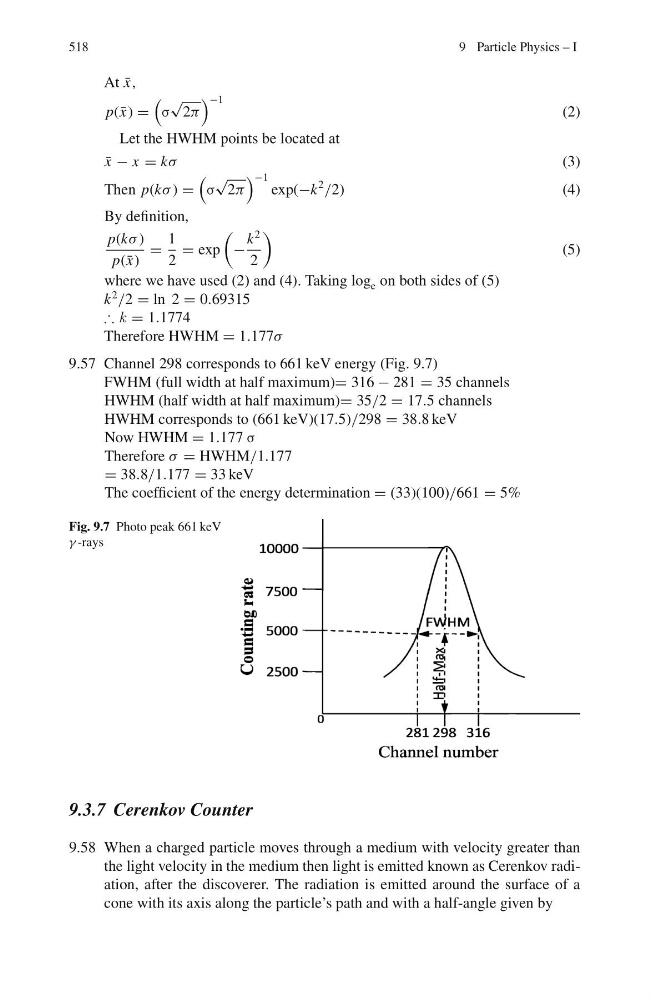
9.57 Channel 298 corresponds to 661 keV energy (Fig. 9.7)
FWHM (full width at half maximum)= 316 − 281 = 35 channels
HWHM (half width at half maximum)= 35/2 = 17.5 channels
HWHM corresponds to (661 keV)(17.5)/298 = 38.8 keV
Now HWHM = 1.177 σ
Therefore σ = HWHM/1.177
= 38.8/1.177 = 33 keV
The coefficient of the energy determination = (33)(100)/661 = 5%
Fig. 9.7 Photo peak 661 keV
γ -rays
9.3.7 Cerenkov Counter
9.58 When a charged particle moves through a medium with velocity greater than
the light velocity in the medium then light is emitted known as Cerenkov radiation, after the discoverer. The radiation is emitted around the surface of a
cone with its axis along the particle’s path and with a half-angle given by
9 Particle Physics – I
At ¯
x,
p( ¯
x) =
σ
√
2π
−1
(2)
Let the HWHM points be located at
¯
x − x = kσ
(3)
Then p(kσ ) =
σ
√
2π
−1
exp(−k
2
/2)
(4)
By definition,
p(kσ )
p( ¯
x)
=
1
2
= exp
−
k
2
2
(5)
where we have used (2) and (4). Taking log e on both sides of (5)
k
2
/2 = ln 2 = 0.69315
∴ k = 1.1774
Therefore HWHM = 1.177σ
9.57 Channel 298 corresponds to 661 keV energy (Fig. 9.7)
FWHM (full width at half maximum)= 316 − 281 = 35 channels
HWHM (half width at half maximum)= 35/2 = 17.5 channels
HWHM corresponds to (661 keV)(17.5)/298 = 38.8 keV
Now HWHM = 1.177 σ
Therefore σ = HWHM/1.177
= 38.8/1.177 = 33 keV
The coefficient of the energy determination = (33)(100)/661 = 5%
Fig. 9.7 Photo peak 661 keV
γ -rays
9.3.7 Cerenkov Counter
9.58 When a charged particle moves through a medium with velocity greater than
the light velocity in the medium then light is emitted known as Cerenkov radiation, after the discoverer. The radiation is emitted around the surface of a
cone with its axis along the particle’s path and with a half-angle given by