

516
9 Particle Physics – I
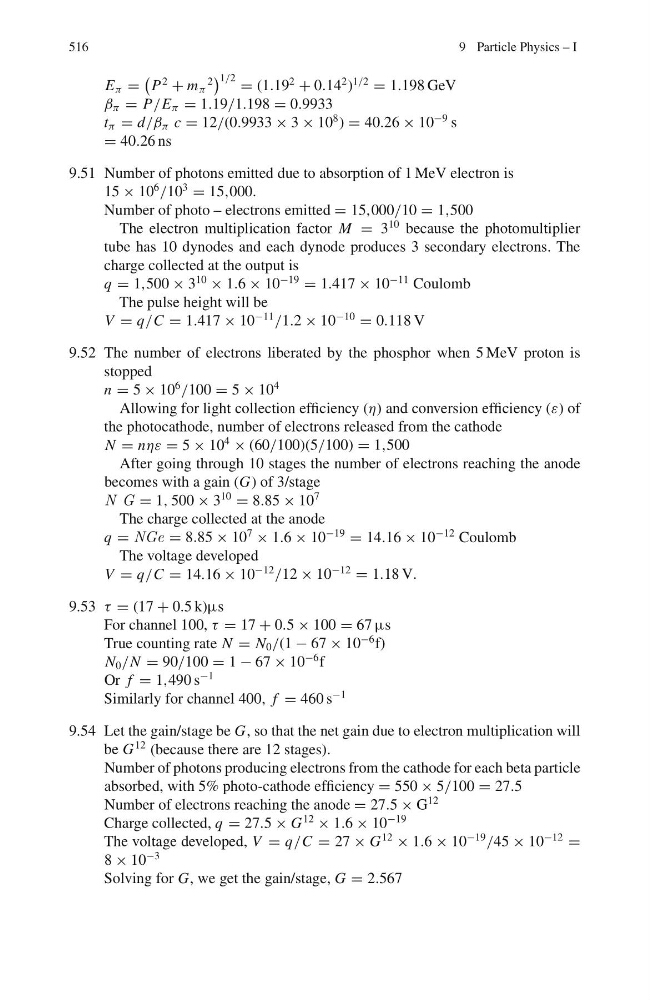
E π =
P
2
+ m π
2
1/2 = (1.19
2
+ 0.14
2 )
1/2
= 1.198 GeV
β π = P/E π = 1.19/1.198 = 0.9933
t π = d/β π c = 12/(0.9933 × 3 × 10
8 ) = 40.26 × 10
−9 s
= 40.26 ns
9.51 Number of photons emitted due to absorption of 1 MeV electron is
15 × 10
6
/10
3
= 15,000.
Number of photo – electrons emitted = 15,000/10 = 1,500
The electron multiplication factor M = 3
10 because the photomultiplier
tube has 10 dynodes and each dynode produces 3 secondary electrons. The
charge collected at the output is
q = 1,500 × 3
10
× 1.6 × 10
−19
= 1.417 × 10
−11 Coulomb
The pulse height will be
V = q/C = 1.417 × 10
−11
/1.2 × 10
−10
= 0.118 V
9.52 The number of electrons liberated by the phosphor when 5 MeV proton is
stopped
n = 5 × 10
6
/100 = 5 × 10
4
Allowing for light collection efficiency (η) and conversion efficiency (ε) of
the photocathode, number of electrons released from the cathode
N = nηε = 5 × 10
4
× (60/100)(5/100) = 1,500
After going through 10 stages the number of electrons reaching the anode
becomes with a gain (G) of 3/stage
N G = 1, 500 × 3
10
= 8.85 × 10
7
The charge collected at the anode
q = NGe = 8.85 × 10
7
× 1.6 × 10
−19
= 14.16 × 10
−12 Coulomb
The voltage developed
V = q/C = 14.16 × 10
−12
/12 × 10
−12
= 1.18 V.
9.53 τ = (17 + 0.5 k)μs
For channel 100, τ = 17 + 0.5 × 100 = 67 μs
True counting rate N = N 0 /(1 − 67 × 10
−6 f)
N 0 /N = 90/100 = 1 − 67 × 10
−6 f
Or f = 1,490 s
−1
Similarly for channel 400, f = 460 s
−1
9.54 Let the gain/stage be G, so that the net gain due to electron multiplication will
be G
12 (because there are 12 stages).
Number of photons producing electrons from the cathode for each beta particle
absorbed, with 5% photo-cathode efficiency = 550 × 5/100 = 27.5
Number of electrons reaching the anode = 27.5 × G
12
Charge collected, q = 27.5 × G
12
× 1.6 × 10
−19
The voltage developed, V = q/C = 27 × G
12
× 1.6 × 10
−19
/45 × 10
−12
=
8 × 10
−3
Solving for G, we get the gain/stage, G = 2.567
9 Particle Physics – I
E π =
P
2
+ m π
2
1/2 = (1.19
2
+ 0.14
2 )
1/2
= 1.198 GeV
β π = P/E π = 1.19/1.198 = 0.9933
t π = d/β π c = 12/(0.9933 × 3 × 10
8 ) = 40.26 × 10
−9 s
= 40.26 ns
9.51 Number of photons emitted due to absorption of 1 MeV electron is
15 × 10
6
/10
3
= 15,000.
Number of photo – electrons emitted = 15,000/10 = 1,500
The electron multiplication factor M = 3
10 because the photomultiplier
tube has 10 dynodes and each dynode produces 3 secondary electrons. The
charge collected at the output is
q = 1,500 × 3
10
× 1.6 × 10
−19
= 1.417 × 10
−11 Coulomb
The pulse height will be
V = q/C = 1.417 × 10
−11
/1.2 × 10
−10
= 0.118 V
9.52 The number of electrons liberated by the phosphor when 5 MeV proton is
stopped
n = 5 × 10
6
/100 = 5 × 10
4
Allowing for light collection efficiency (η) and conversion efficiency (ε) of
the photocathode, number of electrons released from the cathode
N = nηε = 5 × 10
4
× (60/100)(5/100) = 1,500
After going through 10 stages the number of electrons reaching the anode
becomes with a gain (G) of 3/stage
N G = 1, 500 × 3
10
= 8.85 × 10
7
The charge collected at the anode
q = NGe = 8.85 × 10
7
× 1.6 × 10
−19
= 14.16 × 10
−12 Coulomb
The voltage developed
V = q/C = 14.16 × 10
−12
/12 × 10
−12
= 1.18 V.
9.53 τ = (17 + 0.5 k)μs
For channel 100, τ = 17 + 0.5 × 100 = 67 μs
True counting rate N = N 0 /(1 − 67 × 10
−6 f)
N 0 /N = 90/100 = 1 − 67 × 10
−6 f
Or f = 1,490 s
−1
Similarly for channel 400, f = 460 s
−1
9.54 Let the gain/stage be G, so that the net gain due to electron multiplication will
be G
12 (because there are 12 stages).
Number of photons producing electrons from the cathode for each beta particle
absorbed, with 5% photo-cathode efficiency = 550 × 5/100 = 27.5
Number of electrons reaching the anode = 27.5 × G
12
Charge collected, q = 27.5 × G
12
× 1.6 × 10
−19
The voltage developed, V = q/C = 27 × G
12
× 1.6 × 10
−19
/45 × 10
−12
=
8 × 10
−3
Solving for G, we get the gain/stage, G = 2.567