

9.3 Solutions
515
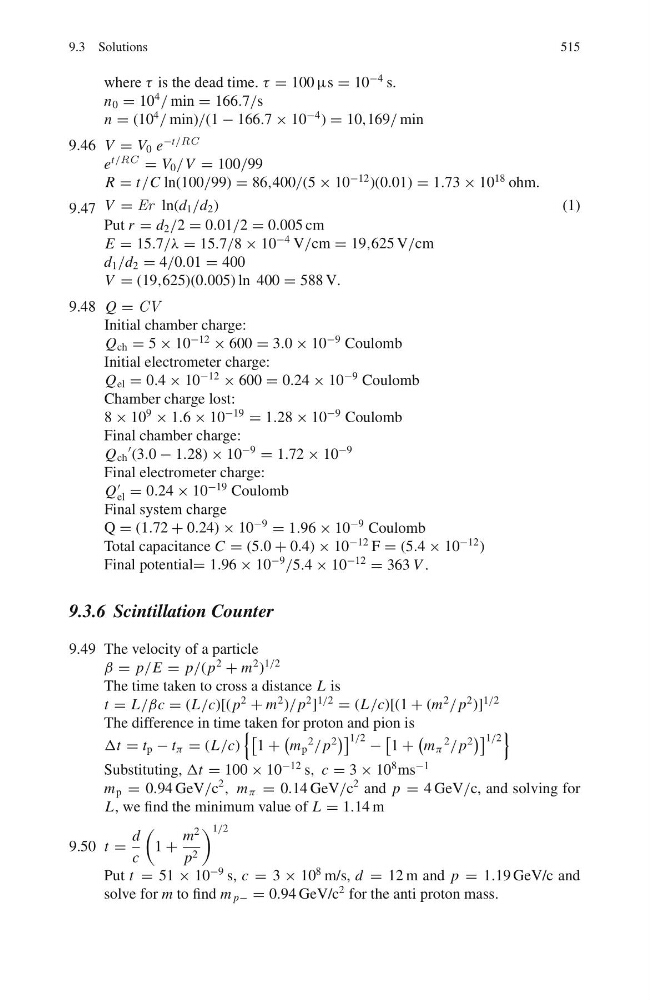
where τ is the dead time. τ = 100 μs = 10
−4 s.
n 0 = 10
4
/ min = 166.7/s
n = (10
4
/ min)/(1 − 166.7 × 10
−4 ) = 10,169/ min
9.46 V = V 0 e
−t/RC
e
t/RC
= V 0 /V = 100/99
R = t/C ln(100/99) = 86,400/(5 × 10
−12 )(0.01) = 1.73 × 10
18 ohm.
9.47 V = Er ln(d 1 /d 2 )
( 1 )
Put r = d 2 /2 = 0.01/2 = 0.005 cm
E = 15.7/λ = 15.7/8 × 10
−4 V/cm = 19,625 V/cm
d 1 /d 2 = 4/0.01 = 400
V = (19,625)(0.005) ln 400 = 588 V.
9.48 Q = CV
Initial chamber charge:
Q ch = 5 × 10
−12
× 600 = 3.0 × 10
−9 Coulomb
Initial electrometer charge:
Q el = 0.4 × 10
−12
× 600 = 0.24 × 10
−9 Coulomb
Chamber charge lost:
8 × 10
9
× 1.6 × 10
−19
= 1.28 × 10
−9 Coulomb
Final chamber charge:
Q ch
(3.0 − 1.28) × 10
−9
= 1.72 × 10
−9
Final electrometer charge:
Q
el = 0.24 × 10
−19 Coulomb
Final system charge
Q = (1.72 + 0.24) × 10
−9
= 1.96 × 10
−9 Coulomb
Total capacitance C = (5.0 + 0.4) × 10
−12 F = (5.4 × 10
−12 )
Final potential= 1.96 × 10
−9
/5.4 × 10
−12
= 363 V .
9.3.6 Scintillation Counter
9.49 The velocity of a particle
β = p/E = p/( p
2
+ m
2 )
1/2
The time taken to cross a distance L is
t = L/βc = (L/c)[( p
2
+ m
2 )/ p
2 ]
1/2
= (L/c)[(1 + (m
2
/ p
2 )]
1/2
The difference in time taken for proton and pion is
Δt = t p − t π = (L/c)
1 +
m p
2
/ p
2
1/2 −
1 +
m π
2
/ p
2
1/2
Substituting, Δt = 100 × 10
−12 s, c = 3 × 10
8 ms
−1
m p = 0.94 GeV/c
2
, m π = 0.14 GeV/c
2 and p = 4 GeV/c, and solving for
L, we find the minimum value of L = 1.14 m
9.50 t =
d
c
1 +
m
2
p 2
1/2
Put t = 51 × 10
−9 s, c = 3 × 10
8 m/s, d = 12 m and p = 1.19 GeV/c and
solve for m to find m p− = 0.94 GeV/c
2 for the anti proton mass.
515
where τ is the dead time. τ = 100 μs = 10
−4 s.
n 0 = 10
4
/ min = 166.7/s
n = (10
4
/ min)/(1 − 166.7 × 10
−4 ) = 10,169/ min
9.46 V = V 0 e
−t/RC
e
t/RC
= V 0 /V = 100/99
R = t/C ln(100/99) = 86,400/(5 × 10
−12 )(0.01) = 1.73 × 10
18 ohm.
9.47 V = Er ln(d 1 /d 2 )
( 1 )
Put r = d 2 /2 = 0.01/2 = 0.005 cm
E = 15.7/λ = 15.7/8 × 10
−4 V/cm = 19,625 V/cm
d 1 /d 2 = 4/0.01 = 400
V = (19,625)(0.005) ln 400 = 588 V.
9.48 Q = CV
Initial chamber charge:
Q ch = 5 × 10
−12
× 600 = 3.0 × 10
−9 Coulomb
Initial electrometer charge:
Q el = 0.4 × 10
−12
× 600 = 0.24 × 10
−9 Coulomb
Chamber charge lost:
8 × 10
9
× 1.6 × 10
−19
= 1.28 × 10
−9 Coulomb
Final chamber charge:
Q ch
(3.0 − 1.28) × 10
−9
= 1.72 × 10
−9
Final electrometer charge:
Q
el = 0.24 × 10
−19 Coulomb
Final system charge
Q = (1.72 + 0.24) × 10
−9
= 1.96 × 10
−9 Coulomb
Total capacitance C = (5.0 + 0.4) × 10
−12 F = (5.4 × 10
−12 )
Final potential= 1.96 × 10
−9
/5.4 × 10
−12
= 363 V .
9.3.6 Scintillation Counter
9.49 The velocity of a particle
β = p/E = p/( p
2
+ m
2 )
1/2
The time taken to cross a distance L is
t = L/βc = (L/c)[( p
2
+ m
2 )/ p
2 ]
1/2
= (L/c)[(1 + (m
2
/ p
2 )]
1/2
The difference in time taken for proton and pion is
Δt = t p − t π = (L/c)
1 +
m p
2
/ p
2
1/2 −
1 +
m π
2
/ p
2
1/2
Substituting, Δt = 100 × 10
−12 s, c = 3 × 10
8 ms
−1
m p = 0.94 GeV/c
2
, m π = 0.14 GeV/c
2 and p = 4 GeV/c, and solving for
L, we find the minimum value of L = 1.14 m
9.50 t =
d
c
1 +
m
2
p 2
1/2
Put t = 51 × 10
−9 s, c = 3 × 10
8 m/s, d = 12 m and p = 1.19 GeV/c and
solve for m to find m p− = 0.94 GeV/c
2 for the anti proton mass.