

510
9 Particle Physics – I
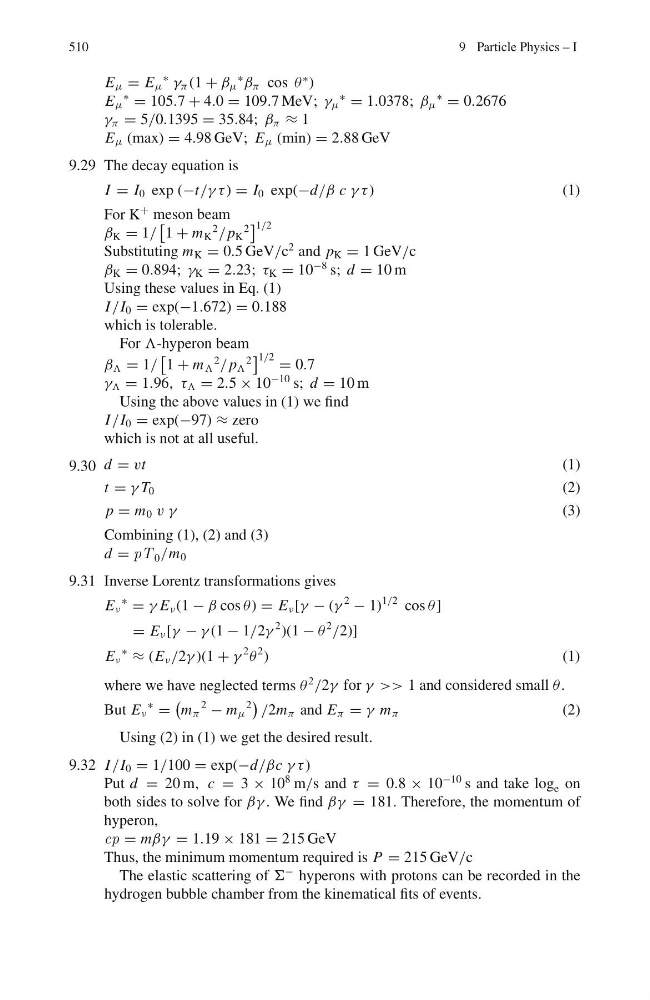
E μ = E μ
∗
γ π (1 + β μ
∗
β π cos θ
∗ )
E μ
∗
= 105.7 + 4.0 = 109.7 MeV; γ μ
∗
= 1.0378; β μ
∗
= 0.2676
γ π = 5/0.1395 = 35.84; β π ≈ 1
E μ (max) = 4.98 GeV; E μ (min) = 2.88 GeV
9.29 The decay equation is
I = I 0 exp (−t/γ τ ) = I 0 exp(−d/β c γ τ )
( 1 )
For K
+ meson beam
β K = 1/
1 + m K
2
/ p K
2
1/2
Substituting m K = 0.5 GeV/c
2 and p K = 1 GeV/c
β K = 0.894; γ K = 2.23; τ K = 10
−8 s; d = 10 m
Using these values in Eq. (1)
I /I 0 = exp(−1.672) = 0.188
which is tolerable.
For Λ-hyperon beam
β Λ = 1/
1 + m Λ
2
/ p Λ
2
1/2 = 0.7
γ Λ = 1.96, τ Λ = 2.5 × 10
−10 s; d = 10 m
Using the above values in (1) we find
I /I 0 = exp(−97) ≈ zero
which is not at all useful.
9.30 d = vt
(1)
t = γ T 0
(2)
p = m 0 v γ
(3)
Combining (1), (2) and (3)
d = pT 0 /m 0
9.31 Inverse Lorentz transformations gives
E ν
∗
= γ E ν (1 − β cos θ) = E ν [γ − (γ
2
− 1)
1/2 cos θ ]
= E ν [γ − γ (1 − 1/2γ
2 )(1 − θ
2
/2)]
E ν
∗
≈ (E ν /2γ )(1 + γ
2
θ
2 )
( 1 )
where we have neglected terms θ
2
/2γ for γ >> 1 and considered small θ .
But E ν
∗
=
m π
2
− m μ
2
/2m π and E π = γ m π
(2)
Using (2) in (1) we get the desired result.
9.32 I /I 0 = 1/100 = exp(−d/βc γ τ )
Put d = 20 m, c = 3 × 10
8 m/s and τ = 0.8 × 10
−10 s and take log e on
both sides to solve for βγ . We find βγ = 181. Therefore, the momentum of
hyperon,
cp = mβγ = 1.19 × 181 = 215 GeV
Thus, the minimum momentum required is P = 215 GeV/c
The elastic scattering of Σ
− hyperons with protons can be recorded in the
hydrogen bubble chamber from the kinematical fits of events.
9 Particle Physics – I
E μ = E μ
∗
γ π (1 + β μ
∗
β π cos θ
∗ )
E μ
∗
= 105.7 + 4.0 = 109.7 MeV; γ μ
∗
= 1.0378; β μ
∗
= 0.2676
γ π = 5/0.1395 = 35.84; β π ≈ 1
E μ (max) = 4.98 GeV; E μ (min) = 2.88 GeV
9.29 The decay equation is
I = I 0 exp (−t/γ τ ) = I 0 exp(−d/β c γ τ )
( 1 )
For K
+ meson beam
β K = 1/
1 + m K
2
/ p K
2
1/2
Substituting m K = 0.5 GeV/c
2 and p K = 1 GeV/c
β K = 0.894; γ K = 2.23; τ K = 10
−8 s; d = 10 m
Using these values in Eq. (1)
I /I 0 = exp(−1.672) = 0.188
which is tolerable.
For Λ-hyperon beam
β Λ = 1/
1 + m Λ
2
/ p Λ
2
1/2 = 0.7
γ Λ = 1.96, τ Λ = 2.5 × 10
−10 s; d = 10 m
Using the above values in (1) we find
I /I 0 = exp(−97) ≈ zero
which is not at all useful.
9.30 d = vt
(1)
t = γ T 0
(2)
p = m 0 v γ
(3)
Combining (1), (2) and (3)
d = pT 0 /m 0
9.31 Inverse Lorentz transformations gives
E ν
∗
= γ E ν (1 − β cos θ) = E ν [γ − (γ
2
− 1)
1/2 cos θ ]
= E ν [γ − γ (1 − 1/2γ
2 )(1 − θ
2
/2)]
E ν
∗
≈ (E ν /2γ )(1 + γ
2
θ
2 )
( 1 )
where we have neglected terms θ
2
/2γ for γ >> 1 and considered small θ .
But E ν
∗
=
m π
2
− m μ
2
/2m π and E π = γ m π
(2)
Using (2) in (1) we get the desired result.
9.32 I /I 0 = 1/100 = exp(−d/βc γ τ )
Put d = 20 m, c = 3 × 10
8 m/s and τ = 0.8 × 10
−10 s and take log e on
both sides to solve for βγ . We find βγ = 181. Therefore, the momentum of
hyperon,
cp = mβγ = 1.19 × 181 = 215 GeV
Thus, the minimum momentum required is P = 215 GeV/c
The elastic scattering of Σ
− hyperons with protons can be recorded in the
hydrogen bubble chamber from the kinematical fits of events.