

9.3 Solutions
509
E n =
m Σ
2
+ m n
2
− m μ
2
/2m Σ = (1,189
2
+ 939
2
− 106
2 )/2 × 1,189 =
960.6 MeV
Therefore T n = E n − m n = 960.6 − 939 = 21.6 MeV
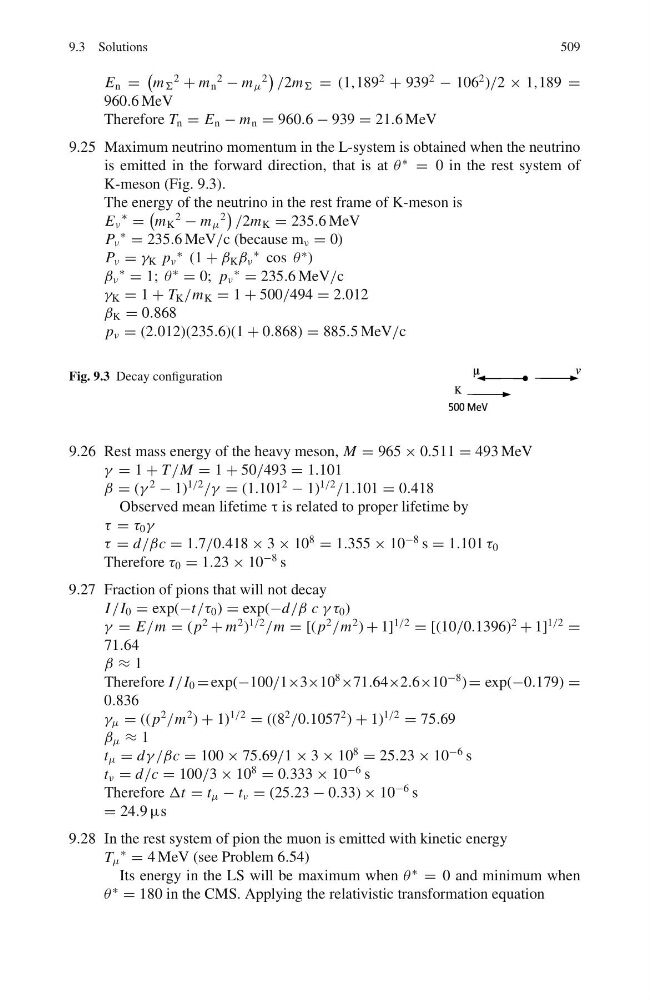
9.25 Maximum neutrino momentum in the L-system is obtained when the neutrino
is emitted in the forward direction, that is at θ
∗
= 0 in the rest system of
K-meson (Fig. 9.3).
The energy of the neutrino in the rest frame of K-meson is
E ν
∗
=
m K
2
− m μ
2
/2m K = 235.6 MeV
P ν
∗
= 235.6 MeV/c (because m ν = 0)
P ν = γ K p ν
∗ (1 + β K β ν
∗ cos θ
∗ )
β ν
∗
= 1; θ
∗
= 0; p ν
∗
= 235.6 MeV/c
γ K = 1 + T K /m K = 1 + 500/494 = 2.012
β K = 0.868
p ν = (2.012)(235.6)(1 + 0.868) = 885.5 MeV/c
Fig. 9.3 Decay configuration
9.26 Rest mass energy of the heavy meson, M = 965 × 0.511 = 493 MeV
γ = 1 + T /M = 1 + 50/493 = 1.101
β = (γ
2
− 1)
1/2
/γ = (1.101
2
− 1)
1/2
/1.101 = 0.418
Observed mean lifetime τ is related to proper lifetime by
τ = τ 0 γ
τ = d/βc = 1.7/0.418 × 3 × 10
8
= 1.355 × 10
−8 s = 1.101 τ 0
Therefore τ 0 = 1.23 × 10
−8 s
9.27 Fraction of pions that will not decay
I /I 0 = exp(−t/τ 0 ) = exp(−d/β c γ τ 0 )
γ = E/m = ( p
2
+ m
2 )
1/2
/m = [( p
2
/m
2 ) + 1]
1/2
= [(10/0.1396)
2
+ 1]
1/2
=
71.64
β ≈ 1
Therefore I /I 0 = exp(−100/1×3×10
8
×71.64×2.6×10
−8 ) = exp(−0.179) =
0.836
γ μ = (( p
2
/m
2 ) + 1)
1/2
= ((8
2
/0.1057
2 ) + 1)
1/2
= 75.69
β μ ≈ 1
t μ = dγ /βc = 100 × 75.69/1 × 3 × 10
8
= 25.23 × 10
−6 s
t ν = d/c = 100/3 × 10
8
= 0.333 × 10
−6 s
Therefore Δt = t μ − t ν = (25.23 − 0.33) × 10
−6 s
= 24.9 μs
9.28 In the rest system of pion the muon is emitted with kinetic energy
T μ
∗
= 4 MeV (see Problem 6.54)
Its energy in the LS will be maximum when θ
∗
= 0 and minimum when
θ
∗
= 180 in the CMS. Applying the relativistic transformation equation
509
E n =
m Σ
2
+ m n
2
− m μ
2
/2m Σ = (1,189
2
+ 939
2
− 106
2 )/2 × 1,189 =
960.6 MeV
Therefore T n = E n − m n = 960.6 − 939 = 21.6 MeV
9.25 Maximum neutrino momentum in the L-system is obtained when the neutrino
is emitted in the forward direction, that is at θ
∗
= 0 in the rest system of
K-meson (Fig. 9.3).
The energy of the neutrino in the rest frame of K-meson is
E ν
∗
=
m K
2
− m μ
2
/2m K = 235.6 MeV
P ν
∗
= 235.6 MeV/c (because m ν = 0)
P ν = γ K p ν
∗ (1 + β K β ν
∗ cos θ
∗ )
β ν
∗
= 1; θ
∗
= 0; p ν
∗
= 235.6 MeV/c
γ K = 1 + T K /m K = 1 + 500/494 = 2.012
β K = 0.868
p ν = (2.012)(235.6)(1 + 0.868) = 885.5 MeV/c
Fig. 9.3 Decay configuration
9.26 Rest mass energy of the heavy meson, M = 965 × 0.511 = 493 MeV
γ = 1 + T /M = 1 + 50/493 = 1.101
β = (γ
2
− 1)
1/2
/γ = (1.101
2
− 1)
1/2
/1.101 = 0.418
Observed mean lifetime τ is related to proper lifetime by
τ = τ 0 γ
τ = d/βc = 1.7/0.418 × 3 × 10
8
= 1.355 × 10
−8 s = 1.101 τ 0
Therefore τ 0 = 1.23 × 10
−8 s
9.27 Fraction of pions that will not decay
I /I 0 = exp(−t/τ 0 ) = exp(−d/β c γ τ 0 )
γ = E/m = ( p
2
+ m
2 )
1/2
/m = [( p
2
/m
2 ) + 1]
1/2
= [(10/0.1396)
2
+ 1]
1/2
=
71.64
β ≈ 1
Therefore I /I 0 = exp(−100/1×3×10
8
×71.64×2.6×10
−8 ) = exp(−0.179) =
0.836
γ μ = (( p
2
/m
2 ) + 1)
1/2
= ((8
2
/0.1057
2 ) + 1)
1/2
= 75.69
β μ ≈ 1
t μ = dγ /βc = 100 × 75.69/1 × 3 × 10
8
= 25.23 × 10
−6 s
t ν = d/c = 100/3 × 10
8
= 0.333 × 10
−6 s
Therefore Δt = t μ − t ν = (25.23 − 0.33) × 10
−6 s
= 24.9 μs
9.28 In the rest system of pion the muon is emitted with kinetic energy
T μ
∗
= 4 MeV (see Problem 6.54)
Its energy in the LS will be maximum when θ
∗
= 0 and minimum when
θ
∗
= 180 in the CMS. Applying the relativistic transformation equation