

9.2 Problems
493
measurements would you make to identify the elastic scattering in a (Σ
− p)
collision?
[University of Manchester]
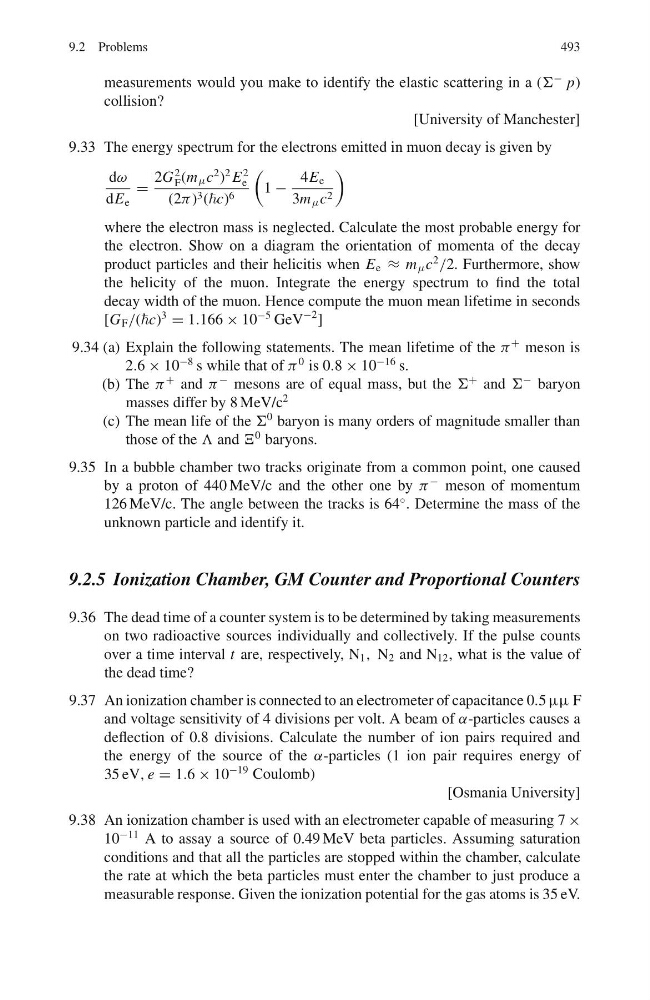
9.33 The energy spectrum for the electrons emitted in muon decay is given by
dω
dE e
=
2G
2
F (m μ c
2 )
2 E
2
e
(2π) 3 (c) 6
1 −
4E e
3m μ c 2
where the electron mass is neglected. Calculate the most probable energy for
the electron. Show on a diagram the orientation of momenta of the decay
product particles and their helicitis when E e ≈ m μ c
2
/2. Furthermore, show
the helicity of the muon. Integrate the energy spectrum to find the total
decay width of the muon. Hence compute the muon mean lifetime in seconds
[G F /(c)
3
= 1.166 × 10
−5 GeV
−2 ]
9.34 (a) Explain the following statements. The mean lifetime of the π
+ meson is
2.6 × 10
−8 s while that of π
0 is 0.8 × 10
−16 s.
(b) The π
+ and π
− mesons are of equal mass, but the Σ
+ and Σ
− baryon
masses differ by 8 MeV/c
2
(c) The mean life of the Σ
0 baryon is many orders of magnitude smaller than
those of the Λ and Ξ
0 baryons.
9.35 In a bubble chamber two tracks originate from a common point, one caused
by a proton of 440 MeV/c and the other one by π
− meson of momentum
126 MeV/c. The angle between the tracks is 64
◦ . Determine the mass of the
unknown particle and identify it.
9.2.5 Ionization Chamber, GM Counter and Proportional Counters
9.36 The dead time of a counter system is to be determined by taking measurements
on two radioactive sources individually and collectively. If the pulse counts
over a time interval t are, respectively, N 1 , N 2 and N 12 , what is the value of
the dead time?
9.37 An ionization chamber is connected to an electrometer of capacitance 0.5 μμ F
and voltage sensitivity of 4 divisions per volt. A beam of α-particles causes a
deflection of 0.8 divisions. Calculate the number of ion pairs required and
the energy of the source of the α-particles (1 ion pair requires energy of
35 eV, e = 1.6 × 10
−19 Coulomb)
[Osmania University]
9.38 An ionization chamber is used with an electrometer capable of measuring 7 ×
10
−11 A to assay a source of 0.49 MeV beta particles. Assuming saturation
conditions and that all the particles are stopped within the chamber, calculate
the rate at which the beta particles must enter the chamber to just produce a
measurable response. Given the ionization potential for the gas atoms is 35 eV.
493
measurements would you make to identify the elastic scattering in a (Σ
− p)
collision?
[University of Manchester]
9.33 The energy spectrum for the electrons emitted in muon decay is given by
dω
dE e
=
2G
2
F (m μ c
2 )
2 E
2
e
(2π) 3 (c) 6
1 −
4E e
3m μ c 2
where the electron mass is neglected. Calculate the most probable energy for
the electron. Show on a diagram the orientation of momenta of the decay
product particles and their helicitis when E e ≈ m μ c
2
/2. Furthermore, show
the helicity of the muon. Integrate the energy spectrum to find the total
decay width of the muon. Hence compute the muon mean lifetime in seconds
[G F /(c)
3
= 1.166 × 10
−5 GeV
−2 ]
9.34 (a) Explain the following statements. The mean lifetime of the π
+ meson is
2.6 × 10
−8 s while that of π
0 is 0.8 × 10
−16 s.
(b) The π
+ and π
− mesons are of equal mass, but the Σ
+ and Σ
− baryon
masses differ by 8 MeV/c
2
(c) The mean life of the Σ
0 baryon is many orders of magnitude smaller than
those of the Λ and Ξ
0 baryons.
9.35 In a bubble chamber two tracks originate from a common point, one caused
by a proton of 440 MeV/c and the other one by π
− meson of momentum
126 MeV/c. The angle between the tracks is 64
◦ . Determine the mass of the
unknown particle and identify it.
9.2.5 Ionization Chamber, GM Counter and Proportional Counters
9.36 The dead time of a counter system is to be determined by taking measurements
on two radioactive sources individually and collectively. If the pulse counts
over a time interval t are, respectively, N 1 , N 2 and N 12 , what is the value of
the dead time?
9.37 An ionization chamber is connected to an electrometer of capacitance 0.5 μμ F
and voltage sensitivity of 4 divisions per volt. A beam of α-particles causes a
deflection of 0.8 divisions. Calculate the number of ion pairs required and
the energy of the source of the α-particles (1 ion pair requires energy of
35 eV, e = 1.6 × 10
−19 Coulomb)
[Osmania University]
9.38 An ionization chamber is used with an electrometer capable of measuring 7 ×
10
−11 A to assay a source of 0.49 MeV beta particles. Assuming saturation
conditions and that all the particles are stopped within the chamber, calculate
the rate at which the beta particles must enter the chamber to just produce a
measurable response. Given the ionization potential for the gas atoms is 35 eV.