

492
9 Particle Physics – I
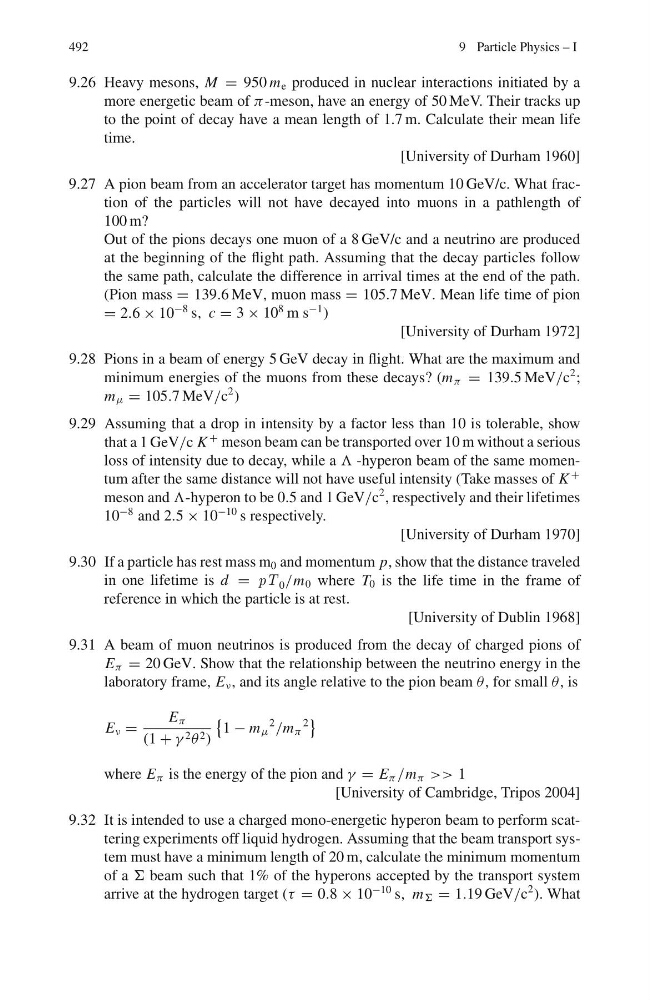
9.26 Heavy mesons, M = 950 m e produced in nuclear interactions initiated by a
more energetic beam of π-meson, have an energy of 50 MeV. Their tracks up
to the point of decay have a mean length of 1.7 m. Calculate their mean life
time.
[University of Durham 1960]
9.27 A pion beam from an accelerator target has momentum 10 GeV/c. What fraction of the particles will not have decayed into muons in a pathlength of
100 m?
Out of the pions decays one muon of a 8 GeV/c and a neutrino are produced
at the beginning of the flight path. Assuming that the decay particles follow
the same path, calculate the difference in arrival times at the end of the path.
(Pion mass = 139.6 MeV, muon mass = 105.7 MeV. Mean life time of pion
= 2.6 × 10
−8 s, c = 3 × 10
8 m s
−1 )
[University of Durham 1972]
9.28 Pions in a beam of energy 5 GeV decay in flight. What are the maximum and
minimum energies of the muons from these decays? (m π = 139.5 MeV/c
2 ;
m μ = 105.7 MeV/c
2 )
9.29 Assuming that a drop in intensity by a factor less than 10 is tolerable, show
that a 1 GeV/c K
+ meson beam can be transported over 10 m without a serious
loss of intensity due to decay, while a Λ -hyperon beam of the same momentum after the same distance will not have useful intensity (Take masses of K
+
meson and Λ-hyperon to be 0.5 and 1 GeV/c
2 , respectively and their lifetimes
10
−8 and 2.5 × 10
−10 s respectively.
[University of Durham 1970]
9.30 If a particle has rest mass m 0 and momentum p, show that the distance traveled
in one lifetime is d = pT 0 /m 0 where T 0 is the life time in the frame of
reference in which the particle is at rest.
[University of Dublin 1968]
9.31 A beam of muon neutrinos is produced from the decay of charged pions of
E π = 20 GeV. Show that the relationship between the neutrino energy in the
laboratory frame, E ν , and its angle relative to the pion beam θ , for small θ , is
E ν =
E π
(1 + γ 2 θ 2 )
1 − m μ
2
/m π
2
where E π is the energy of the pion and γ = E π /m π >> 1
[University of Cambridge, Tripos 2004]
9.32 It is intended to use a charged mono-energetic hyperon beam to perform scattering experiments off liquid hydrogen. Assuming that the beam transport system must have a minimum length of 20 m, calculate the minimum momentum
of a Σ beam such that 1% of the hyperons accepted by the transport system
arrive at the hydrogen target (τ = 0.8 × 10
−10 s, m Σ = 1.19 GeV/c
2 ). What
9 Particle Physics – I
9.26 Heavy mesons, M = 950 m e produced in nuclear interactions initiated by a
more energetic beam of π-meson, have an energy of 50 MeV. Their tracks up
to the point of decay have a mean length of 1.7 m. Calculate their mean life
time.
[University of Durham 1960]
9.27 A pion beam from an accelerator target has momentum 10 GeV/c. What fraction of the particles will not have decayed into muons in a pathlength of
100 m?
Out of the pions decays one muon of a 8 GeV/c and a neutrino are produced
at the beginning of the flight path. Assuming that the decay particles follow
the same path, calculate the difference in arrival times at the end of the path.
(Pion mass = 139.6 MeV, muon mass = 105.7 MeV. Mean life time of pion
= 2.6 × 10
−8 s, c = 3 × 10
8 m s
−1 )
[University of Durham 1972]
9.28 Pions in a beam of energy 5 GeV decay in flight. What are the maximum and
minimum energies of the muons from these decays? (m π = 139.5 MeV/c
2 ;
m μ = 105.7 MeV/c
2 )
9.29 Assuming that a drop in intensity by a factor less than 10 is tolerable, show
that a 1 GeV/c K
+ meson beam can be transported over 10 m without a serious
loss of intensity due to decay, while a Λ -hyperon beam of the same momentum after the same distance will not have useful intensity (Take masses of K
+
meson and Λ-hyperon to be 0.5 and 1 GeV/c
2 , respectively and their lifetimes
10
−8 and 2.5 × 10
−10 s respectively.
[University of Durham 1970]
9.30 If a particle has rest mass m 0 and momentum p, show that the distance traveled
in one lifetime is d = pT 0 /m 0 where T 0 is the life time in the frame of
reference in which the particle is at rest.
[University of Dublin 1968]
9.31 A beam of muon neutrinos is produced from the decay of charged pions of
E π = 20 GeV. Show that the relationship between the neutrino energy in the
laboratory frame, E ν , and its angle relative to the pion beam θ , for small θ , is
E ν =
E π
(1 + γ 2 θ 2 )
1 − m μ
2
/m π
2
where E π is the energy of the pion and γ = E π /m π >> 1
[University of Cambridge, Tripos 2004]
9.32 It is intended to use a charged mono-energetic hyperon beam to perform scattering experiments off liquid hydrogen. Assuming that the beam transport system must have a minimum length of 20 m, calculate the minimum momentum
of a Σ beam such that 1% of the hyperons accepted by the transport system
arrive at the hydrogen target (τ = 0.8 × 10
−10 s, m Σ = 1.19 GeV/c
2 ). What