

454
8 Nuclear Physics – II
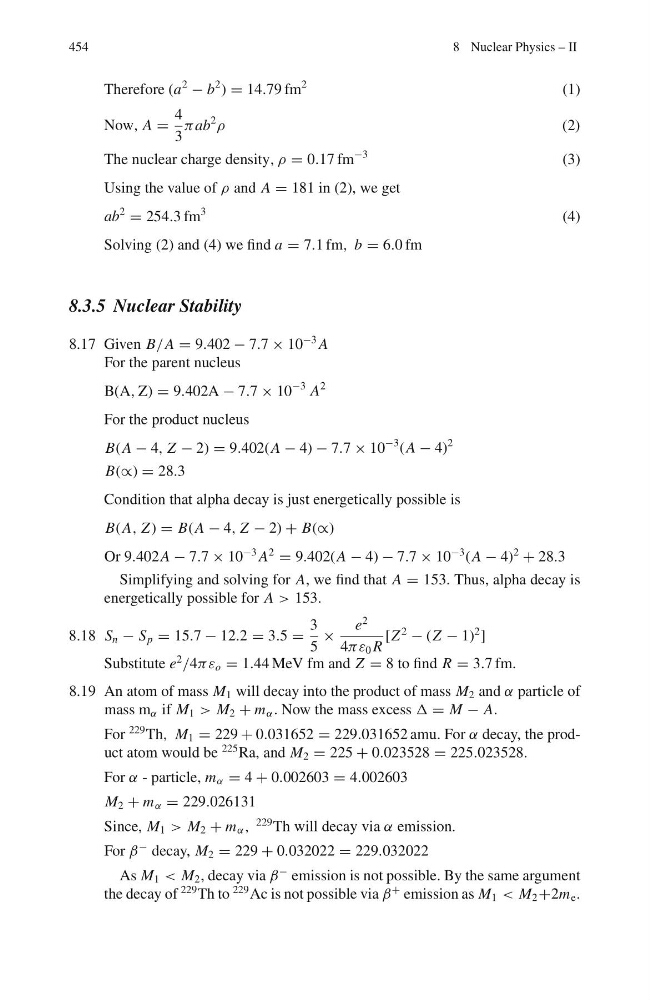
Therefore (a
2
− b
2 ) = 14.79 fm
2
(1)
Now, A =
4
3
πab
2
ρ
(2)
The nuclear charge density, ρ = 0.17 fm
−3
(3)
Using the value of ρ and A = 181 in (2), we get
ab
2
= 254.3 fm
3
(4)
Solving (2) and (4) we find a = 7.1 fm, b = 6.0 fm
8.3.5 Nuclear Stability
8.17 Given B/A = 9.402 − 7.7 × 10
−3 A
For the parent nucleus
B(A, Z) = 9.402A − 7.7 × 10
−3 A
2
For the product nucleus
B( A − 4, Z − 2) = 9.402(A − 4) − 7.7 × 10
−3 ( A − 4)
2
B(∝) = 28.3
Condition that alpha decay is just energetically possible is
B( A, Z ) = B(A − 4, Z − 2) + B(∝)
Or 9.402A − 7.7 × 10
−3 A
2
= 9.402(A − 4) − 7.7 × 10
−3 ( A − 4)
2
+ 28.3
Simplifying and solving for A, we find that A = 153. Thus, alpha decay is
energetically possible for A > 153.
8.18 S n − S p = 15.7 − 12.2 = 3.5 =
3
5
×
e
2
4πε 0 R
[Z
2
− (Z − 1)
2 ]
Substitute e
2
/4πε o = 1.44 MeV fm and Z = 8 to find R = 3.7 fm.
8.19 An atom of mass M 1 will decay into the product of mass M 2 and α particle of
mass m α if M 1 > M 2 + m α . Now the mass excess Δ = M − A.
For
229 Th, M 1 = 229 + 0.031652 = 229.031652 amu. For α decay, the product atom would be
225 Ra, and M 2 = 225 + 0.023528 = 225.023528.
For α - particle, m α = 4 + 0.002603 = 4.002603
M 2 + m α = 229.026131
Since, M 1 > M 2 + m α ,
229 Th will decay via α emission.
For β
− decay, M 2 = 229 + 0.032022 = 229.032022
As M 1 < M 2 , decay via β
− emission is not possible. By the same argument
the decay of
229 Th to
229 Ac is not possible via β
+ emission as M 1 < M 2 +2m e .
8 Nuclear Physics – II
Therefore (a
2
− b
2 ) = 14.79 fm
2
(1)
Now, A =
4
3
πab
2
ρ
(2)
The nuclear charge density, ρ = 0.17 fm
−3
(3)
Using the value of ρ and A = 181 in (2), we get
ab
2
= 254.3 fm
3
(4)
Solving (2) and (4) we find a = 7.1 fm, b = 6.0 fm
8.3.5 Nuclear Stability
8.17 Given B/A = 9.402 − 7.7 × 10
−3 A
For the parent nucleus
B(A, Z) = 9.402A − 7.7 × 10
−3 A
2
For the product nucleus
B( A − 4, Z − 2) = 9.402(A − 4) − 7.7 × 10
−3 ( A − 4)
2
B(∝) = 28.3
Condition that alpha decay is just energetically possible is
B( A, Z ) = B(A − 4, Z − 2) + B(∝)
Or 9.402A − 7.7 × 10
−3 A
2
= 9.402(A − 4) − 7.7 × 10
−3 ( A − 4)
2
+ 28.3
Simplifying and solving for A, we find that A = 153. Thus, alpha decay is
energetically possible for A > 153.
8.18 S n − S p = 15.7 − 12.2 = 3.5 =
3
5
×
e
2
4πε 0 R
[Z
2
− (Z − 1)
2 ]
Substitute e
2
/4πε o = 1.44 MeV fm and Z = 8 to find R = 3.7 fm.
8.19 An atom of mass M 1 will decay into the product of mass M 2 and α particle of
mass m α if M 1 > M 2 + m α . Now the mass excess Δ = M − A.
For
229 Th, M 1 = 229 + 0.031652 = 229.031652 amu. For α decay, the product atom would be
225 Ra, and M 2 = 225 + 0.023528 = 225.023528.
For α - particle, m α = 4 + 0.002603 = 4.002603
M 2 + m α = 229.026131
Since, M 1 > M 2 + m α ,
229 Th will decay via α emission.
For β
− decay, M 2 = 229 + 0.032022 = 229.032022
As M 1 < M 2 , decay via β
− emission is not possible. By the same argument
the decay of
229 Th to
229 Ac is not possible via β
+ emission as M 1 < M 2 +2m e .