

8.3 Solutions
453
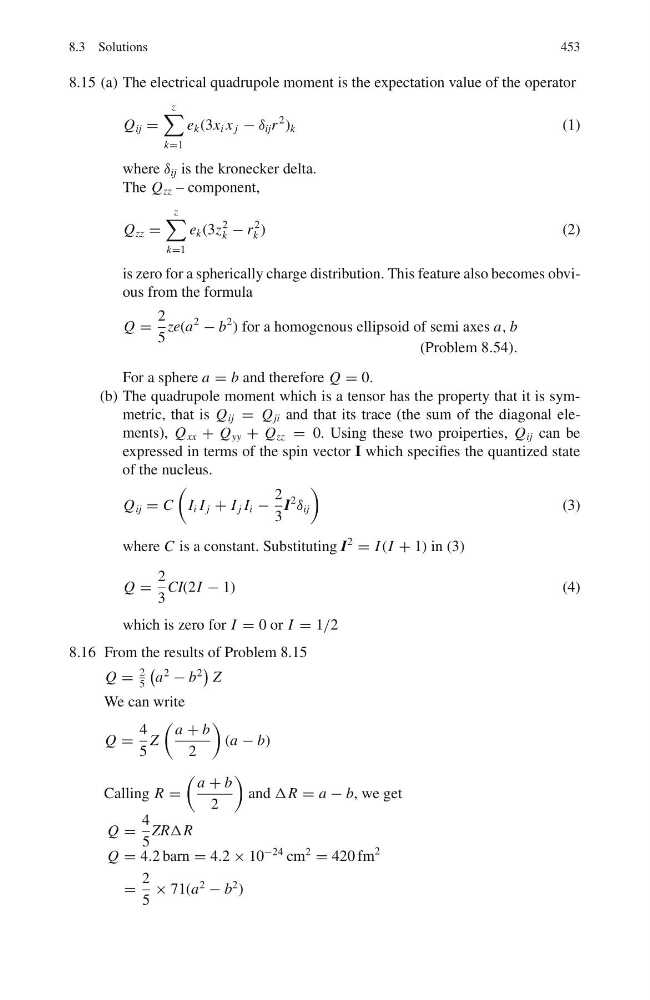
8.15 (a) The electrical quadrupole moment is the expectation value of the operator
Q ij =
z
k=1
e k (3x i x j − δ ij r
2 ) k
(1)
where δ ij is the kronecker delta.
The Q zz – component,
Q zz =
z
k=1
e k (3z
2
k − r
2
k )
( 2 )
is zero for a spherically charge distribution. This feature also becomes obvious from the formula
Q =
2
5
ze(a
2
− b
2 ) for a homogenous ellipsoid of semi axes a, b
(Problem 8.54).
For a sphere a = b and therefore Q = 0.
(b) The quadrupole moment which is a tensor has the property that it is symmetric, that is Q ij = Q ji and that its trace (the sum of the diagonal elements), Q xx + Q yy + Q zz = 0. Using these two proiperties, Q ij can be
expressed in terms of the spin vector I which specifies the quantized state
of the nucleus.
Q ij = C
I i I j + I j I i −
2
3
I
2
δ ij
(3)
where C is a constant. Substituting I
2
= I (I + 1) in (3)
Q =
2
3
CI(2I − 1)
(4)
which is zero for I = 0 or I = 1/2
8.16 From the results of Problem 8.15
Q =
2
5
a
2
− b
2
Z
We can write
Q =
4
5
Z
a + b
2
(a − b)
Calling R =
a + b
2
and ΔR = a − b, we get
Q =
4
5
ZRΔR
Q = 4.2 barn = 4.2 × 10
−24 cm
2
= 420 fm
2
=
2
5
× 71(a
2
− b
2 )
453
8.15 (a) The electrical quadrupole moment is the expectation value of the operator
Q ij =
z
k=1
e k (3x i x j − δ ij r
2 ) k
(1)
where δ ij is the kronecker delta.
The Q zz – component,
Q zz =
z
k=1
e k (3z
2
k − r
2
k )
( 2 )
is zero for a spherically charge distribution. This feature also becomes obvious from the formula
Q =
2
5
ze(a
2
− b
2 ) for a homogenous ellipsoid of semi axes a, b
(Problem 8.54).
For a sphere a = b and therefore Q = 0.
(b) The quadrupole moment which is a tensor has the property that it is symmetric, that is Q ij = Q ji and that its trace (the sum of the diagonal elements), Q xx + Q yy + Q zz = 0. Using these two proiperties, Q ij can be
expressed in terms of the spin vector I which specifies the quantized state
of the nucleus.
Q ij = C
I i I j + I j I i −
2
3
I
2
δ ij
(3)
where C is a constant. Substituting I
2
= I (I + 1) in (3)
Q =
2
3
CI(2I − 1)
(4)
which is zero for I = 0 or I = 1/2
8.16 From the results of Problem 8.15
Q =
2
5
a
2
− b
2
Z
We can write
Q =
4
5
Z
a + b
2
(a − b)
Calling R =
a + b
2
and ΔR = a − b, we get
Q =
4
5
ZRΔR
Q = 4.2 barn = 4.2 × 10
−24 cm
2
= 420 fm
2
=
2
5
× 71(a
2
− b
2 )