

8.3 Solutions
449
ΔE c =
3
5
.
1
4πε 0
.
e
2
R
[Z (Z + 1) − Z (Z − 1)]
=
6Ze
2
5R
.
e
2
4πε 0
= 1.2 × 1.44
Z
R
MeV-fm
Equating ΔE c to M Si − M A = 3.48 + 2 × 0.51 = 4.5 MeV, and Z = 13,
we find R from which r o = R/A
1/3 can be determined, where A = 27. Thus
r o = 1.66 fm.
8.5 ΔP x .Δx = (uncertainty principle)
or cΔP x =
c
Δx
=
197.3 MeV − fm
5 fm
= 39.6 MeV
The kinetic energy T =
c
2 p
2
2Mc
2
=
(39.6)
2
2 × 940
= 0.83 MeV
8.6 The mass-energy equation for positron decay is
M(
14 O) − M(
14 N ) = 2m e +
E β (max) + E γ
931.5
= 2 × 0.000548 +
1.835 + 2.313
931.5
= 0.005549
or M(
14 O) = 14.003074 + 0.005549 = 14.008623 amu
8.3.2 Electric Potential and Energy
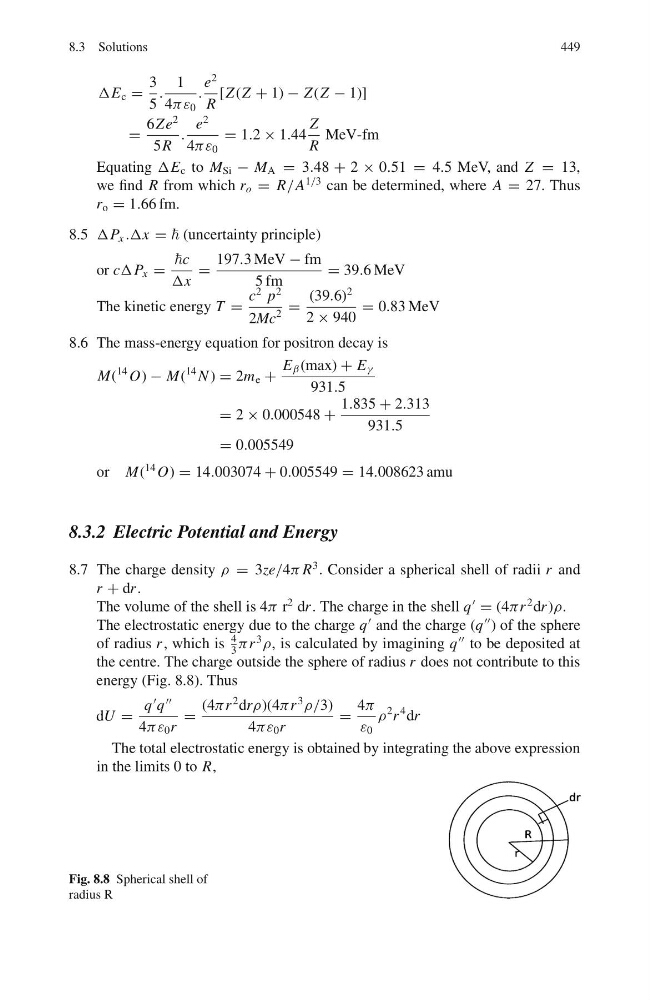
8.7 The charge density ρ = 3ze/4π R
3 . Consider a spherical shell of radii r and
r + dr .
The volume of the shell is 4π r
2 dr . The charge in the shell q
= (4πr
2 dr )ρ.
The electrostatic energy due to the charge q
and the charge (q
) of the sphere
of radius r , which is
4
3
πr
3
ρ, is calculated by imagining q
to be deposited at
the centre. The charge outside the sphere of radius r does not contribute to this
energy (Fig. 8.8). Thus
dU =
q
q
4πε 0 r
=
(4πr
2 drρ)(4πr
3
ρ/3)
4πε 0 r
=
4π
ε 0
ρ
2 r
4 dr
The total electrostatic energy is obtained by integrating the above expression
in the limits 0 to R,
Fig. 8.8 Spherical shell of
radius R
449
ΔE c =
3
5
.
1
4πε 0
.
e
2
R
[Z (Z + 1) − Z (Z − 1)]
=
6Ze
2
5R
.
e
2
4πε 0
= 1.2 × 1.44
Z
R
MeV-fm
Equating ΔE c to M Si − M A = 3.48 + 2 × 0.51 = 4.5 MeV, and Z = 13,
we find R from which r o = R/A
1/3 can be determined, where A = 27. Thus
r o = 1.66 fm.
8.5 ΔP x .Δx = (uncertainty principle)
or cΔP x =
c
Δx
=
197.3 MeV − fm
5 fm
= 39.6 MeV
The kinetic energy T =
c
2 p
2
2Mc
2
=
(39.6)
2
2 × 940
= 0.83 MeV
8.6 The mass-energy equation for positron decay is
M(
14 O) − M(
14 N ) = 2m e +
E β (max) + E γ
931.5
= 2 × 0.000548 +
1.835 + 2.313
931.5
= 0.005549
or M(
14 O) = 14.003074 + 0.005549 = 14.008623 amu
8.3.2 Electric Potential and Energy
8.7 The charge density ρ = 3ze/4π R
3 . Consider a spherical shell of radii r and
r + dr .
The volume of the shell is 4π r
2 dr . The charge in the shell q
= (4πr
2 dr )ρ.
The electrostatic energy due to the charge q
and the charge (q
) of the sphere
of radius r , which is
4
3
πr
3
ρ, is calculated by imagining q
to be deposited at
the centre. The charge outside the sphere of radius r does not contribute to this
energy (Fig. 8.8). Thus
dU =
q
q
4πε 0 r
=
(4πr
2 drρ)(4πr
3
ρ/3)
4πε 0 r
=
4π
ε 0
ρ
2 r
4 dr
The total electrostatic energy is obtained by integrating the above expression
in the limits 0 to R,
Fig. 8.8 Spherical shell of
radius R