

448
8 Nuclear Physics – II
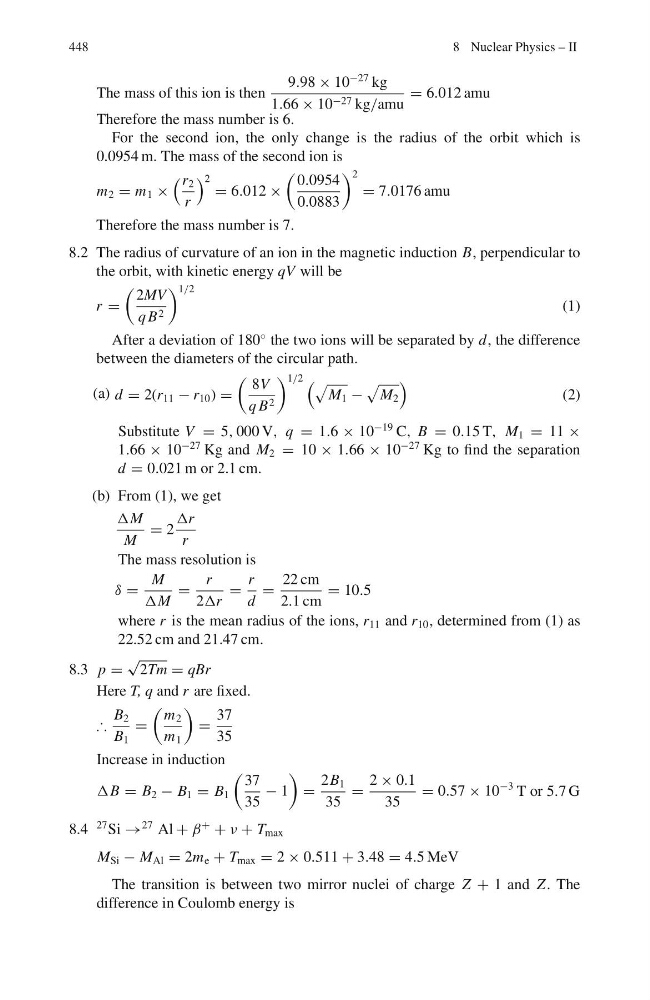
The mass of this ion is then
9.98 × 10
−27 kg
1.66 × 10 −27 kg/amu
= 6.012 amu
Therefore the mass number is 6.
For the second ion, the only change is the radius of the orbit which is
0.0954 m. The mass of the second ion is
m 2 = m 1 ×
r 2
r
2 = 6.012 ×
0.0954
0.0883
2
= 7.0176 amu
Therefore the mass number is 7.
8.2 The radius of curvature of an ion in the magnetic induction B, perpendicular to
the orbit, with kinetic energy qV will be
r =
2MV
q B 2
1/2
(1)
After a deviation of 180
◦ the two ions will be separated by d, the difference
between the diameters of the circular path.
(a) d = 2(r 11 − r 10 ) =
8V
q B 2
1/2
M 1 −
M 2
(2)
Substitute V = 5, 000 V, q = 1.6 × 10
−19 C, B = 0.15 T, M 1 = 11 ×
1.66 × 10
−27 Kg and M 2 = 10 × 1.66 × 10
−27 Kg to find the separation
d = 0.021 m or 2.1 cm.
(b) From (1), we get
ΔM
M
= 2
Δr
r
The mass resolution is
δ =
M
ΔM
=
r
2Δr
=
r
d
=
22 cm
2.1 cm
= 10.5
where r is the mean radius of the ions, r 11 and r 10 , determined from (1) as
22.52 cm and 21.47 cm.
8.3 p =
√
2Tm = qBr
Here T, q and r are fixed.
∴
B 2
B 1
=
m 2
m 1
=
37
35
Increase in induction
ΔB = B 2 − B 1 = B 1
37
35
− 1
=
2B 1
35
=
2 × 0.1
35
= 0.57 × 10
−3 T or 5.7 G
8.4
27 Si →
27 Al + β
+
+ ν + T max
M Si − M Al = 2m e + T max = 2 × 0.511 + 3.48 = 4.5 MeV
The transition is between two mirror nuclei of charge Z + 1 and Z . The
difference in Coulomb energy is
8 Nuclear Physics – II
The mass of this ion is then
9.98 × 10
−27 kg
1.66 × 10 −27 kg/amu
= 6.012 amu
Therefore the mass number is 6.
For the second ion, the only change is the radius of the orbit which is
0.0954 m. The mass of the second ion is
m 2 = m 1 ×
r 2
r
2 = 6.012 ×
0.0954
0.0883
2
= 7.0176 amu
Therefore the mass number is 7.
8.2 The radius of curvature of an ion in the magnetic induction B, perpendicular to
the orbit, with kinetic energy qV will be
r =
2MV
q B 2
1/2
(1)
After a deviation of 180
◦ the two ions will be separated by d, the difference
between the diameters of the circular path.
(a) d = 2(r 11 − r 10 ) =
8V
q B 2
1/2
M 1 −
M 2
(2)
Substitute V = 5, 000 V, q = 1.6 × 10
−19 C, B = 0.15 T, M 1 = 11 ×
1.66 × 10
−27 Kg and M 2 = 10 × 1.66 × 10
−27 Kg to find the separation
d = 0.021 m or 2.1 cm.
(b) From (1), we get
ΔM
M
= 2
Δr
r
The mass resolution is
δ =
M
ΔM
=
r
2Δr
=
r
d
=
22 cm
2.1 cm
= 10.5
where r is the mean radius of the ions, r 11 and r 10 , determined from (1) as
22.52 cm and 21.47 cm.
8.3 p =
√
2Tm = qBr
Here T, q and r are fixed.
∴
B 2
B 1
=
m 2
m 1
=
37
35
Increase in induction
ΔB = B 2 − B 1 = B 1
37
35
− 1
=
2B 1
35
=
2 × 0.1
35
= 0.57 × 10
−3 T or 5.7 G
8.4
27 Si →
27 Al + β
+
+ ν + T max
M Si − M Al = 2m e + T max = 2 × 0.511 + 3.48 = 4.5 MeV
The transition is between two mirror nuclei of charge Z + 1 and Z . The
difference in Coulomb energy is