

8.2 Problems
439
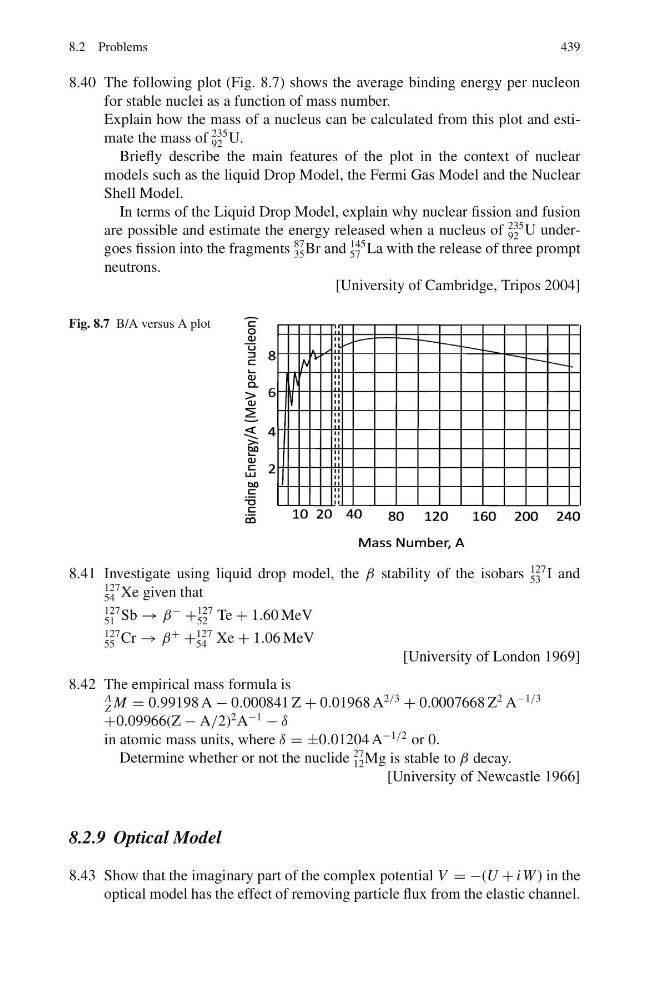
8.40 The following plot (Fig. 8.7) shows the average binding energy per nucleon
for stable nuclei as a function of mass number.
Explain how the mass of a nucleus can be calculated from this plot and estimate the mass of
235
92 U.
Briefly describe the main features of the plot in the context of nuclear
models such as the liquid Drop Model, the Fermi Gas Model and the Nuclear
Shell Model.
In terms of the Liquid Drop Model, explain why nuclear fission and fusion
are possible and estimate the energy released when a nucleus of
235
92 U undergoes fission into the fragments
87
35 Br and
145
57 La with the release of three prompt
neutrons.
[University of Cambridge, Tripos 2004]
Fig. 8.7 B/A versus A plot
8.41 Investigate using liquid drop model, the β stability of the isobars
127
53 I and
127
54 Xe given that
127
51 Sb → β
−
+
127
52 Te + 1.60 MeV
127
55 Cr → β
+
+
127
54 Xe + 1.06 MeV
[University of London 1969]
8.42 The empirical mass formula is
A
Z M = 0.99198 A − 0.000841 Z + 0.01968 A
2/3
+ 0.0007668 Z
2 A
−1/3
+0.09966(Z − A/2)
2 A
−1
− δ
in atomic mass units, where δ = ±0.01204 A
−1/2 or 0.
Determine whether or not the nuclide
27
12 Mg is stable to β decay.
[University of Newcastle 1966]
8.2.9 Optical Model
8.43 Show that the imaginary part of the complex potential V = −(U + i W ) in the
optical model has the effect of removing particle flux from the elastic channel.
439
8.40 The following plot (Fig. 8.7) shows the average binding energy per nucleon
for stable nuclei as a function of mass number.
Explain how the mass of a nucleus can be calculated from this plot and estimate the mass of
235
92 U.
Briefly describe the main features of the plot in the context of nuclear
models such as the liquid Drop Model, the Fermi Gas Model and the Nuclear
Shell Model.
In terms of the Liquid Drop Model, explain why nuclear fission and fusion
are possible and estimate the energy released when a nucleus of
235
92 U undergoes fission into the fragments
87
35 Br and
145
57 La with the release of three prompt
neutrons.
[University of Cambridge, Tripos 2004]
Fig. 8.7 B/A versus A plot
8.41 Investigate using liquid drop model, the β stability of the isobars
127
53 I and
127
54 Xe given that
127
51 Sb → β
−
+
127
52 Te + 1.60 MeV
127
55 Cr → β
+
+
127
54 Xe + 1.06 MeV
[University of London 1969]
8.42 The empirical mass formula is
A
Z M = 0.99198 A − 0.000841 Z + 0.01968 A
2/3
+ 0.0007668 Z
2 A
−1/3
+0.09966(Z − A/2)
2 A
−1
− δ
in atomic mass units, where δ = ±0.01204 A
−1/2 or 0.
Determine whether or not the nuclide
27
12 Mg is stable to β decay.
[University of Newcastle 1966]
8.2.9 Optical Model
8.43 Show that the imaginary part of the complex potential V = −(U + i W ) in the
optical model has the effect of removing particle flux from the elastic channel.