

438
8 Nuclear Physics – II
8.2.8 Liquid Drop Model
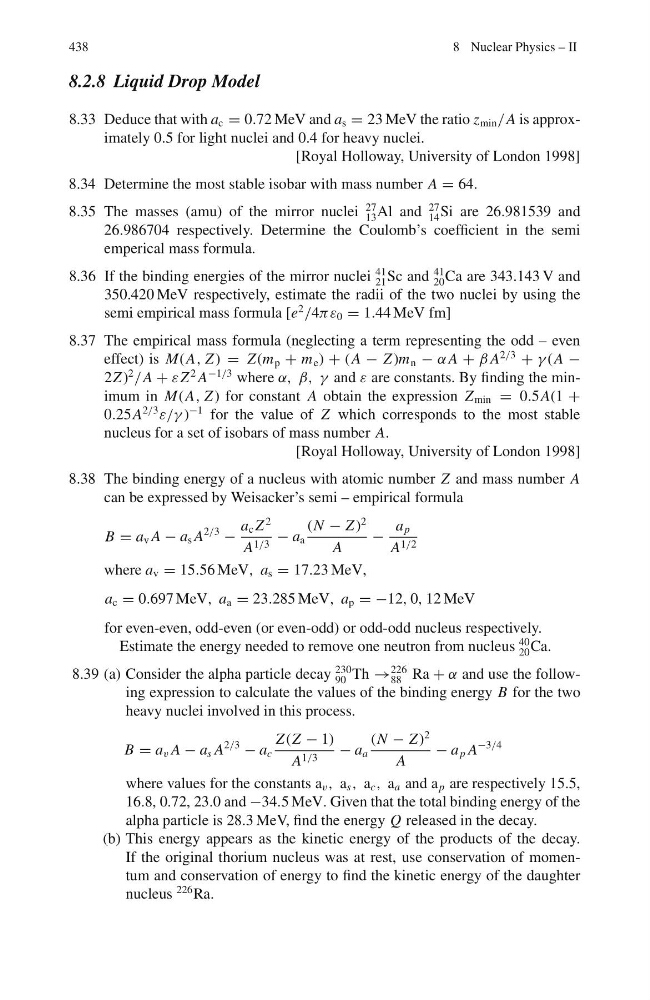
8.33 Deduce that with a c = 0.72 MeV and a s = 23 MeV the ratio z min /A is approximately 0.5 for light nuclei and 0.4 for heavy nuclei.
[Royal Holloway, University of London 1998]
8.34 Determine the most stable isobar with mass number A = 64.
8.35 The masses (amu) of the mirror nuclei
27
13 Al and
27
14 Si are 26.981539 and
26.986704 respectively. Determine the Coulomb’s coefficient in the semi
emperical mass formula.
8.36 If the binding energies of the mirror nuclei
41
21 Sc and
41
20 Ca are 343.143 V and
350.420 MeV respectively, estimate the radii of the two nuclei by using the
semi empirical mass formula [e
2
/4πε 0 = 1.44 MeV fm]
8.37 The empirical mass formula (neglecting a term representing the odd – even
effect) is M(A, Z ) = Z (m p + m e ) + ( A − Z )m n − α A + β A
2/3
+ γ ( A −
2Z )
2
/A + ε Z
2 A
−1/3 where α, β, γ and ε are constants. By finding the minimum in M(A, Z ) for constant A obtain the expression Z min = 0.5A(1 +
0.25A
2/3
ε/γ )
−1 for the value of Z which corresponds to the most stable
nucleus for a set of isobars of mass number A.
[Royal Holloway, University of London 1998]
8.38 The binding energy of a nucleus with atomic number Z and mass number A
can be expressed by Weisacker’s semi – empirical formula
B = a v A − a s A
2/3
−
a c Z
2
A 1/3 − a a
(N − Z )
2
A
−
a p
A 1/2
where a v = 15.56 MeV, a s = 17.23 MeV,
a c = 0.697 MeV, a a = 23.285 MeV, a p = −12, 0, 12 MeV
for even-even, odd-even (or even-odd) or odd-odd nucleus respectively.
Estimate the energy needed to remove one neutron from nucleus
40
20 Ca.
8.39 (a) Consider the alpha particle decay
230
90 Th →
226
88 Ra + α and use the following expression to calculate the values of the binding energy B for the two
heavy nuclei involved in this process.
B = a v A − a s A
2/3
− a c
Z (Z − 1)
A 1/3 − a a
(N − Z )
2
A
− a p A
−3/4
where values for the constants a v , a s , a c , a a and a p are respectively 15.5,
16.8, 0.72, 23.0 and −34.5 MeV. Given that the total binding energy of the
alpha particle is 28.3 MeV, find the energy Q released in the decay.
(b) This energy appears as the kinetic energy of the products of the decay.
If the original thorium nucleus was at rest, use conservation of momentum and conservation of energy to find the kinetic energy of the daughter
nucleus
226 Ra.
8 Nuclear Physics – II
8.2.8 Liquid Drop Model
8.33 Deduce that with a c = 0.72 MeV and a s = 23 MeV the ratio z min /A is approximately 0.5 for light nuclei and 0.4 for heavy nuclei.
[Royal Holloway, University of London 1998]
8.34 Determine the most stable isobar with mass number A = 64.
8.35 The masses (amu) of the mirror nuclei
27
13 Al and
27
14 Si are 26.981539 and
26.986704 respectively. Determine the Coulomb’s coefficient in the semi
emperical mass formula.
8.36 If the binding energies of the mirror nuclei
41
21 Sc and
41
20 Ca are 343.143 V and
350.420 MeV respectively, estimate the radii of the two nuclei by using the
semi empirical mass formula [e
2
/4πε 0 = 1.44 MeV fm]
8.37 The empirical mass formula (neglecting a term representing the odd – even
effect) is M(A, Z ) = Z (m p + m e ) + ( A − Z )m n − α A + β A
2/3
+ γ ( A −
2Z )
2
/A + ε Z
2 A
−1/3 where α, β, γ and ε are constants. By finding the minimum in M(A, Z ) for constant A obtain the expression Z min = 0.5A(1 +
0.25A
2/3
ε/γ )
−1 for the value of Z which corresponds to the most stable
nucleus for a set of isobars of mass number A.
[Royal Holloway, University of London 1998]
8.38 The binding energy of a nucleus with atomic number Z and mass number A
can be expressed by Weisacker’s semi – empirical formula
B = a v A − a s A
2/3
−
a c Z
2
A 1/3 − a a
(N − Z )
2
A
−
a p
A 1/2
where a v = 15.56 MeV, a s = 17.23 MeV,
a c = 0.697 MeV, a a = 23.285 MeV, a p = −12, 0, 12 MeV
for even-even, odd-even (or even-odd) or odd-odd nucleus respectively.
Estimate the energy needed to remove one neutron from nucleus
40
20 Ca.
8.39 (a) Consider the alpha particle decay
230
90 Th →
226
88 Ra + α and use the following expression to calculate the values of the binding energy B for the two
heavy nuclei involved in this process.
B = a v A − a s A
2/3
− a c
Z (Z − 1)
A 1/3 − a a
(N − Z )
2
A
− a p A
−3/4
where values for the constants a v , a s , a c , a a and a p are respectively 15.5,
16.8, 0.72, 23.0 and −34.5 MeV. Given that the total binding energy of the
alpha particle is 28.3 MeV, find the energy Q released in the decay.
(b) This energy appears as the kinetic energy of the products of the decay.
If the original thorium nucleus was at rest, use conservation of momentum and conservation of energy to find the kinetic energy of the daughter
nucleus
226 Ra.