

7.3 Solutions
425
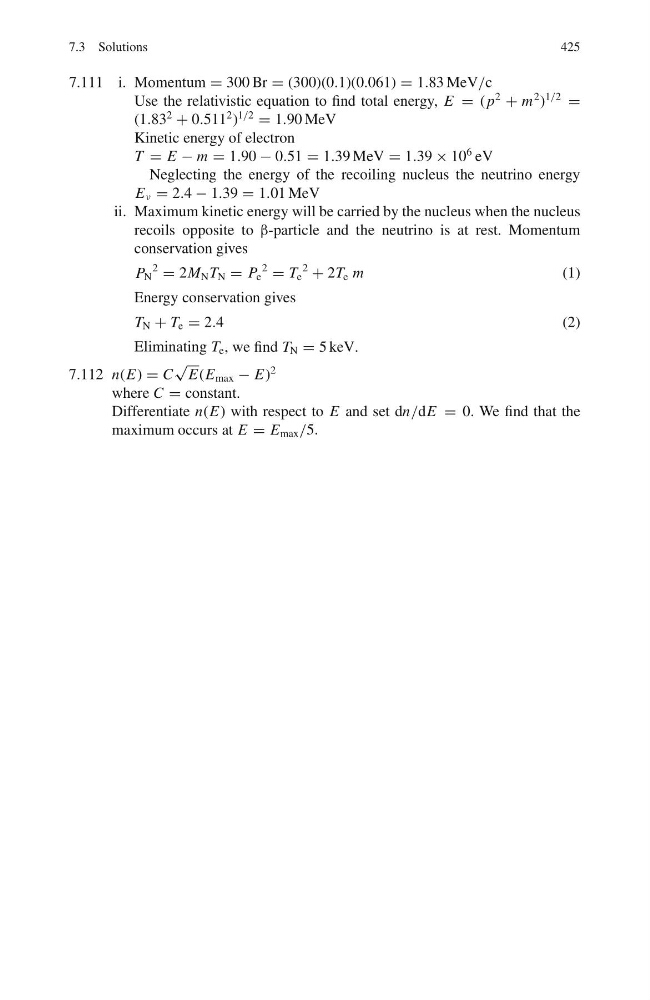
7.111 i. Momentum = 300 Br = (300)(0.1)(0.061) = 1.83 MeV/c
Use the relativistic equation to find total energy, E = ( p
2
+ m
2 )
1/2
=
(1.83
2
+ 0.511
2 )
1/2
= 1.90 MeV
Kinetic energy of electron
T = E − m = 1.90 − 0.51 = 1.39 MeV = 1.39 × 10
6 eV
Neglecting the energy of the recoiling nucleus the neutrino energy
E ν = 2.4 − 1.39 = 1.01 MeV
ii. Maximum kinetic energy will be carried by the nucleus when the nucleus
recoils opposite to β-particle and the neutrino is at rest. Momentum
conservation gives
P N
2
= 2M N T N = P e
2
= T e
2
+ 2T e m
(1)
Energy conservation gives
T N + T e = 2.4
( 2 )
Eliminating T e , we find T N = 5 keV.
7.112 n(E) = C
√
E(E max − E)
2
where C = constant.
Differentiate n(E) with respect to E and set dn/dE = 0. We find that the
maximum occurs at E = E max /5.
425
7.111 i. Momentum = 300 Br = (300)(0.1)(0.061) = 1.83 MeV/c
Use the relativistic equation to find total energy, E = ( p
2
+ m
2 )
1/2
=
(1.83
2
+ 0.511
2 )
1/2
= 1.90 MeV
Kinetic energy of electron
T = E − m = 1.90 − 0.51 = 1.39 MeV = 1.39 × 10
6 eV
Neglecting the energy of the recoiling nucleus the neutrino energy
E ν = 2.4 − 1.39 = 1.01 MeV
ii. Maximum kinetic energy will be carried by the nucleus when the nucleus
recoils opposite to β-particle and the neutrino is at rest. Momentum
conservation gives
P N
2
= 2M N T N = P e
2
= T e
2
+ 2T e m
(1)
Energy conservation gives
T N + T e = 2.4
( 2 )
Eliminating T e , we find T N = 5 keV.
7.112 n(E) = C
√
E(E max − E)
2
where C = constant.
Differentiate n(E) with respect to E and set dn/dE = 0. We find that the
maximum occurs at E = E max /5.