

424
7 Nuclear Physics – I
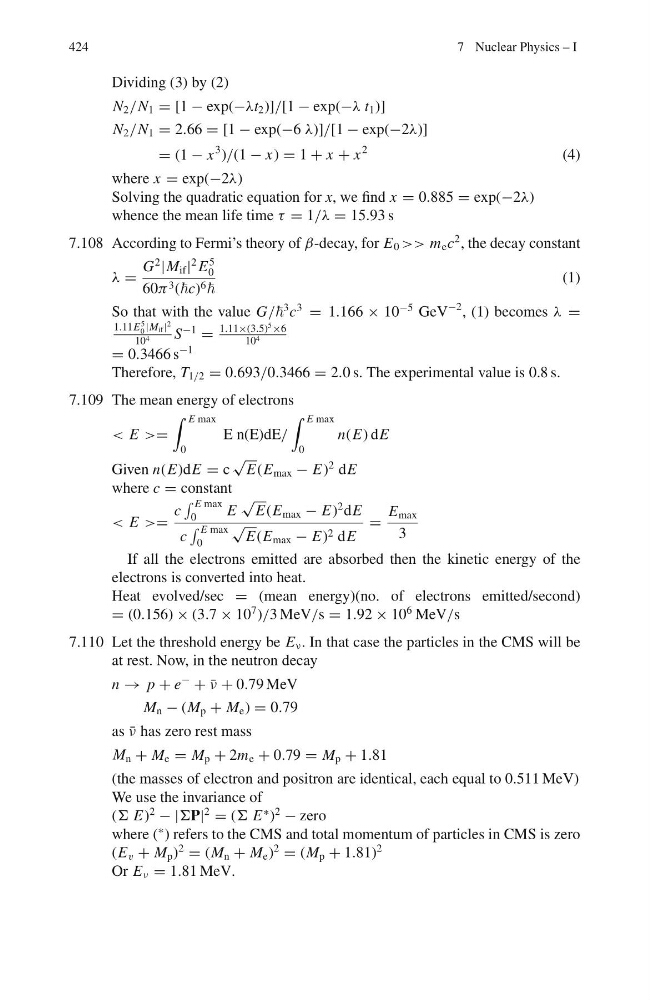
Dividing (3) by (2)
N 2 /N 1 = [1 − exp(−λt 2 )]/[1 − exp(−λ t 1 )]
N 2 /N 1 = 2.66 = [1 − exp(−6 λ)]/[1 − exp(−2λ)]
= (1 − x
3 )/(1 − x) = 1 + x + x
2
(4)
where x = exp(−2λ)
Solving the quadratic equation for x, we find x = 0.885 = exp(−2λ)
whence the mean life time τ = 1/λ = 15.93 s
7.108 According to Fermi’s theory of β-decay, for E 0 >> m e c
2 , the decay constant
λ =
G
2
|M if |
2 E
5
0
60π 3 (c) 6
(1)
So that with the value G/
3 c
3
= 1.166 × 10
−5 GeV
−2 , (1) becomes λ =
1.11E
5
0 |M if |
2
10 4
S
−1
=
1.11×(3.5)
5 ×6
10 4
= 0.3466 s
−1
Therefore, T 1/2 = 0.693/0.3466 = 2.0 s. The experimental value is 0.8 s.
7.109 The mean energy of electrons
< E >=
E max
0
E n(E)dE/
E max
0
n(E) dE
Given n(E)dE = c
√
E(E max − E)
2 dE
where c = constant
< E >=
c
E max
0
E
√
E(E max − E)
2 dE
c
E max
0
√
E(E max − E) 2 dE
=
E max
3
If all the electrons emitted are absorbed then the kinetic energy of the
electrons is converted into heat.
Heat evolved/sec = (mean energy)(no. of electrons emitted/second)
= (0.156) × (3.7 × 10
7 )/3 MeV/s = 1.92 × 10
6 MeV/s
7.110 Let the threshold energy be E ν . In that case the particles in the CMS will be
at rest. Now, in the neutron decay
n → p + e
−
+ ¯
ν + 0.79 MeV
M n − (M p + M e ) = 0.79
as ¯
ν has zero rest mass
M n + M e = M p + 2m e + 0.79 = M p + 1.81
(the masses of electron and positron are identical, each equal to 0.511 MeV)
We use the invariance of
(Σ E)
2
− |ΣP|
2
= (Σ E
∗ )
2
− zero
where (
∗ ) refers to the CMS and total momentum of particles in CMS is zero
(E v + M p )
2
= (M n + M e )
2
= (M p + 1.81)
2
Or E ν = 1.81 MeV.
7 Nuclear Physics – I
Dividing (3) by (2)
N 2 /N 1 = [1 − exp(−λt 2 )]/[1 − exp(−λ t 1 )]
N 2 /N 1 = 2.66 = [1 − exp(−6 λ)]/[1 − exp(−2λ)]
= (1 − x
3 )/(1 − x) = 1 + x + x
2
(4)
where x = exp(−2λ)
Solving the quadratic equation for x, we find x = 0.885 = exp(−2λ)
whence the mean life time τ = 1/λ = 15.93 s
7.108 According to Fermi’s theory of β-decay, for E 0 >> m e c
2 , the decay constant
λ =
G
2
|M if |
2 E
5
0
60π 3 (c) 6
(1)
So that with the value G/
3 c
3
= 1.166 × 10
−5 GeV
−2 , (1) becomes λ =
1.11E
5
0 |M if |
2
10 4
S
−1
=
1.11×(3.5)
5 ×6
10 4
= 0.3466 s
−1
Therefore, T 1/2 = 0.693/0.3466 = 2.0 s. The experimental value is 0.8 s.
7.109 The mean energy of electrons
< E >=
E max
0
E n(E)dE/
E max
0
n(E) dE
Given n(E)dE = c
√
E(E max − E)
2 dE
where c = constant
< E >=
c
E max
0
E
√
E(E max − E)
2 dE
c
E max
0
√
E(E max − E) 2 dE
=
E max
3
If all the electrons emitted are absorbed then the kinetic energy of the
electrons is converted into heat.
Heat evolved/sec = (mean energy)(no. of electrons emitted/second)
= (0.156) × (3.7 × 10
7 )/3 MeV/s = 1.92 × 10
6 MeV/s
7.110 Let the threshold energy be E ν . In that case the particles in the CMS will be
at rest. Now, in the neutron decay
n → p + e
−
+ ¯
ν + 0.79 MeV
M n − (M p + M e ) = 0.79
as ¯
ν has zero rest mass
M n + M e = M p + 2m e + 0.79 = M p + 1.81
(the masses of electron and positron are identical, each equal to 0.511 MeV)
We use the invariance of
(Σ E)
2
− |ΣP|
2
= (Σ E
∗ )
2
− zero
where (
∗ ) refers to the CMS and total momentum of particles in CMS is zero
(E v + M p )
2
= (M n + M e )
2
= (M p + 1.81)
2
Or E ν = 1.81 MeV.