

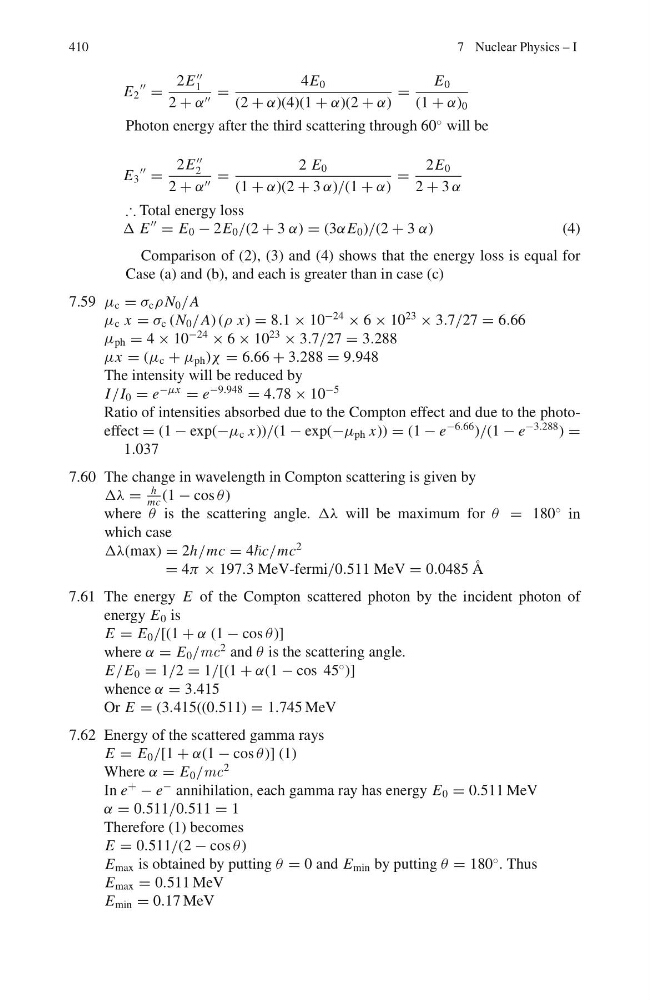
410
7 Nuclear Physics – I
E 2
=
2E
1
2 + α =
4E 0
(2 + α)(4)(1 + α)(2 + α)
=
E 0
(1 + α) 0
Photon energy after the third scattering through 60
◦ will be
E 3
=
2E
2
2 + α =
2 E 0
(1 + α)(2 + 3 α)/(1 + α)
=
2E 0
2 + 3 α
∴ Total energy loss
Δ E
= E 0 − 2E 0 /(2 + 3 α) = (3α E 0 )/(2 + 3 α)
( 4 )
Comparison of (2), (3) and (4) shows that the energy loss is equal for
Case (a) and (b), and each is greater than in case (c)
7.59 μ c = σ c ρ N 0 /A
μ c x = σ c (N 0 /A) (ρ x) = 8.1 × 10
−24
× 6 × 10
23
× 3.7/27 = 6.66
μ ph = 4 × 10
−24
× 6 × 10
23
× 3.7/27 = 3.288
μx = (μ c + μ ph )χ = 6.66 + 3.288 = 9.948
The intensity will be reduced by
I /I 0 = e
−μx
= e
−9.948
= 4.78 × 10
−5
Ratio of intensities absorbed due to the Compton effect and due to the photoeffect = (1 − exp(−μ c x))/(1 − exp(−μ ph x)) = (1 − e
−6.66 )/(1 − e
−3.288 ) =
1.037
7.60 The change in wavelength in Compton scattering is given by
Δλ =
h
mc
(1 − cos θ)
where θ is the scattering angle. Δλ will be maximum for θ = 180
◦ in
which case
Δλ(max) = 2h/mc = 4c/mc
2
= 4π × 197.3 MeV-fermi/0.511 MeV = 0.0485 ˚
A
7.61 The energy E of the Compton scattered photon by the incident photon of
energy E 0 is
E = E 0 /[(1 + α (1 − cos θ)]
where α = E 0 /mc
2 and θ is the scattering angle.
E/E 0 = 1/2 = 1/[(1 + α(1 − cos 45
◦ )]
whence α = 3.415
Or E = (3.415((0.511) = 1.745 MeV
7.62 Energy of the scattered gamma rays
E = E 0 /[1 + α(1 − cos θ)] (1)
Where α = E 0 /mc
2
In e
+
− e
− annihilation, each gamma ray has energy E 0 = 0.511 MeV
α = 0.511/0.511 = 1
Therefore (1) becomes
E = 0.511/(2 − cos θ )
E max is obtained by putting θ = 0 and E min by putting θ = 180
◦ . Thus
E max = 0.511 MeV
E min = 0.17 MeV
7 Nuclear Physics – I
E 2
=
2E
1
2 + α =
4E 0
(2 + α)(4)(1 + α)(2 + α)
=
E 0
(1 + α) 0
Photon energy after the third scattering through 60
◦ will be
E 3
=
2E
2
2 + α =
2 E 0
(1 + α)(2 + 3 α)/(1 + α)
=
2E 0
2 + 3 α
∴ Total energy loss
Δ E
= E 0 − 2E 0 /(2 + 3 α) = (3α E 0 )/(2 + 3 α)
( 4 )
Comparison of (2), (3) and (4) shows that the energy loss is equal for
Case (a) and (b), and each is greater than in case (c)
7.59 μ c = σ c ρ N 0 /A
μ c x = σ c (N 0 /A) (ρ x) = 8.1 × 10
−24
× 6 × 10
23
× 3.7/27 = 6.66
μ ph = 4 × 10
−24
× 6 × 10
23
× 3.7/27 = 3.288
μx = (μ c + μ ph )χ = 6.66 + 3.288 = 9.948
The intensity will be reduced by
I /I 0 = e
−μx
= e
−9.948
= 4.78 × 10
−5
Ratio of intensities absorbed due to the Compton effect and due to the photoeffect = (1 − exp(−μ c x))/(1 − exp(−μ ph x)) = (1 − e
−6.66 )/(1 − e
−3.288 ) =
1.037
7.60 The change in wavelength in Compton scattering is given by
Δλ =
h
mc
(1 − cos θ)
where θ is the scattering angle. Δλ will be maximum for θ = 180
◦ in
which case
Δλ(max) = 2h/mc = 4c/mc
2
= 4π × 197.3 MeV-fermi/0.511 MeV = 0.0485 ˚
A
7.61 The energy E of the Compton scattered photon by the incident photon of
energy E 0 is
E = E 0 /[(1 + α (1 − cos θ)]
where α = E 0 /mc
2 and θ is the scattering angle.
E/E 0 = 1/2 = 1/[(1 + α(1 − cos 45
◦ )]
whence α = 3.415
Or E = (3.415((0.511) = 1.745 MeV
7.62 Energy of the scattered gamma rays
E = E 0 /[1 + α(1 − cos θ)] (1)
Where α = E 0 /mc
2
In e
+
− e
− annihilation, each gamma ray has energy E 0 = 0.511 MeV
α = 0.511/0.511 = 1
Therefore (1) becomes
E = 0.511/(2 − cos θ )
E max is obtained by putting θ = 0 and E min by putting θ = 180
◦ . Thus
E max = 0.511 MeV
E min = 0.17 MeV