

7.3 Solutions
409
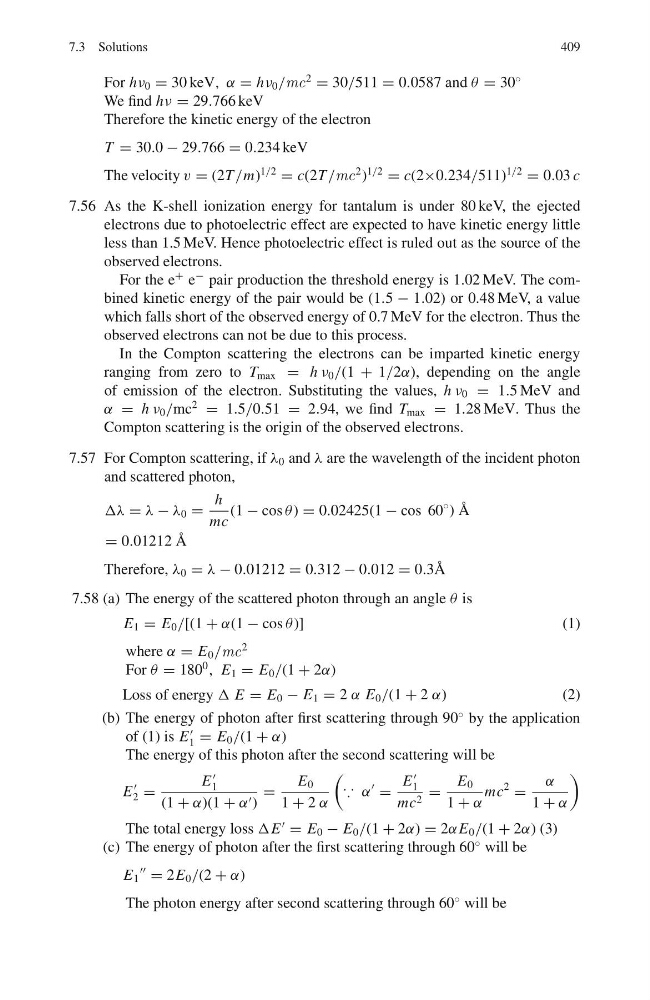
For hν 0 = 30 keV, α = hν 0 /mc
2
= 30/511 = 0.0587 and θ = 30
◦
We find hν = 29.766 keV
Therefore the kinetic energy of the electron
T = 30.0 − 29.766 = 0.234 keV
The velocity v = (2T /m)
1/2
= c(2T /mc
2 )
1/2
= c(2×0.234/511)
1/2
= 0.03 c
7.56 As the K-shell ionization energy for tantalum is under 80 keV, the ejected
electrons due to photoelectric effect are expected to have kinetic energy little
less than 1.5 MeV. Hence photoelectric effect is ruled out as the source of the
observed electrons.
For the e
+ e
− pair production the threshold energy is 1.02 MeV. The combined kinetic energy of the pair would be (1.5 − 1.02) or 0.48 MeV, a value
which falls short of the observed energy of 0.7 MeV for the electron. Thus the
observed electrons can not be due to this process.
In the Compton scattering the electrons can be imparted kinetic energy
ranging from zero to T max = h ν 0 /(1 + 1/2α), depending on the angle
of emission of the electron. Substituting the values, h ν 0 = 1.5 MeV and
α = h ν 0 /mc
2
= 1.5/0.51 = 2.94, we find T max = 1.28 MeV. Thus the
Compton scattering is the origin of the observed electrons.
7.57 For Compton scattering, if λ 0 and λ are the wavelength of the incident photon
and scattered photon,
Δλ = λ − λ 0 =
h
mc
(1 − cos θ) = 0.02425(1 − cos 60
◦ ) ˚
A
= 0.01212 ˚
A
Therefore, λ 0 = λ − 0.01212 = 0.312 − 0.012 = 0.3 ˚
A
7.58 (a) The energy of the scattered photon through an angle θ is
E 1 = E 0 /[(1 + α(1 − cos θ)]
(1)
where α = E 0 /mc
2
For θ = 180
0
, E 1 = E 0 /(1 + 2α)
Loss of energy Δ E = E 0 − E 1 = 2 α E 0 /(1 + 2 α)
( 2 )
(b) The energy of photon after first scattering through 90
◦ by the application
of (1) is E
1 = E 0 /(1 + α)
The energy of this photon after the second scattering will be
E
2 =
E
1
(1 + α)(1 + α )
=
E 0
1 + 2 α
∵ α
=
E
1
mc 2 =
E 0
1 + α
mc
2
=
α
1 + α
The total energy loss ΔE
= E 0 − E 0 /(1 + 2α) = 2α E 0 /(1 + 2α) (3)
(c) The energy of photon after the first scattering through 60
◦ will be
E 1
= 2E 0 /(2 + α)
The photon energy after second scattering through 60
◦ will be
409
For hν 0 = 30 keV, α = hν 0 /mc
2
= 30/511 = 0.0587 and θ = 30
◦
We find hν = 29.766 keV
Therefore the kinetic energy of the electron
T = 30.0 − 29.766 = 0.234 keV
The velocity v = (2T /m)
1/2
= c(2T /mc
2 )
1/2
= c(2×0.234/511)
1/2
= 0.03 c
7.56 As the K-shell ionization energy for tantalum is under 80 keV, the ejected
electrons due to photoelectric effect are expected to have kinetic energy little
less than 1.5 MeV. Hence photoelectric effect is ruled out as the source of the
observed electrons.
For the e
+ e
− pair production the threshold energy is 1.02 MeV. The combined kinetic energy of the pair would be (1.5 − 1.02) or 0.48 MeV, a value
which falls short of the observed energy of 0.7 MeV for the electron. Thus the
observed electrons can not be due to this process.
In the Compton scattering the electrons can be imparted kinetic energy
ranging from zero to T max = h ν 0 /(1 + 1/2α), depending on the angle
of emission of the electron. Substituting the values, h ν 0 = 1.5 MeV and
α = h ν 0 /mc
2
= 1.5/0.51 = 2.94, we find T max = 1.28 MeV. Thus the
Compton scattering is the origin of the observed electrons.
7.57 For Compton scattering, if λ 0 and λ are the wavelength of the incident photon
and scattered photon,
Δλ = λ − λ 0 =
h
mc
(1 − cos θ) = 0.02425(1 − cos 60
◦ ) ˚
A
= 0.01212 ˚
A
Therefore, λ 0 = λ − 0.01212 = 0.312 − 0.012 = 0.3 ˚
A
7.58 (a) The energy of the scattered photon through an angle θ is
E 1 = E 0 /[(1 + α(1 − cos θ)]
(1)
where α = E 0 /mc
2
For θ = 180
0
, E 1 = E 0 /(1 + 2α)
Loss of energy Δ E = E 0 − E 1 = 2 α E 0 /(1 + 2 α)
( 2 )
(b) The energy of photon after first scattering through 90
◦ by the application
of (1) is E
1 = E 0 /(1 + α)
The energy of this photon after the second scattering will be
E
2 =
E
1
(1 + α)(1 + α )
=
E 0
1 + 2 α
∵ α
=
E
1
mc 2 =
E 0
1 + α
mc
2
=
α
1 + α
The total energy loss ΔE
= E 0 − E 0 /(1 + 2α) = 2α E 0 /(1 + 2α) (3)
(c) The energy of photon after the first scattering through 60
◦ will be
E 1
= 2E 0 /(2 + α)
The photon energy after second scattering through 60
◦ will be