

7.3 Solutions
407
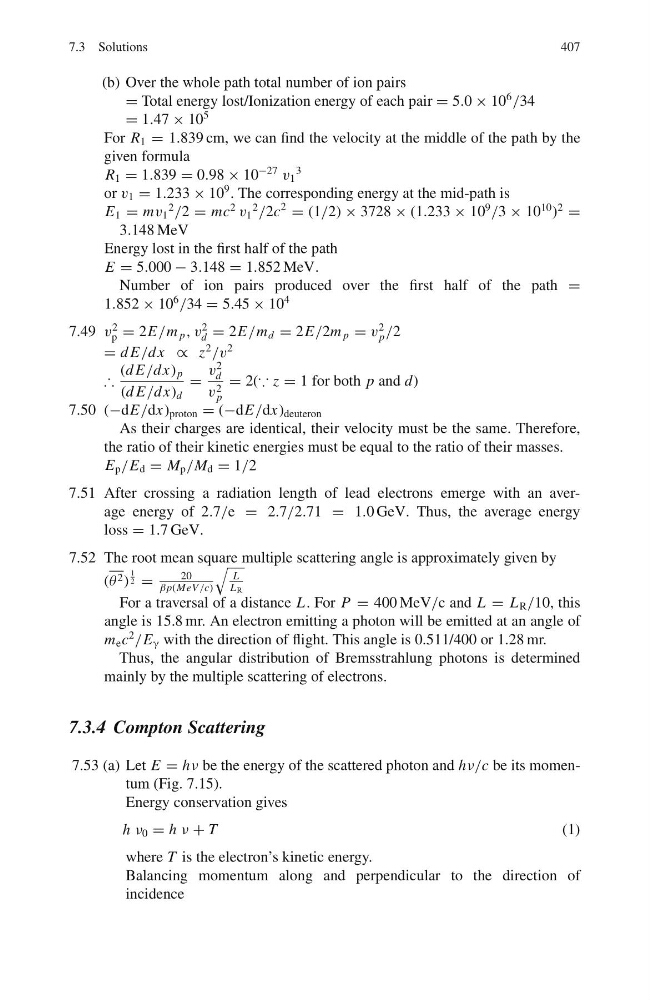
(b) Over the whole path total number of ion pairs
= Total energy lost/Ionization energy of each pair = 5.0 × 10
6
/34
= 1.47 × 10
5
For R 1 = 1.839 cm, we can find the velocity at the middle of the path by the
given formula
R 1 = 1.839 = 0.98 × 10
−27
v 1
3
or v 1 = 1.233 × 10
9 . The corresponding energy at the mid-path is
E 1 = mv 1
2
/2 = mc
2
v 1
2
/2c
2
= (1/2) × 3728 × (1.233 × 10
9
/3 × 10
10 )
2
=
3.148 MeV
Energy lost in the first half of the path
E = 5.000 − 3.148 = 1.852 MeV.
Number of ion pairs produced over the first half of the path =
1.852 × 10
6
/34 = 5.45 × 10
4
7.49 v
2
p = 2E/m p , v
2
d = 2E/m d = 2E/2m p = v
2
p /2
= d E/dx ∝ z
2
/v
2
∴
(d E/dx) p
(d E/dx) d
=
v
2
d
v 2
p
= 2(∵ z = 1 for both p and d)
7.50 (−dE/dx) proton = (−dE/dx) deuteron
As their charges are identical, their velocity must be the same. Therefore,
the ratio of their kinetic energies must be equal to the ratio of their masses.
E p /E d = M p /M d = 1/2
7.51 After crossing a radiation length of lead electrons emerge with an average energy of 2.7/e = 2.7/2.71 = 1.0 GeV. Thus, the average energy
loss = 1.7 GeV.
7.52 The root mean square multiple scattering angle is approximately given by
(θ 2 )
1
2 =
20
βp(MeV/c)
L
LR
For a traversal of a distance L. For P = 400 MeV/c and L = L R /10, this
angle is 15.8 mr. An electron emitting a photon will be emitted at an angle of
m e c
2
/E γ with the direction of flight. This angle is 0.511/400 or 1.28 mr.
Thus, the angular distribution of Bremsstrahlung photons is determined
mainly by the multiple scattering of electrons.
7.3.4 Compton Scattering
7.53 (a) Let E = hν be the energy of the scattered photon and hν/c be its momentum (Fig. 7.15).
Energy conservation gives
h ν 0 = h ν + T
(1)
where T is the electron’s kinetic energy.
Balancing momentum along and perpendicular to the direction of
incidence
407
(b) Over the whole path total number of ion pairs
= Total energy lost/Ionization energy of each pair = 5.0 × 10
6
/34
= 1.47 × 10
5
For R 1 = 1.839 cm, we can find the velocity at the middle of the path by the
given formula
R 1 = 1.839 = 0.98 × 10
−27
v 1
3
or v 1 = 1.233 × 10
9 . The corresponding energy at the mid-path is
E 1 = mv 1
2
/2 = mc
2
v 1
2
/2c
2
= (1/2) × 3728 × (1.233 × 10
9
/3 × 10
10 )
2
=
3.148 MeV
Energy lost in the first half of the path
E = 5.000 − 3.148 = 1.852 MeV.
Number of ion pairs produced over the first half of the path =
1.852 × 10
6
/34 = 5.45 × 10
4
7.49 v
2
p = 2E/m p , v
2
d = 2E/m d = 2E/2m p = v
2
p /2
= d E/dx ∝ z
2
/v
2
∴
(d E/dx) p
(d E/dx) d
=
v
2
d
v 2
p
= 2(∵ z = 1 for both p and d)
7.50 (−dE/dx) proton = (−dE/dx) deuteron
As their charges are identical, their velocity must be the same. Therefore,
the ratio of their kinetic energies must be equal to the ratio of their masses.
E p /E d = M p /M d = 1/2
7.51 After crossing a radiation length of lead electrons emerge with an average energy of 2.7/e = 2.7/2.71 = 1.0 GeV. Thus, the average energy
loss = 1.7 GeV.
7.52 The root mean square multiple scattering angle is approximately given by
(θ 2 )
1
2 =
20
βp(MeV/c)
L
LR
For a traversal of a distance L. For P = 400 MeV/c and L = L R /10, this
angle is 15.8 mr. An electron emitting a photon will be emitted at an angle of
m e c
2
/E γ with the direction of flight. This angle is 0.511/400 or 1.28 mr.
Thus, the angular distribution of Bremsstrahlung photons is determined
mainly by the multiple scattering of electrons.
7.3.4 Compton Scattering
7.53 (a) Let E = hν be the energy of the scattered photon and hν/c be its momentum (Fig. 7.15).
Energy conservation gives
h ν 0 = h ν + T
(1)
where T is the electron’s kinetic energy.
Balancing momentum along and perpendicular to the direction of
incidence