

406
7 Nuclear Physics – I
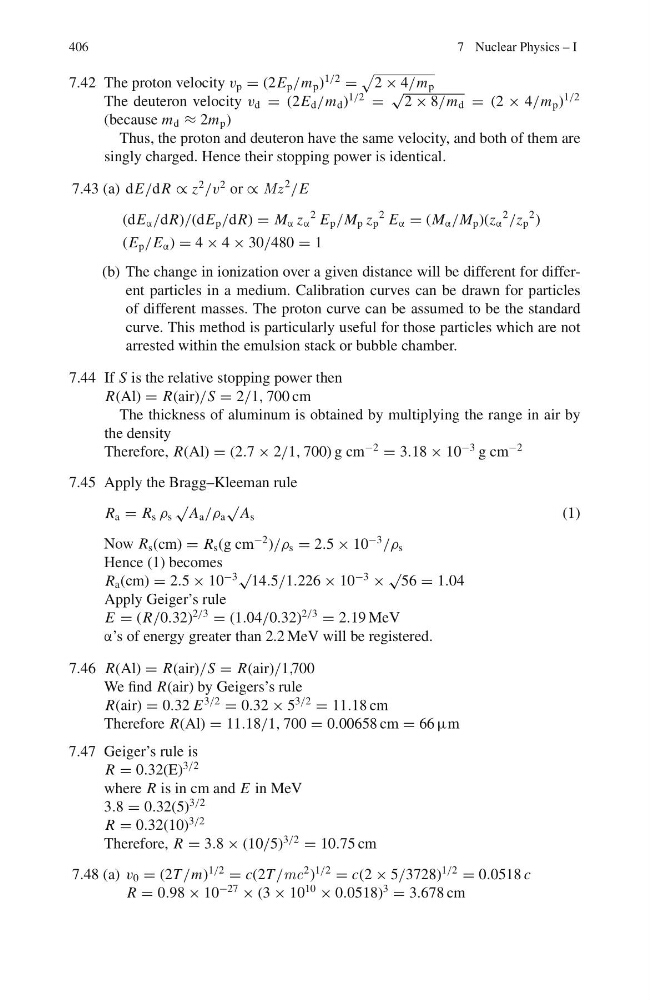
7.42 The proton velocity v p = (2E p /m p )
1/2
=
2 × 4/m p
The deuteron velocity v d = (2E d /m d )
1/2
=
√
2 × 8/m d = (2 × 4/m p )
1/2
(because m d ≈ 2m p )
Thus, the proton and deuteron have the same velocity, and both of them are
singly charged. Hence their stopping power is identical.
7.43 (a) dE/dR ∝ z
2
/v
2 or ∝ Mz
2
/E
(dE α /dR)/(dE p /dR) = M α z α
2 E p /M p z p
2 E α = (M α /M p )(z α
2
/z p
2 )
(E p /E α ) = 4 × 4 × 30/480 = 1
(b) The change in ionization over a given distance will be different for different particles in a medium. Calibration curves can be drawn for particles
of different masses. The proton curve can be assumed to be the standard
curve. This method is particularly useful for those particles which are not
arrested within the emulsion stack or bubble chamber.
7.44 If S is the relative stopping power then
R(Al) = R(air)/S = 2/1, 700 cm
The thickness of aluminum is obtained by multiplying the range in air by
the density
Therefore, R(Al) = (2.7 × 2/1, 700) g cm
−2
= 3.18 × 10
−3 g cm
−2
7.45 Apply the Bragg–Kleeman rule
R a = R s ρ s
√
A a /ρ a
√
A s
(1)
Now R s (cm) = R s (g cm
−2 )/ρ s = 2.5 × 10
−3
/ρ s
Hence (1) becomes
R a (cm) = 2.5 × 10
−3 √
14.5/1.226 × 10
−3
×
√
56 = 1.04
Apply Geiger’s rule
E = (R/0.32)
2/3
= (1.04/0.32)
2/3
= 2.19 MeV
α’s of energy greater than 2.2 MeV will be registered.
7.46 R(Al) = R(air)/S = R(air)/1,700
We find R(air) by Geigers’s rule
R(air) = 0.32 E
3/2
= 0.32 × 5
3/2
= 11.18 cm
Therefore R(Al) = 11.18/1, 700 = 0.00658 cm = 66 μm
7.47 Geiger’s rule is
R = 0.32(E)
3/2
where R is in cm and E in MeV
3.8 = 0.32(5)
3/2
R = 0.32(10)
3/2
Therefore, R = 3.8 × (10/5)
3/2
= 10.75 cm
7.48 (a) v 0 = (2T /m)
1/2
= c(2T /mc
2 )
1/2
= c(2 × 5/3728)
1/2
= 0.0518 c
R = 0.98 × 10
−27
× (3 × 10
10
× 0.0518)
3
= 3.678 cm
7 Nuclear Physics – I
7.42 The proton velocity v p = (2E p /m p )
1/2
=
2 × 4/m p
The deuteron velocity v d = (2E d /m d )
1/2
=
√
2 × 8/m d = (2 × 4/m p )
1/2
(because m d ≈ 2m p )
Thus, the proton and deuteron have the same velocity, and both of them are
singly charged. Hence their stopping power is identical.
7.43 (a) dE/dR ∝ z
2
/v
2 or ∝ Mz
2
/E
(dE α /dR)/(dE p /dR) = M α z α
2 E p /M p z p
2 E α = (M α /M p )(z α
2
/z p
2 )
(E p /E α ) = 4 × 4 × 30/480 = 1
(b) The change in ionization over a given distance will be different for different particles in a medium. Calibration curves can be drawn for particles
of different masses. The proton curve can be assumed to be the standard
curve. This method is particularly useful for those particles which are not
arrested within the emulsion stack or bubble chamber.
7.44 If S is the relative stopping power then
R(Al) = R(air)/S = 2/1, 700 cm
The thickness of aluminum is obtained by multiplying the range in air by
the density
Therefore, R(Al) = (2.7 × 2/1, 700) g cm
−2
= 3.18 × 10
−3 g cm
−2
7.45 Apply the Bragg–Kleeman rule
R a = R s ρ s
√
A a /ρ a
√
A s
(1)
Now R s (cm) = R s (g cm
−2 )/ρ s = 2.5 × 10
−3
/ρ s
Hence (1) becomes
R a (cm) = 2.5 × 10
−3 √
14.5/1.226 × 10
−3
×
√
56 = 1.04
Apply Geiger’s rule
E = (R/0.32)
2/3
= (1.04/0.32)
2/3
= 2.19 MeV
α’s of energy greater than 2.2 MeV will be registered.
7.46 R(Al) = R(air)/S = R(air)/1,700
We find R(air) by Geigers’s rule
R(air) = 0.32 E
3/2
= 0.32 × 5
3/2
= 11.18 cm
Therefore R(Al) = 11.18/1, 700 = 0.00658 cm = 66 μm
7.47 Geiger’s rule is
R = 0.32(E)
3/2
where R is in cm and E in MeV
3.8 = 0.32(5)
3/2
R = 0.32(10)
3/2
Therefore, R = 3.8 × (10/5)
3/2
= 10.75 cm
7.48 (a) v 0 = (2T /m)
1/2
= c(2T /mc
2 )
1/2
= c(2 × 5/3728)
1/2
= 0.0518 c
R = 0.98 × 10
−27
× (3 × 10
10
× 0.0518)
3
= 3.678 cm