

336
6 Special Theory of Relativity
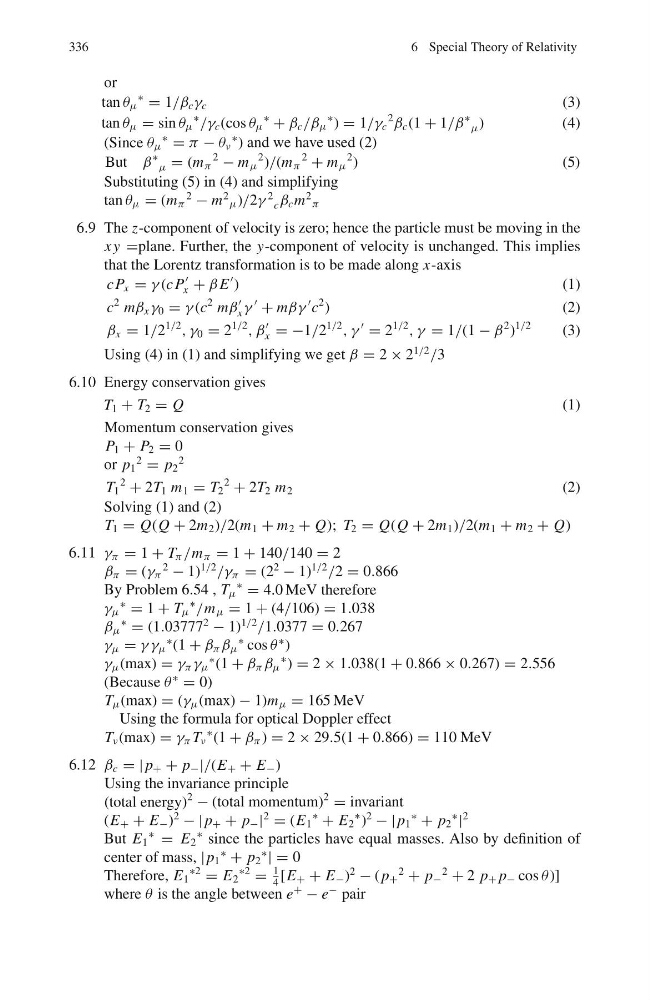
or
tan θ μ
∗
= 1/β c γ c
(3)
tan θ μ = sin θ μ
∗
/γ c (cos θ μ
∗
+ β c /β μ
∗ ) = 1/γ c
2
β c (1 + 1/β
∗ μ )
( 4 )
(Since θ μ
∗
= π − θ ν
∗ ) and we have used (2)
But β
∗ μ = (m π
2
− m μ
2 )/(m π
2
+ m μ
2 )
( 5 )
Substituting (5) in (4) and simplifying
tan θ μ = (m π
2
− m
2 μ )/2γ
2
c β c m
2 π
6.9 The z-component of velocity is zero; hence the particle must be moving in the
x y =plane. Further, the y-component of velocity is unchanged. This implies
that the Lorentz transformation is to be made along x-axis
cP x = γ (cP
x + β E
)
( 1 )
c
2 mβ x γ 0 = γ (c
2 mβ
x γ
+ mβγ
c
2 )
( 2 )
β x = 1/2
1/2
, γ 0 = 2
1/2
, β
x = −1/2
1/2
, γ
= 2
1/2
, γ = 1/(1 − β
2 )
1/2
(3)
Using (4) in (1) and simplifying we get β = 2 × 2
1/2
/3
6.10 Energy conservation gives
T 1 + T 2 = Q
(1)
Momentum conservation gives
P 1 + P 2 = 0
or p 1
2
= p 2
2
T 1
2
+ 2T 1 m 1 = T 2
2
+ 2T 2 m 2
(2)
Solving (1) and (2)
T 1 = Q(Q + 2m 2 )/2(m 1 + m 2 + Q); T 2 = Q(Q + 2m 1 )/2(m 1 + m 2 + Q)
6.11 γ π = 1 + T π /m π = 1 + 140/140 = 2
β π = (γ π
2
− 1)
1/2
/γ π = (2
2
− 1)
1/2
/2 = 0.866
By Problem 6.54 , T μ
∗
= 4.0 MeV therefore
γ μ
∗
= 1 + T μ
∗
/m μ = 1 + (4/106) = 1.038
β μ
∗
= (1.03777
2
− 1)
1/2
/1.0377 = 0.267
γ μ = γ γ μ
∗ (1 + β π β μ
∗ cos θ
∗ )
γ μ (max) = γ π γ μ
∗ (1 + β π β μ
∗ ) = 2 × 1.038(1 + 0.866 × 0.267) = 2.556
(Because θ
∗
= 0)
T μ (max) = (γ μ (max) − 1)m μ = 165 MeV
Using the formula for optical Doppler effect
T ν (max) = γ π T ν
∗ (1 + β π ) = 2 × 29.5(1 + 0.866) = 110 MeV
6.12 β c = |p + + p − |/(E + + E − )
Using the invariance principle
(total energy)
2
− (total momentum)
2
= invariant
(E + + E − )
2
− |p + + p − |
2
= (E 1
∗
+ E 2
∗ )
2
− |p 1
∗
+ p 2
∗
|
2
But E 1
∗
= E 2
∗ since the particles have equal masses. Also by definition of
center of mass, | p 1
∗
+ p 2
∗
| = 0
Therefore, E 1
∗2
= E 2
∗2
=
1
4
[E + + E − )
2
− ( p +
2
+ p −
2
+ 2 p + p − cos θ )]
where θ is the angle between e
+
− e
− pair
6 Special Theory of Relativity
or
tan θ μ
∗
= 1/β c γ c
(3)
tan θ μ = sin θ μ
∗
/γ c (cos θ μ
∗
+ β c /β μ
∗ ) = 1/γ c
2
β c (1 + 1/β
∗ μ )
( 4 )
(Since θ μ
∗
= π − θ ν
∗ ) and we have used (2)
But β
∗ μ = (m π
2
− m μ
2 )/(m π
2
+ m μ
2 )
( 5 )
Substituting (5) in (4) and simplifying
tan θ μ = (m π
2
− m
2 μ )/2γ
2
c β c m
2 π
6.9 The z-component of velocity is zero; hence the particle must be moving in the
x y =plane. Further, the y-component of velocity is unchanged. This implies
that the Lorentz transformation is to be made along x-axis
cP x = γ (cP
x + β E
)
( 1 )
c
2 mβ x γ 0 = γ (c
2 mβ
x γ
+ mβγ
c
2 )
( 2 )
β x = 1/2
1/2
, γ 0 = 2
1/2
, β
x = −1/2
1/2
, γ
= 2
1/2
, γ = 1/(1 − β
2 )
1/2
(3)
Using (4) in (1) and simplifying we get β = 2 × 2
1/2
/3
6.10 Energy conservation gives
T 1 + T 2 = Q
(1)
Momentum conservation gives
P 1 + P 2 = 0
or p 1
2
= p 2
2
T 1
2
+ 2T 1 m 1 = T 2
2
+ 2T 2 m 2
(2)
Solving (1) and (2)
T 1 = Q(Q + 2m 2 )/2(m 1 + m 2 + Q); T 2 = Q(Q + 2m 1 )/2(m 1 + m 2 + Q)
6.11 γ π = 1 + T π /m π = 1 + 140/140 = 2
β π = (γ π
2
− 1)
1/2
/γ π = (2
2
− 1)
1/2
/2 = 0.866
By Problem 6.54 , T μ
∗
= 4.0 MeV therefore
γ μ
∗
= 1 + T μ
∗
/m μ = 1 + (4/106) = 1.038
β μ
∗
= (1.03777
2
− 1)
1/2
/1.0377 = 0.267
γ μ = γ γ μ
∗ (1 + β π β μ
∗ cos θ
∗ )
γ μ (max) = γ π γ μ
∗ (1 + β π β μ
∗ ) = 2 × 1.038(1 + 0.866 × 0.267) = 2.556
(Because θ
∗
= 0)
T μ (max) = (γ μ (max) − 1)m μ = 165 MeV
Using the formula for optical Doppler effect
T ν (max) = γ π T ν
∗ (1 + β π ) = 2 × 29.5(1 + 0.866) = 110 MeV
6.12 β c = |p + + p − |/(E + + E − )
Using the invariance principle
(total energy)
2
− (total momentum)
2
= invariant
(E + + E − )
2
− |p + + p − |
2
= (E 1
∗
+ E 2
∗ )
2
− |p 1
∗
+ p 2
∗
|
2
But E 1
∗
= E 2
∗ since the particles have equal masses. Also by definition of
center of mass, | p 1
∗
+ p 2
∗
| = 0
Therefore, E 1
∗2
= E 2
∗2
=
1
4
[E + + E − )
2
− ( p +
2
+ p −
2
+ 2 p + p − cos θ )]
where θ is the angle between e
+
− e
− pair