

6.3 Solutions
335
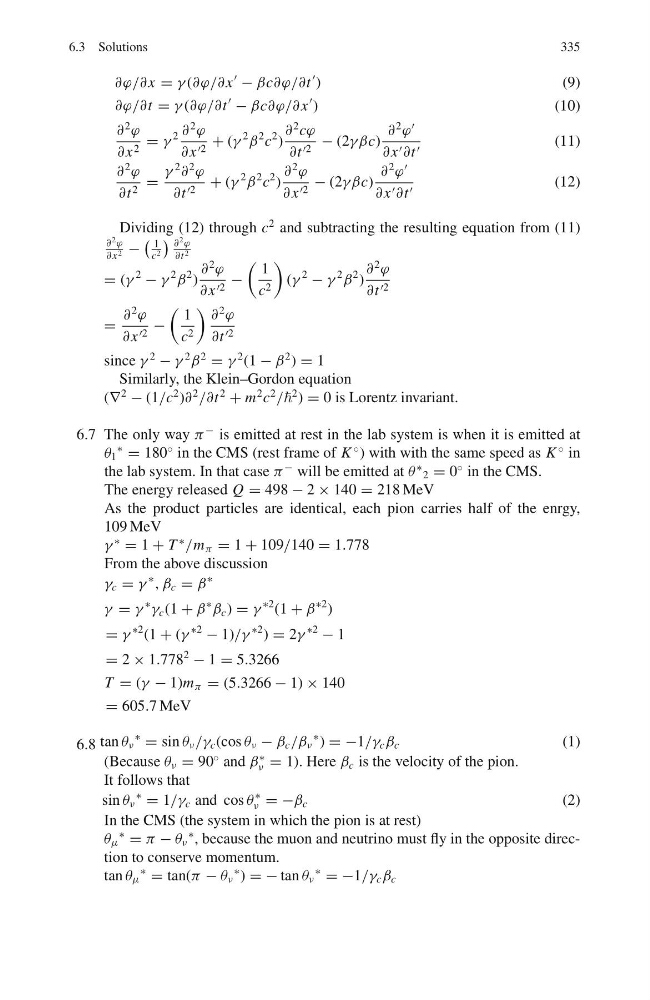
∂ϕ/∂x = γ (∂ϕ/∂ x
− βc∂ϕ/∂t
)
( 9 )
∂ϕ/∂t = γ (∂ϕ/∂t
− βc∂ϕ/∂x
)
(10)
∂
2
ϕ
∂ x 2 = γ
2 ∂
2
ϕ
∂ x 2 + (γ
2
β
2 c
2 )
∂
2 cϕ
∂t 2 − (2γβc)
∂
2
ϕ
∂ x ∂t
(11)
∂
2
ϕ
∂t 2 =
γ
2
∂
2
ϕ
∂t 2 + (γ
2
β
2 c
2 )
∂
2
ϕ
∂ x 2 − (2γβc)
∂
2
ϕ
∂ x ∂t
(12)
Dividing (12) through c
2 and subtracting the resulting equation from (11)
∂
2 ϕ
∂ x 2 −
1
c 2
∂
2 ϕ
∂t 2
= (γ
2
− γ
2
β
2 )
∂
2
ϕ
∂ x 2 −
1
c 2
(γ
2
− γ
2
β
2 )
∂
2
ϕ
∂t 2
=
∂
2
ϕ
∂ x 2 −
1
c 2
∂
2
ϕ
∂t 2
since γ
2
− γ
2
β
2
= γ
2 (1 − β
2 ) = 1
Similarly, the Klein–Gordon equation
(∇
2
− (1/c
2 )∂
2
/∂t
2
+ m
2 c
2
/
2 ) = 0 is Lorentz invariant.
6.7 The only way π
− is emitted at rest in the lab system is when it is emitted at
θ 1
∗
= 180
◦ in the CMS (rest frame of K
◦ ) with with the same speed as K
◦ in
the lab system. In that case π
− will be emitted at θ
∗
2 = 0
◦ in the CMS.
The energy released Q = 498 − 2 × 140 = 218 MeV
As the product particles are identical, each pion carries half of the enrgy,
109 MeV
γ
∗
= 1 + T
∗
/m π = 1 + 109/140 = 1.778
From the above discussion
γ c = γ
∗
, β c = β
∗
γ = γ
∗
γ c (1 + β
∗
β c ) = γ
∗2 (1 + β
∗2 )
= γ
∗2 (1 + (γ
∗2
− 1)/γ
∗2 ) = 2γ
∗2
− 1
= 2 × 1.778
2
− 1 = 5.3266
T = (γ − 1)m π = (5.3266 − 1) × 140
= 605.7 MeV
6.8 tan θ ν
∗
= sin θ ν /γ c (cos θ ν − β c /β ν
∗ ) = −1/γ c β c
(1)
(Because θ ν = 90
◦ and β
∗
ν = 1). Here β c is the velocity of the pion.
It follows that
sin θ ν
∗
= 1/γ c and cos θ
∗
ν = −β c
(2)
In the CMS (the system in which the pion is at rest)
θ μ
∗
= π − θ ν
∗ , because the muon and neutrino must fly in the opposite direction to conserve momentum.
tan θ μ
∗
= tan(π − θ ν
∗ ) = − tan θ ν
∗
= −1/γ c β c
335
∂ϕ/∂x = γ (∂ϕ/∂ x
− βc∂ϕ/∂t
)
( 9 )
∂ϕ/∂t = γ (∂ϕ/∂t
− βc∂ϕ/∂x
)
(10)
∂
2
ϕ
∂ x 2 = γ
2 ∂
2
ϕ
∂ x 2 + (γ
2
β
2 c
2 )
∂
2 cϕ
∂t 2 − (2γβc)
∂
2
ϕ
∂ x ∂t
(11)
∂
2
ϕ
∂t 2 =
γ
2
∂
2
ϕ
∂t 2 + (γ
2
β
2 c
2 )
∂
2
ϕ
∂ x 2 − (2γβc)
∂
2
ϕ
∂ x ∂t
(12)
Dividing (12) through c
2 and subtracting the resulting equation from (11)
∂
2 ϕ
∂ x 2 −
1
c 2
∂
2 ϕ
∂t 2
= (γ
2
− γ
2
β
2 )
∂
2
ϕ
∂ x 2 −
1
c 2
(γ
2
− γ
2
β
2 )
∂
2
ϕ
∂t 2
=
∂
2
ϕ
∂ x 2 −
1
c 2
∂
2
ϕ
∂t 2
since γ
2
− γ
2
β
2
= γ
2 (1 − β
2 ) = 1
Similarly, the Klein–Gordon equation
(∇
2
− (1/c
2 )∂
2
/∂t
2
+ m
2 c
2
/
2 ) = 0 is Lorentz invariant.
6.7 The only way π
− is emitted at rest in the lab system is when it is emitted at
θ 1
∗
= 180
◦ in the CMS (rest frame of K
◦ ) with with the same speed as K
◦ in
the lab system. In that case π
− will be emitted at θ
∗
2 = 0
◦ in the CMS.
The energy released Q = 498 − 2 × 140 = 218 MeV
As the product particles are identical, each pion carries half of the enrgy,
109 MeV
γ
∗
= 1 + T
∗
/m π = 1 + 109/140 = 1.778
From the above discussion
γ c = γ
∗
, β c = β
∗
γ = γ
∗
γ c (1 + β
∗
β c ) = γ
∗2 (1 + β
∗2 )
= γ
∗2 (1 + (γ
∗2
− 1)/γ
∗2 ) = 2γ
∗2
− 1
= 2 × 1.778
2
− 1 = 5.3266
T = (γ − 1)m π = (5.3266 − 1) × 140
= 605.7 MeV
6.8 tan θ ν
∗
= sin θ ν /γ c (cos θ ν − β c /β ν
∗ ) = −1/γ c β c
(1)
(Because θ ν = 90
◦ and β
∗
ν = 1). Here β c is the velocity of the pion.
It follows that
sin θ ν
∗
= 1/γ c and cos θ
∗
ν = −β c
(2)
In the CMS (the system in which the pion is at rest)
θ μ
∗
= π − θ ν
∗ , because the muon and neutrino must fly in the opposite direction to conserve momentum.
tan θ μ
∗
= tan(π − θ ν
∗ ) = − tan θ ν
∗
= −1/γ c β c