

6.2 Problems
319
6.2 Problems
6.2.1 Lorentz Transformations
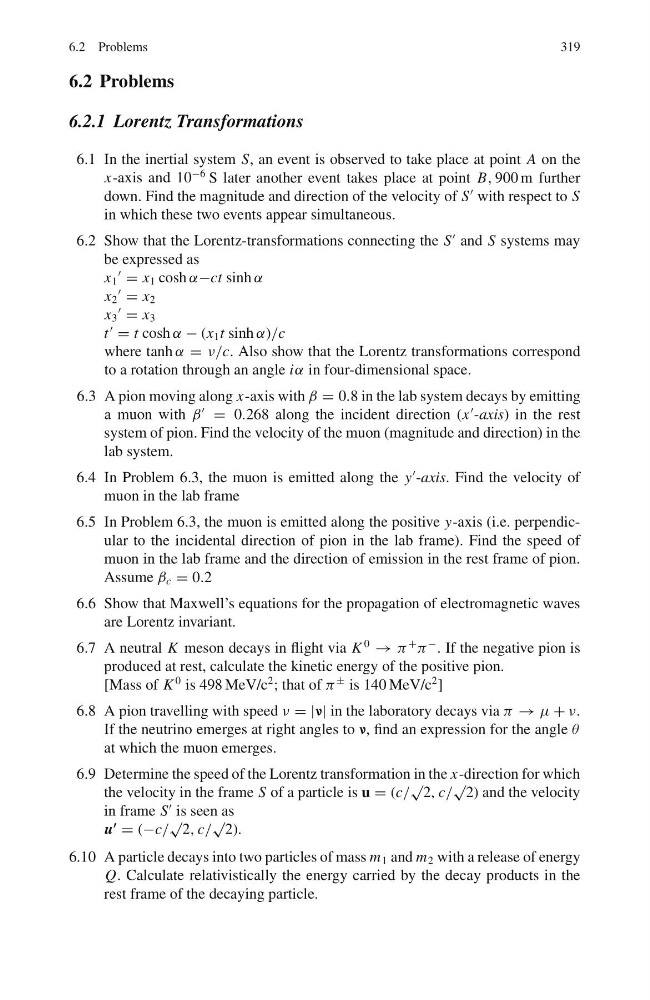
6.1 In the inertial system S, an event is observed to take place at point A on the
x-axis and 10
−6 S later another event takes place at point B, 900 m further
down. Find the magnitude and direction of the velocity of S
with respect to S
in which these two events appear simultaneous.
6.2 Show that the Lorentz-transformations connecting the S
and S systems may
be expressed as
x 1
= x 1 cosh α−ct sinh α
x 2
= x 2
x 3
= x 3
t
= t cosh α − (x 1 t sinh α)/c
where tanh α = ν/c. Also show that the Lorentz transformations correspond
to a rotation through an angle iα in four-dimensional space.
6.3 A pion moving along x-axis with β = 0.8 in the lab system decays by emitting
a muon with β
= 0.268 along the incident direction (x
-axis) in the rest
system of pion. Find the velocity of the muon (magnitude and direction) in the
lab system.
6.4 In Problem 6.3, the muon is emitted along the y
-axis. Find the velocity of
muon in the lab frame
6.5 In Problem 6.3, the muon is emitted along the positive y-axis (i.e. perpendicular to the incidental direction of pion in the lab frame). Find the speed of
muon in the lab frame and the direction of emission in the rest frame of pion.
Assume β c = 0.2
6.6 Show that Maxwell’s equations for the propagation of electromagnetic waves
are Lorentz invariant.
6.7 A neutral K meson decays in flight via K
0
→ π
+
π
− . If the negative pion is
produced at rest, calculate the kinetic energy of the positive pion.
[Mass of K
0 is 498 MeV/c
2 ; that of π
± is 140 MeV/c
2 ]
6.8 A pion travelling with speed ν = |ν| in the laboratory decays via π → μ + ν.
If the neutrino emerges at right angles to ν, find an expression for the angle θ
at which the muon emerges.
6.9 Determine the speed of the Lorentz transformation in the x-direction for which
the velocity in the frame S of a particle is u = (c/
√
2, c/
√
2) and the velocity
in frame S
is seen as
u
= (−c/
√
2, c/
√
2).
6.10 A particle decays into two particles of mass m 1 and m 2 with a release of energy
Q. Calculate relativistically the energy carried by the decay products in the
rest frame of the decaying particle.
319
6.2 Problems
6.2.1 Lorentz Transformations
6.1 In the inertial system S, an event is observed to take place at point A on the
x-axis and 10
−6 S later another event takes place at point B, 900 m further
down. Find the magnitude and direction of the velocity of S
with respect to S
in which these two events appear simultaneous.
6.2 Show that the Lorentz-transformations connecting the S
and S systems may
be expressed as
x 1
= x 1 cosh α−ct sinh α
x 2
= x 2
x 3
= x 3
t
= t cosh α − (x 1 t sinh α)/c
where tanh α = ν/c. Also show that the Lorentz transformations correspond
to a rotation through an angle iα in four-dimensional space.
6.3 A pion moving along x-axis with β = 0.8 in the lab system decays by emitting
a muon with β
= 0.268 along the incident direction (x
-axis) in the rest
system of pion. Find the velocity of the muon (magnitude and direction) in the
lab system.
6.4 In Problem 6.3, the muon is emitted along the y
-axis. Find the velocity of
muon in the lab frame
6.5 In Problem 6.3, the muon is emitted along the positive y-axis (i.e. perpendicular to the incidental direction of pion in the lab frame). Find the speed of
muon in the lab frame and the direction of emission in the rest frame of pion.
Assume β c = 0.2
6.6 Show that Maxwell’s equations for the propagation of electromagnetic waves
are Lorentz invariant.
6.7 A neutral K meson decays in flight via K
0
→ π
+
π
− . If the negative pion is
produced at rest, calculate the kinetic energy of the positive pion.
[Mass of K
0 is 498 MeV/c
2 ; that of π
± is 140 MeV/c
2 ]
6.8 A pion travelling with speed ν = |ν| in the laboratory decays via π → μ + ν.
If the neutrino emerges at right angles to ν, find an expression for the angle θ
at which the muon emerges.
6.9 Determine the speed of the Lorentz transformation in the x-direction for which
the velocity in the frame S of a particle is u = (c/
√
2, c/
√
2) and the velocity
in frame S
is seen as
u
= (−c/
√
2, c/
√
2).
6.10 A particle decays into two particles of mass m 1 and m 2 with a release of energy
Q. Calculate relativistically the energy carried by the decay products in the
rest frame of the decaying particle.