

318
6 Special Theory of Relativity
Inverse transformations
cp x = γ (cp
x + β E
)
(6.41)
cp y = cp
y
(6.42)
cp z = cp
z
(6.43)
E = γ (E
− βcp
x ∗ )
(6.44)
E
2
− c
2 p
2
= E
2
− c
2 p
2
= m
2
0 = Invariant
(6.45)
γ
= γ γ 0 (1 − ββ 0 cos θ 0 )
(6.46)
γ 0 = γ γ
(1 + ββ
∗ cos θ
∗ )
(6.47)
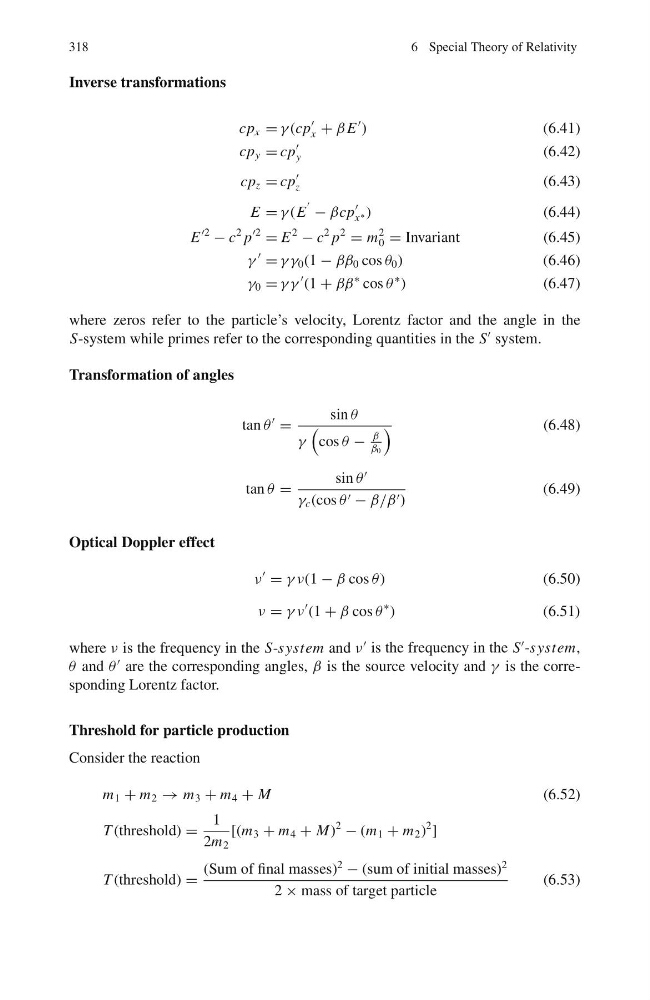
where zeros refer to the particle’s velocity, Lorentz factor and the angle in the
S-system while primes refer to the corresponding quantities in the S
system.
Transformation of angles
tan θ
=
sin θ
γ
cos θ −
β
β0
(6.48)
tan θ =
sin θ
γ c (cos θ − β/β )
(6.49)
Optical Doppler effect
ν
= γ ν(1 − β cos θ)
(6.50)
ν = γ ν
(1 + β cos θ
∗ )
(6.51)
where ν is the frequency in the S-system and ν
is the frequency in the S
-system,
θ and θ
are the corresponding angles, β is the source velocity and γ is the corresponding Lorentz factor.
Threshold for particle production
Consider the reaction
m 1 + m 2 → m 3 + m 4 + M
(6.52)
T (threshold) =
1
2m 2
[(m 3 + m 4 + M)
2
− (m 1 + m 2 )
2 ]
T (threshold) =
(Sum of final masses)
2
− (sum of initial masses)
2
2 × mass of target particle
(6.53)
6 Special Theory of Relativity
Inverse transformations
cp x = γ (cp
x + β E
)
(6.41)
cp y = cp
y
(6.42)
cp z = cp
z
(6.43)
E = γ (E
− βcp
x ∗ )
(6.44)
E
2
− c
2 p
2
= E
2
− c
2 p
2
= m
2
0 = Invariant
(6.45)
γ
= γ γ 0 (1 − ββ 0 cos θ 0 )
(6.46)
γ 0 = γ γ
(1 + ββ
∗ cos θ
∗ )
(6.47)
where zeros refer to the particle’s velocity, Lorentz factor and the angle in the
S-system while primes refer to the corresponding quantities in the S
system.
Transformation of angles
tan θ
=
sin θ
γ
cos θ −
β
β0
(6.48)
tan θ =
sin θ
γ c (cos θ − β/β )
(6.49)
Optical Doppler effect
ν
= γ ν(1 − β cos θ)
(6.50)
ν = γ ν
(1 + β cos θ
∗ )
(6.51)
where ν is the frequency in the S-system and ν
is the frequency in the S
-system,
θ and θ
are the corresponding angles, β is the source velocity and γ is the corresponding Lorentz factor.
Threshold for particle production
Consider the reaction
m 1 + m 2 → m 3 + m 4 + M
(6.52)
T (threshold) =
1
2m 2
[(m 3 + m 4 + M)
2
− (m 1 + m 2 )
2 ]
T (threshold) =
(Sum of final masses)
2
− (sum of initial masses)
2
2 × mass of target particle
(6.53)