

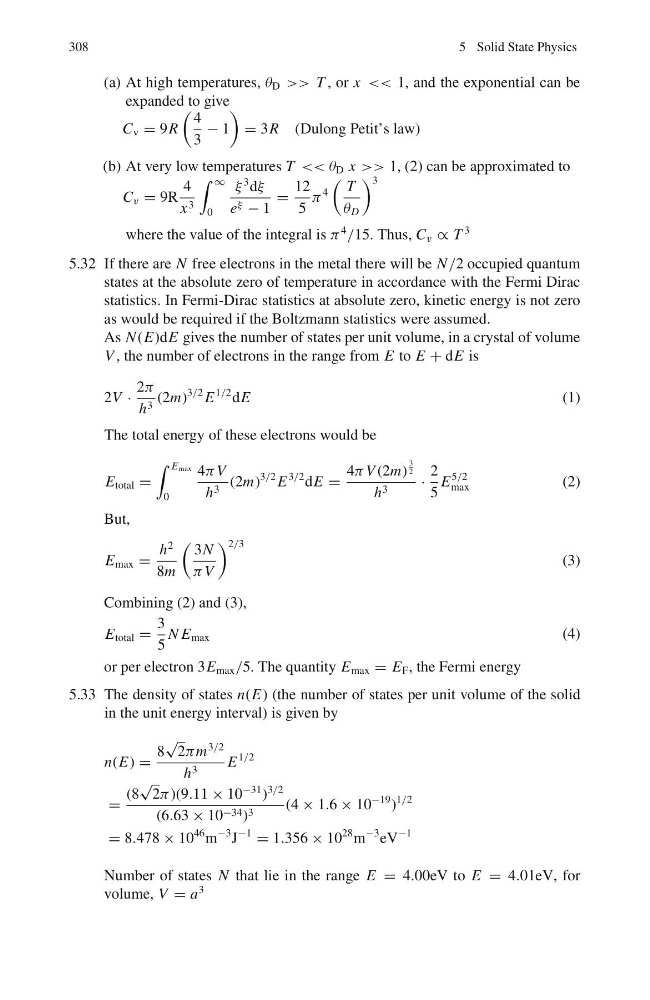
308
5 Solid State Physics
(a) At high temperatures, θ D >> T , or x << 1, and the exponential can be
expanded to give
C v = 9R
4
3
− 1
= 3R (Dulong Petit’s law)
(b) At very low temperatures T << θ D x >> 1, (2) can be approximated to
C v = 9R
4
x 3
∞
0
ξ
3 dξ
e ξ − 1
=
12
5
π
4
T
θ D
3
where the value of the integral is π
4
/15. Thus, C v ∝ T
3
5.32 If there are N free electrons in the metal there will be N /2 occupied quantum
states at the absolute zero of temperature in accordance with the Fermi Dirac
statistics. In Fermi-Dirac statistics at absolute zero, kinetic energy is not zero
as would be required if the Boltzmann statistics were assumed.
As N (E)dE gives the number of states per unit volume, in a crystal of volume
V , the number of electrons in the range from E to E + dE is
2V ·
2π
h 3 (2m)
3/2 E
1/2 dE
(1)
The total energy of these electrons would be
E total =
Emax
0
4π V
h 3 (2m)
3/2 E
3/2 dE =
4π V (2m)
3
2
h 3
·
2
5
E
5/2
max
(2)
But,
E max =
h
2
8m
3N
π V
2/3
(3)
Combining (2) and (3),
E total =
3
5
N E max
(4)
or per electron 3E max /5. The quantity E max = E F , the Fermi energy
5.33 The density of states n(E) (the number of states per unit volume of the solid
in the unit energy interval) is given by
n(E) =
8
√
2π m
3/2
h 3
E
1/2
=
(8
√
2π )(9.11 × 10
−31 )
3/2
(6.63 × 10 −34 ) 3
(4 × 1.6 × 10
−19 )
1/2
= 8.478 × 10
46 m
−3 J
−1
= 1.356 × 10
28 m
−3 eV
−1
Number of states N that lie in the range E = 4.00eV to E = 4.01eV, for
volume, V = a
3
5 Solid State Physics
(a) At high temperatures, θ D >> T , or x << 1, and the exponential can be
expanded to give
C v = 9R
4
3
− 1
= 3R (Dulong Petit’s law)
(b) At very low temperatures T << θ D x >> 1, (2) can be approximated to
C v = 9R
4
x 3
∞
0
ξ
3 dξ
e ξ − 1
=
12
5
π
4
T
θ D
3
where the value of the integral is π
4
/15. Thus, C v ∝ T
3
5.32 If there are N free electrons in the metal there will be N /2 occupied quantum
states at the absolute zero of temperature in accordance with the Fermi Dirac
statistics. In Fermi-Dirac statistics at absolute zero, kinetic energy is not zero
as would be required if the Boltzmann statistics were assumed.
As N (E)dE gives the number of states per unit volume, in a crystal of volume
V , the number of electrons in the range from E to E + dE is
2V ·
2π
h 3 (2m)
3/2 E
1/2 dE
(1)
The total energy of these electrons would be
E total =
Emax
0
4π V
h 3 (2m)
3/2 E
3/2 dE =
4π V (2m)
3
2
h 3
·
2
5
E
5/2
max
(2)
But,
E max =
h
2
8m
3N
π V
2/3
(3)
Combining (2) and (3),
E total =
3
5
N E max
(4)
or per electron 3E max /5. The quantity E max = E F , the Fermi energy
5.33 The density of states n(E) (the number of states per unit volume of the solid
in the unit energy interval) is given by
n(E) =
8
√
2π m
3/2
h 3
E
1/2
=
(8
√
2π )(9.11 × 10
−31 )
3/2
(6.63 × 10 −34 ) 3
(4 × 1.6 × 10
−19 )
1/2
= 8.478 × 10
46 m
−3 J
−1
= 1.356 × 10
28 m
−3 eV
−1
Number of states N that lie in the range E = 4.00eV to E = 4.01eV, for
volume, V = a
3