

5.3 Solutions
307
(b) p(E) =
1
e −1.932 + 1
= 0.873
(c) p(E) =
1
e 0 + 1
= 0.5
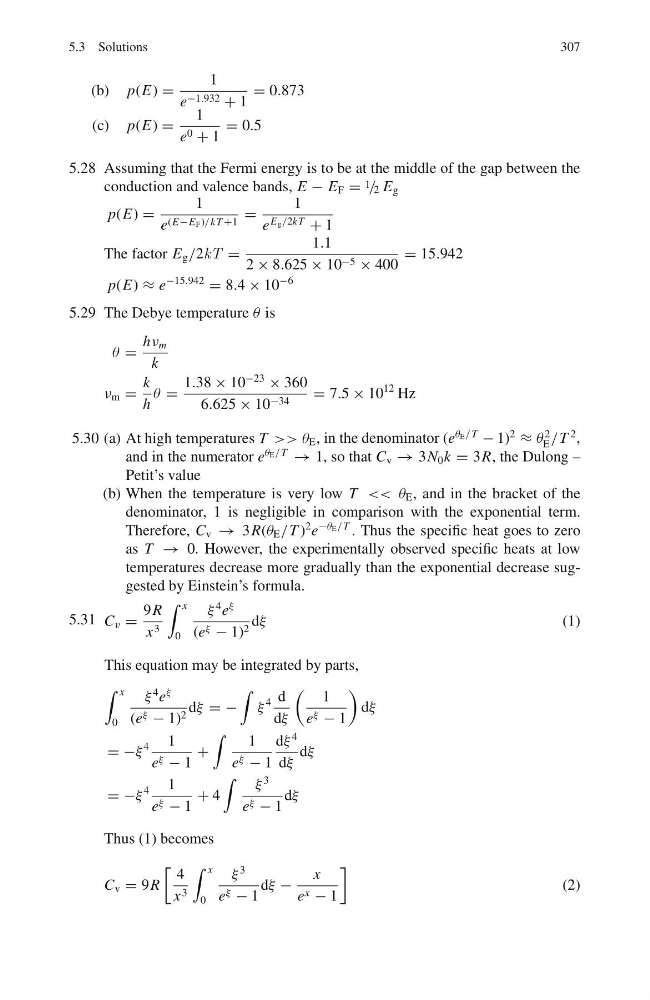
5.28 Assuming that the Fermi energy is to be at the middle of the gap between the
conduction and valence bands, E − E F = 1 / 2 E g
p(E) =
1
e (E−EF)/kT +1 =
1
e E g /2kT + 1
The factor E g /2kT =
1.1
2 × 8.625 × 10 −5 × 400
= 15.942
p(E) ≈ e
−15.942
= 8.4 × 10
−6
5.29 The Debye temperature θ is
θ =
hν m
k
ν m =
k
h
θ =
1.38 × 10
−23
× 360
6.625 × 10 −34
= 7.5 × 10
12 Hz
5.30 (a) At high temperatures T >> θ E , in the denominator (e
θ E /T
− 1)
2
≈ θ
2
E /T
2 ,
and in the numerator e
θE/T
→ 1, so that C v → 3N 0 k = 3R, the Dulong –
Petit’s value
(b) When the temperature is very low T << θ E , and in the bracket of the
denominator, 1 is negligible in comparison with the exponential term.
Therefore, C v → 3R(θ E /T )
2 e
−θE/T . Thus the specific heat goes to zero
as T → 0. However, the experimentally observed specific heats at low
temperatures decrease more gradually than the exponential decrease suggested by Einstein’s formula.
5.31 C v =
9R
x 3
x
0
ξ
4 e
ξ
(e ξ − 1) 2 dξ
(1)
This equation may be integrated by parts,
x
0
ξ
4 e
ξ
(e ξ − 1) 2 dξ = −
ξ
4 d
dξ
1
e ξ − 1
dξ
= −ξ
4
1
e ξ − 1
+
1
e ξ − 1
dξ
4
dξ
dξ
= −ξ
4
1
e ξ − 1
+ 4
ξ
3
e ξ − 1
dξ
Thus (1) becomes
C v = 9R
4
x 3
x
0
ξ
3
e ξ − 1
dξ −
x
e x − 1
(2)
307
(b) p(E) =
1
e −1.932 + 1
= 0.873
(c) p(E) =
1
e 0 + 1
= 0.5
5.28 Assuming that the Fermi energy is to be at the middle of the gap between the
conduction and valence bands, E − E F = 1 / 2 E g
p(E) =
1
e (E−EF)/kT +1 =
1
e E g /2kT + 1
The factor E g /2kT =
1.1
2 × 8.625 × 10 −5 × 400
= 15.942
p(E) ≈ e
−15.942
= 8.4 × 10
−6
5.29 The Debye temperature θ is
θ =
hν m
k
ν m =
k
h
θ =
1.38 × 10
−23
× 360
6.625 × 10 −34
= 7.5 × 10
12 Hz
5.30 (a) At high temperatures T >> θ E , in the denominator (e
θ E /T
− 1)
2
≈ θ
2
E /T
2 ,
and in the numerator e
θE/T
→ 1, so that C v → 3N 0 k = 3R, the Dulong –
Petit’s value
(b) When the temperature is very low T << θ E , and in the bracket of the
denominator, 1 is negligible in comparison with the exponential term.
Therefore, C v → 3R(θ E /T )
2 e
−θE/T . Thus the specific heat goes to zero
as T → 0. However, the experimentally observed specific heats at low
temperatures decrease more gradually than the exponential decrease suggested by Einstein’s formula.
5.31 C v =
9R
x 3
x
0
ξ
4 e
ξ
(e ξ − 1) 2 dξ
(1)
This equation may be integrated by parts,
x
0
ξ
4 e
ξ
(e ξ − 1) 2 dξ = −
ξ
4 d
dξ
1
e ξ − 1
dξ
= −ξ
4
1
e ξ − 1
+
1
e ξ − 1
dξ
4
dξ
dξ
= −ξ
4
1
e ξ − 1
+ 4
ξ
3
e ξ − 1
dξ
Thus (1) becomes
C v = 9R
4
x 3
x
0
ξ
3
e ξ − 1
dξ −
x
e x − 1
(2)