

292
5 Solid State Physics
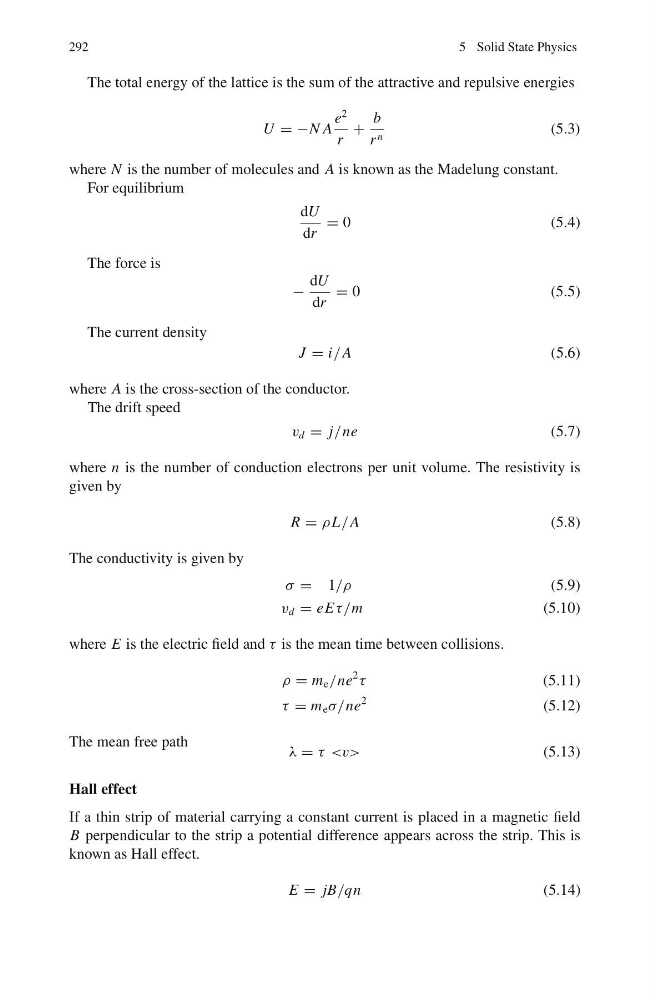
The total energy of the lattice is the sum of the attractive and repulsive energies
U = −N A
e
2
r
+
b
r n
(5.3)
where N is the number of molecules and A is known as the Madelung constant.
For equilibrium
dU
dr
= 0
(5.4)
The force is
−
dU
dr
= 0
(5.5)
The current density
J = i/A
(5.6)
where A is the cross-section of the conductor.
The drift speed
v d = j/ne
(5.7)
where n is the number of conduction electrons per unit volume. The resistivity is
given by
R = ρ L/A
(5.8)
The conductivity is given by
σ = 1/ρ
(5.9)
v d = eEτ/m
(5.10)
where E is the electric field and τ is the mean time between collisions.
ρ = m e /ne
2
τ
(5.11)
τ = m e σ/ne
2
(5.12)
The mean free path
λ = τ
(5.13)
Hall effect
If a thin strip of material carrying a constant current is placed in a magnetic field
B perpendicular to the strip a potential difference appears across the strip. This is
known as Hall effect.
E = jB/qn
(5.14)
5 Solid State Physics
The total energy of the lattice is the sum of the attractive and repulsive energies
U = −N A
e
2
r
+
b
r n
(5.3)
where N is the number of molecules and A is known as the Madelung constant.
For equilibrium
dU
dr
= 0
(5.4)
The force is
−
dU
dr
= 0
(5.5)
The current density
J = i/A
(5.6)
where A is the cross-section of the conductor.
The drift speed
v d = j/ne
(5.7)
where n is the number of conduction electrons per unit volume. The resistivity is
given by
R = ρ L/A
(5.8)
The conductivity is given by
σ = 1/ρ
(5.9)
v d = eEτ/m
(5.10)
where E is the electric field and τ is the mean time between collisions.
ρ = m e /ne
2
τ
(5.11)
τ = m e σ/ne
2
(5.12)
The mean free path
λ = τ
(5.13)
Hall effect
If a thin strip of material carrying a constant current is placed in a magnetic field
B perpendicular to the strip a potential difference appears across the strip. This is
known as Hall effect.
E = jB/qn
(5.14)