

4.3 Solutions
287
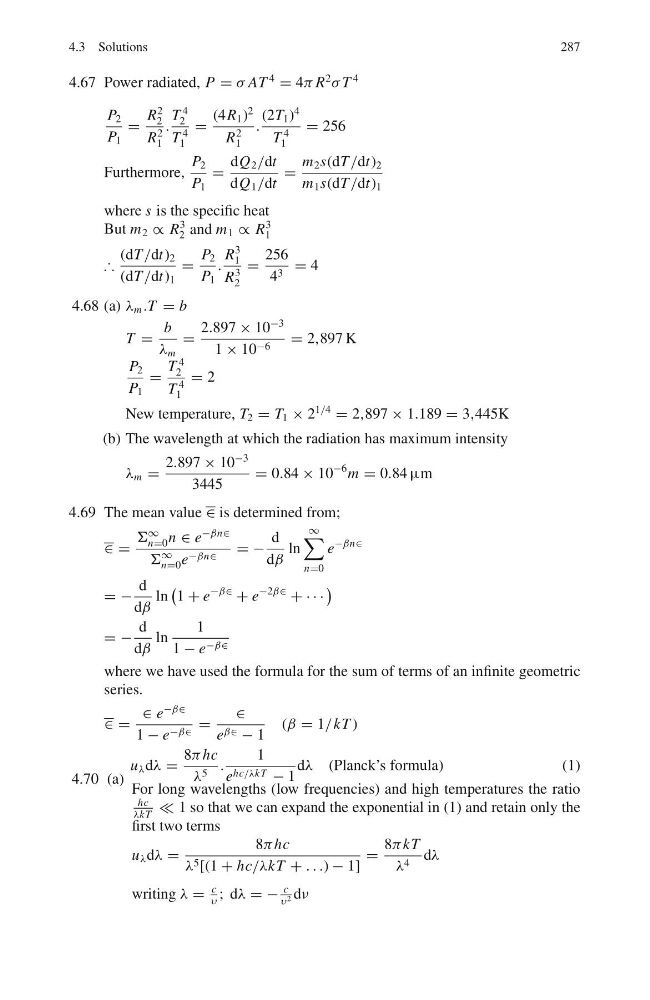
4.67 Power radiated, P = σ AT
4
= 4π R
2
σ T
4
P 2
P 1
=
R
2
2
R
2
1
.
T
4
2
T
4
1
=
(4R 1 )
2
R
2
1
.
(2T 1 )
4
T
4
1
= 256
Furthermore,
P 2
P 1
=
dQ 2 /dt
dQ 1 /dt
=
m 2 s(dT /dt) 2
m 1 s(dT /dt) 1
where s is the specific heat
But m 2 ∝ R
3
2 and m 1 ∝ R
3
1
∴
(dT /dt) 2
(dT /dt) 1
=
P 2
P 1
.
R
3
1
R
3
2
=
256
4 3 = 4
4.68 (a) λ m .T = b
T =
b
λ m
=
2.897 × 10
−3
1 × 10 −6 = 2,897 K
P 2
P 1
=
T
4
2
T
4
1
= 2
New temperature, T 2 = T 1 × 2
1/4
= 2,897 × 1.189 = 3,445K
(b) The wavelength at which the radiation has maximum intensity
λ m =
2.897 × 10
−3
3445
= 0.84 × 10
−6 m = 0.84 μm
4.69 The mean value ∈ is determined from;
∈ =
Σ
∞
n=0 n ∈ e
−βn∈
Σ
∞
n=0 e −βn∈ = −
d
dβ
ln
∞
n=0
e
−βn∈
= −
d
dβ
ln
1 + e
−β∈
+ e
−2β∈
+ · · ·
= −
d
dβ
ln
1
1 − e −β∈
where we have used the formula for the sum of terms of an infinite geometric
series.
∈ =
∈ e
−β∈
1 − e −β∈ =
∈
e β∈ − 1
(β = 1/kT )
4.70 (a)
u λ dλ =
8π hc
λ 5 .
1
e hc/λkT − 1
dλ (Planck’s formula)
(1)
For long wavelengths (low frequencies) and high temperatures the ratio
hc
λkT
1 so that we can expand the exponential in (1) and retain only the
first two terms
u λ dλ =
8π hc
λ 5 [(1 + hc/λkT + . . .) − 1]
=
8π kT
λ 4 dλ
writing λ =
c
υ
; dλ = −
c
υ 2 dν
287
4.67 Power radiated, P = σ AT
4
= 4π R
2
σ T
4
P 2
P 1
=
R
2
2
R
2
1
.
T
4
2
T
4
1
=
(4R 1 )
2
R
2
1
.
(2T 1 )
4
T
4
1
= 256
Furthermore,
P 2
P 1
=
dQ 2 /dt
dQ 1 /dt
=
m 2 s(dT /dt) 2
m 1 s(dT /dt) 1
where s is the specific heat
But m 2 ∝ R
3
2 and m 1 ∝ R
3
1
∴
(dT /dt) 2
(dT /dt) 1
=
P 2
P 1
.
R
3
1
R
3
2
=
256
4 3 = 4
4.68 (a) λ m .T = b
T =
b
λ m
=
2.897 × 10
−3
1 × 10 −6 = 2,897 K
P 2
P 1
=
T
4
2
T
4
1
= 2
New temperature, T 2 = T 1 × 2
1/4
= 2,897 × 1.189 = 3,445K
(b) The wavelength at which the radiation has maximum intensity
λ m =
2.897 × 10
−3
3445
= 0.84 × 10
−6 m = 0.84 μm
4.69 The mean value ∈ is determined from;
∈ =
Σ
∞
n=0 n ∈ e
−βn∈
Σ
∞
n=0 e −βn∈ = −
d
dβ
ln
∞
n=0
e
−βn∈
= −
d
dβ
ln
1 + e
−β∈
+ e
−2β∈
+ · · ·
= −
d
dβ
ln
1
1 − e −β∈
where we have used the formula for the sum of terms of an infinite geometric
series.
∈ =
∈ e
−β∈
1 − e −β∈ =
∈
e β∈ − 1
(β = 1/kT )
4.70 (a)
u λ dλ =
8π hc
λ 5 .
1
e hc/λkT − 1
dλ (Planck’s formula)
(1)
For long wavelengths (low frequencies) and high temperatures the ratio
hc
λkT
1 so that we can expand the exponential in (1) and retain only the
first two terms
u λ dλ =
8π hc
λ 5 [(1 + hc/λkT + . . .) − 1]
=
8π kT
λ 4 dλ
writing λ =
c
υ
; dλ = −
c
υ 2 dν