

286
4 Thermodynamics and Statistical Physics
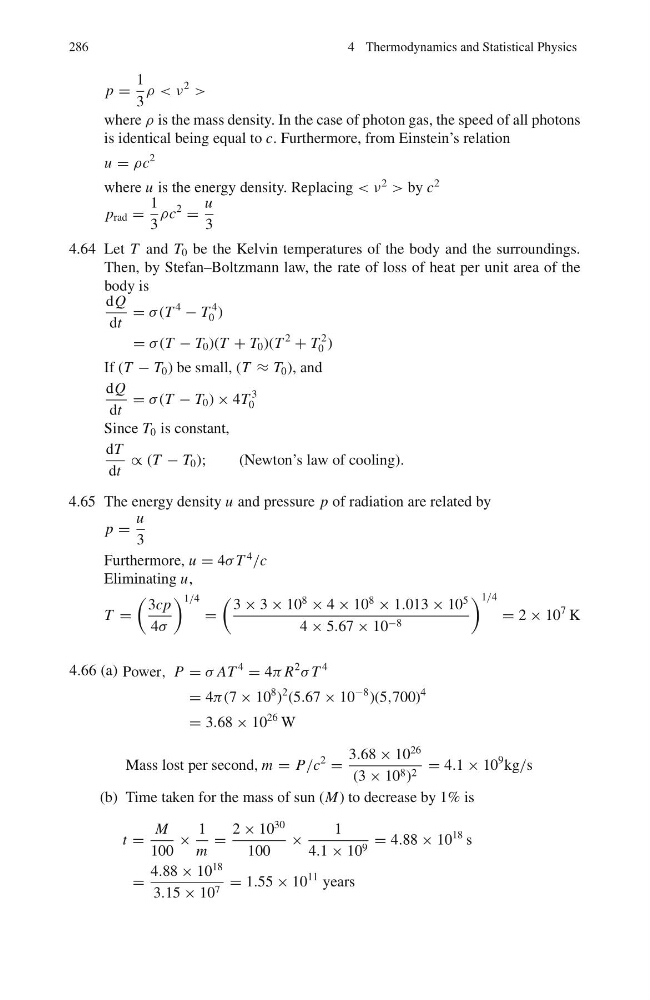
p =
1
3
ρ < ν
2
>
where ρ is the mass density. In the case of photon gas, the speed of all photons
is identical being equal to c. Furthermore, from Einstein’s relation
u = ρc
2
where u is the energy density. Replacing < ν
2
> by c
2
p rad =
1
3
ρc
2
=
u
3
4.64 Let T and T 0 be the Kelvin temperatures of the body and the surroundings.
Then, by Stefan–Boltzmann law, the rate of loss of heat per unit area of the
body is
dQ
dt
= σ (T
4
− T
4
0 )
= σ (T − T 0 )(T + T 0 )(T
2
+ T
2
0 )
If (T − T 0 ) be small, (T ≈ T 0 ), and
dQ
dt
= σ (T − T 0 ) × 4T
3
0
Since T 0 is constant,
dT
dt
∝ (T − T 0 );
(Newton’s law of cooling).
4.65 The energy density u and pressure p of radiation are related by
p =
u
3
Furthermore, u = 4σ T
4
/c
Eliminating u,
T =
3cp
4σ
1/4
=
3 × 3 × 10
8
× 4 × 10
8
× 1.013 × 10
5
4 × 5.67 × 10 −8
1/4
= 2 × 10
7 K
4.66 (a) Power, P = σ AT
4
= 4π R
2
σ T
4
= 4π(7 × 10
8 )
2 (5.67 × 10
−8 )(5,700)
4
= 3.68 × 10
26 W
Mass lost per second, m = P/c
2
=
3.68 × 10
26
(3 × 10 8 ) 2 = 4.1 × 10
9 kg/s
(b) Time taken for the mass of sun (M) to decrease by 1% is
t =
M
100
×
1
m
=
2 × 10
30
100
×
1
4.1 × 10 9 = 4.88 × 10
18 s
=
4.88 × 10
18
3.15 × 10 7 = 1.55 × 10
11 years
4 Thermodynamics and Statistical Physics
p =
1
3
ρ < ν
2
>
where ρ is the mass density. In the case of photon gas, the speed of all photons
is identical being equal to c. Furthermore, from Einstein’s relation
u = ρc
2
where u is the energy density. Replacing < ν
2
> by c
2
p rad =
1
3
ρc
2
=
u
3
4.64 Let T and T 0 be the Kelvin temperatures of the body and the surroundings.
Then, by Stefan–Boltzmann law, the rate of loss of heat per unit area of the
body is
dQ
dt
= σ (T
4
− T
4
0 )
= σ (T − T 0 )(T + T 0 )(T
2
+ T
2
0 )
If (T − T 0 ) be small, (T ≈ T 0 ), and
dQ
dt
= σ (T − T 0 ) × 4T
3
0
Since T 0 is constant,
dT
dt
∝ (T − T 0 );
(Newton’s law of cooling).
4.65 The energy density u and pressure p of radiation are related by
p =
u
3
Furthermore, u = 4σ T
4
/c
Eliminating u,
T =
3cp
4σ
1/4
=
3 × 3 × 10
8
× 4 × 10
8
× 1.013 × 10
5
4 × 5.67 × 10 −8
1/4
= 2 × 10
7 K
4.66 (a) Power, P = σ AT
4
= 4π R
2
σ T
4
= 4π(7 × 10
8 )
2 (5.67 × 10
−8 )(5,700)
4
= 3.68 × 10
26 W
Mass lost per second, m = P/c
2
=
3.68 × 10
26
(3 × 10 8 ) 2 = 4.1 × 10
9 kg/s
(b) Time taken for the mass of sun (M) to decrease by 1% is
t =
M
100
×
1
m
=
2 × 10
30
100
×
1
4.1 × 10 9 = 4.88 × 10
18 s
=
4.88 × 10
18
3.15 × 10 7 = 1.55 × 10
11 years