

284
4 Thermodynamics and Statistical Physics
=
e
−nω/kT
e
−ω/kT
1 − e −ω/kT
=
e
−nω/kT
1
e ω/kT −1
= e
−nω/kT
e
ω/kT
− 1
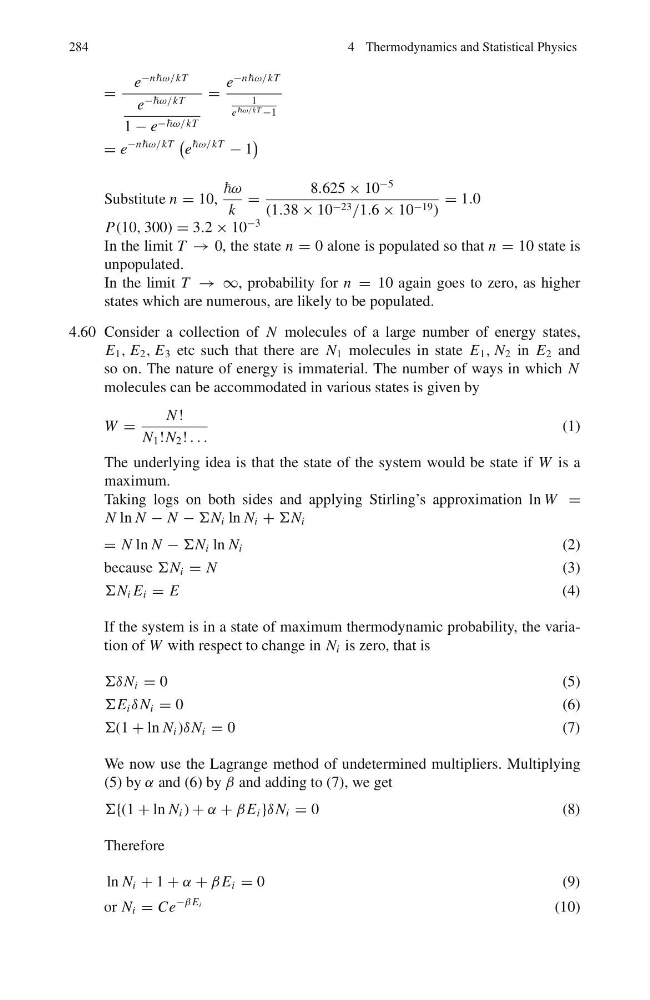
Substitute n = 10,
ω
k
=
8.625 × 10
−5
(1.38 × 10 −23 /1.6 × 10 −19 )
= 1.0
P(10, 300) = 3.2 × 10
−3
In the limit T → 0, the state n = 0 alone is populated so that n = 10 state is
unpopulated.
In the limit T → ∞, probability for n = 10 again goes to zero, as higher
states which are numerous, are likely to be populated.
4.60 Consider a collection of N molecules of a large number of energy states,
E 1 , E 2 , E 3 etc such that there are N 1 molecules in state E 1 , N 2 in E 2 and
so on. The nature of energy is immaterial. The number of ways in which N
molecules can be accommodated in various states is given by
W =
N !
N 1 !N 2 ! . . .
(1)
The underlying idea is that the state of the system would be state if W is a
maximum.
Taking logs on both sides and applying Stirling’s approximation ln W =
N ln N − N − ΣN i ln N i + ΣN i
= N ln N − ΣN i ln N i
(2)
because ΣN i = N
(3)
ΣN i E i = E
(4)
If the system is in a state of maximum thermodynamic probability, the variation of W with respect to change in N i is zero, that is
Σδ N i = 0
( 5 )
ΣE i δ N i = 0
( 6 )
Σ(1 + ln N i )δ N i = 0
( 7 )
We now use the Lagrange method of undetermined multipliers. Multiplying
(5) by α and (6) by β and adding to (7), we get
Σ{(1 + ln N i ) + α + β E i }δ N i = 0
( 8 )
Therefore
ln N i + 1 + α + β E i = 0
( 9 )
or N i = Ce
−β E i
(10)
4 Thermodynamics and Statistical Physics
=
e
−nω/kT
e
−ω/kT
1 − e −ω/kT
=
e
−nω/kT
1
e ω/kT −1
= e
−nω/kT
e
ω/kT
− 1
Substitute n = 10,
ω
k
=
8.625 × 10
−5
(1.38 × 10 −23 /1.6 × 10 −19 )
= 1.0
P(10, 300) = 3.2 × 10
−3
In the limit T → 0, the state n = 0 alone is populated so that n = 10 state is
unpopulated.
In the limit T → ∞, probability for n = 10 again goes to zero, as higher
states which are numerous, are likely to be populated.
4.60 Consider a collection of N molecules of a large number of energy states,
E 1 , E 2 , E 3 etc such that there are N 1 molecules in state E 1 , N 2 in E 2 and
so on. The nature of energy is immaterial. The number of ways in which N
molecules can be accommodated in various states is given by
W =
N !
N 1 !N 2 ! . . .
(1)
The underlying idea is that the state of the system would be state if W is a
maximum.
Taking logs on both sides and applying Stirling’s approximation ln W =
N ln N − N − ΣN i ln N i + ΣN i
= N ln N − ΣN i ln N i
(2)
because ΣN i = N
(3)
ΣN i E i = E
(4)
If the system is in a state of maximum thermodynamic probability, the variation of W with respect to change in N i is zero, that is
Σδ N i = 0
( 5 )
ΣE i δ N i = 0
( 6 )
Σ(1 + ln N i )δ N i = 0
( 7 )
We now use the Lagrange method of undetermined multipliers. Multiplying
(5) by α and (6) by β and adding to (7), we get
Σ{(1 + ln N i ) + α + β E i }δ N i = 0
( 8 )
Therefore
ln N i + 1 + α + β E i = 0
( 9 )
or N i = Ce
−β E i
(10)