

282
4 Thermodynamics and Statistical Physics
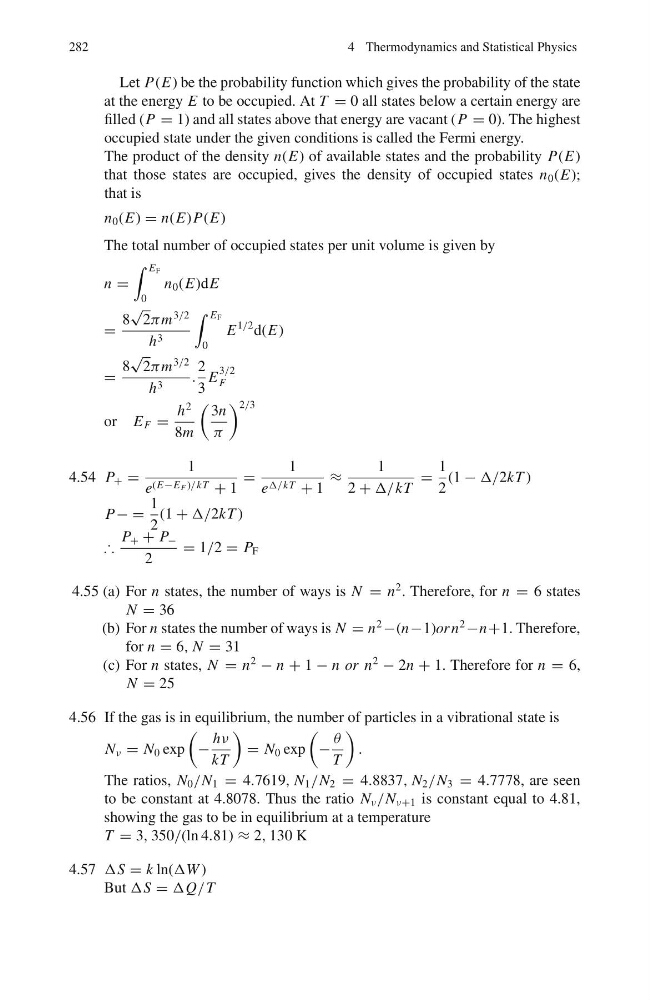
Let P(E) be the probability function which gives the probability of the state
at the energy E to be occupied. At T = 0 all states below a certain energy are
filled (P = 1) and all states above that energy are vacant (P = 0). The highest
occupied state under the given conditions is called the Fermi energy.
The product of the density n(E) of available states and the probability P(E)
that those states are occupied, gives the density of occupied states n 0 (E);
that is
n 0 (E) = n(E)P(E)
The total number of occupied states per unit volume is given by
n =
E F
0
n 0 (E)dE
=
8
√
2π m
3/2
h 3
EF
0
E
1/2 d(E)
=
8
√
2π m
3/2
h 3
.
2
3
E
3/2
F
or E F =
h
2
8m
3n
π
2/3
4.54 P + =
1
e (E−EF )/kT + 1
=
1
e Δ/kT + 1
≈
1
2 + Δ/kT
=
1
2
(1 − Δ/2kT )
P− =
1
2
(1 + Δ/2kT )
∴
P + + P −
2
= 1/2 = P F
4.55 (a) For n states, the number of ways is N = n
2 . Therefore, for n = 6 states
N = 36
(b) For n states the number of ways is N = n
2
−(n−1)or n
2
−n+1. Therefore,
for n = 6, N = 31
(c) For n states, N = n
2
− n + 1 − n or n
2
− 2n + 1. Therefore for n = 6,
N = 25
4.56 If the gas is in equilibrium, the number of particles in a vibrational state is
N ν = N 0 exp
−
hν
kT
= N 0 exp
−
θ
T
.
The ratios, N 0 /N 1 = 4.7619, N 1 /N 2 = 4.8837, N 2 /N 3 = 4.7778, are seen
to be constant at 4.8078. Thus the ratio N ν /N ν+1 is constant equal to 4.81,
showing the gas to be in equilibrium at a temperature
T = 3, 350/(ln 4.81) ≈ 2, 130 K
4.57 ΔS = k ln(ΔW )
But ΔS = ΔQ/T
4 Thermodynamics and Statistical Physics
Let P(E) be the probability function which gives the probability of the state
at the energy E to be occupied. At T = 0 all states below a certain energy are
filled (P = 1) and all states above that energy are vacant (P = 0). The highest
occupied state under the given conditions is called the Fermi energy.
The product of the density n(E) of available states and the probability P(E)
that those states are occupied, gives the density of occupied states n 0 (E);
that is
n 0 (E) = n(E)P(E)
The total number of occupied states per unit volume is given by
n =
E F
0
n 0 (E)dE
=
8
√
2π m
3/2
h 3
EF
0
E
1/2 d(E)
=
8
√
2π m
3/2
h 3
.
2
3
E
3/2
F
or E F =
h
2
8m
3n
π
2/3
4.54 P + =
1
e (E−EF )/kT + 1
=
1
e Δ/kT + 1
≈
1
2 + Δ/kT
=
1
2
(1 − Δ/2kT )
P− =
1
2
(1 + Δ/2kT )
∴
P + + P −
2
= 1/2 = P F
4.55 (a) For n states, the number of ways is N = n
2 . Therefore, for n = 6 states
N = 36
(b) For n states the number of ways is N = n
2
−(n−1)or n
2
−n+1. Therefore,
for n = 6, N = 31
(c) For n states, N = n
2
− n + 1 − n or n
2
− 2n + 1. Therefore for n = 6,
N = 25
4.56 If the gas is in equilibrium, the number of particles in a vibrational state is
N ν = N 0 exp
−
hν
kT
= N 0 exp
−
θ
T
.
The ratios, N 0 /N 1 = 4.7619, N 1 /N 2 = 4.8837, N 2 /N 3 = 4.7778, are seen
to be constant at 4.8078. Thus the ratio N ν /N ν+1 is constant equal to 4.81,
showing the gas to be in equilibrium at a temperature
T = 3, 350/(ln 4.81) ≈ 2, 130 K
4.57 ΔS = k ln(ΔW )
But ΔS = ΔQ/T