

254
4 Thermodynamics and Statistical Physics
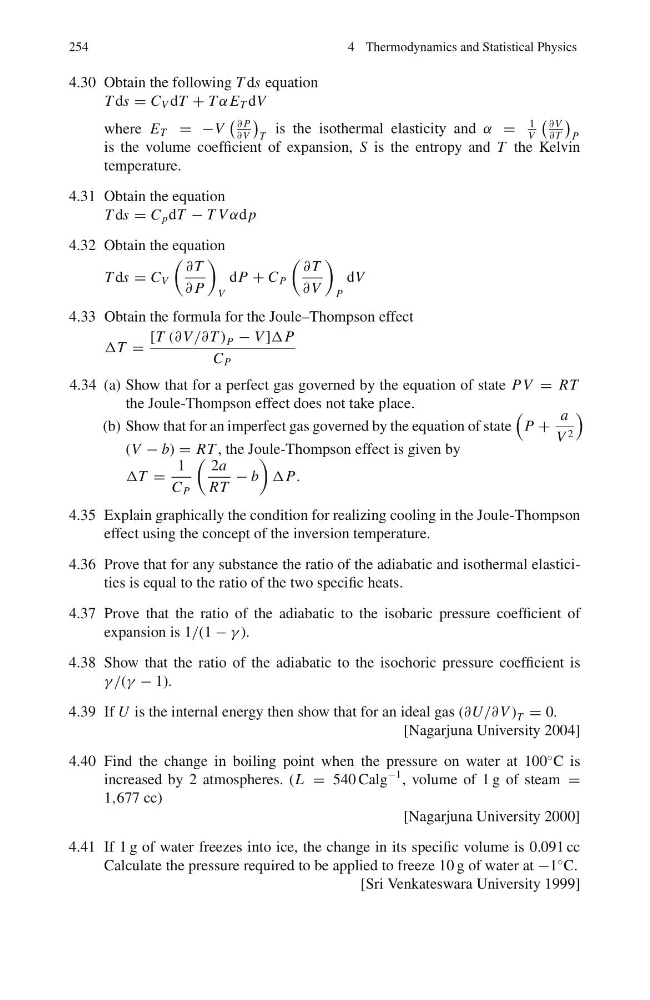
4.30 Obtain the following T ds equation
T ds = C V dT + T α E T dV
where E T = −V
∂ P
∂ V
T
is the isothermal elasticity and α =
1
V
∂ V
∂ T
P
is the volume coefficient of expansion, S is the entropy and T the Kelvin
temperature.
4.31 Obtain the equation
T ds = C p dT − T V αd p
4.32 Obtain the equation
T ds = C V
∂ T
∂ P
V
dP + C P
∂ T
∂ V
P
dV
4.33 Obtain the formula for the Joule–Thompson effect
ΔT =
[T (∂ V /∂ T ) P − V ]ΔP
C P
4.34 (a) Show that for a perfect gas governed by the equation of state PV = RT
the Joule-Thompson effect does not take place.
(b) Show that for an imperfect gas governed by the equation of state
P +
a
V 2
(V − b) = RT , the Joule-Thompson effect is given by
ΔT =
1
C P
2a
RT
− b
ΔP.
4.35 Explain graphically the condition for realizing cooling in the Joule-Thompson
effect using the concept of the inversion temperature.
4.36 Prove that for any substance the ratio of the adiabatic and isothermal elasticities is equal to the ratio of the two specific heats.
4.37 Prove that the ratio of the adiabatic to the isobaric pressure coefficient of
expansion is 1/(1 − γ ).
4.38 Show that the ratio of the adiabatic to the isochoric pressure coefficient is
γ /(γ − 1).
4.39 If U is the internal energy then show that for an ideal gas (∂U/∂ V ) T = 0.
[Nagarjuna University 2004]
4.40 Find the change in boiling point when the pressure on water at 100
◦ C is
increased by 2 atmospheres. (L = 540 Calg
−1 , volume of 1 g of steam =
1,677 cc)
[Nagarjuna University 2000]
4.41 If 1 g of water freezes into ice, the change in its specific volume is 0.091 cc
Calculate the pressure required to be applied to freeze 10 g of water at −1
◦ C.
[Sri Venkateswara University 1999]
4 Thermodynamics and Statistical Physics
4.30 Obtain the following T ds equation
T ds = C V dT + T α E T dV
where E T = −V
∂ P
∂ V
T
is the isothermal elasticity and α =
1
V
∂ V
∂ T
P
is the volume coefficient of expansion, S is the entropy and T the Kelvin
temperature.
4.31 Obtain the equation
T ds = C p dT − T V αd p
4.32 Obtain the equation
T ds = C V
∂ T
∂ P
V
dP + C P
∂ T
∂ V
P
dV
4.33 Obtain the formula for the Joule–Thompson effect
ΔT =
[T (∂ V /∂ T ) P − V ]ΔP
C P
4.34 (a) Show that for a perfect gas governed by the equation of state PV = RT
the Joule-Thompson effect does not take place.
(b) Show that for an imperfect gas governed by the equation of state
P +
a
V 2
(V − b) = RT , the Joule-Thompson effect is given by
ΔT =
1
C P
2a
RT
− b
ΔP.
4.35 Explain graphically the condition for realizing cooling in the Joule-Thompson
effect using the concept of the inversion temperature.
4.36 Prove that for any substance the ratio of the adiabatic and isothermal elasticities is equal to the ratio of the two specific heats.
4.37 Prove that the ratio of the adiabatic to the isobaric pressure coefficient of
expansion is 1/(1 − γ ).
4.38 Show that the ratio of the adiabatic to the isochoric pressure coefficient is
γ /(γ − 1).
4.39 If U is the internal energy then show that for an ideal gas (∂U/∂ V ) T = 0.
[Nagarjuna University 2004]
4.40 Find the change in boiling point when the pressure on water at 100
◦ C is
increased by 2 atmospheres. (L = 540 Calg
−1 , volume of 1 g of steam =
1,677 cc)
[Nagarjuna University 2000]
4.41 If 1 g of water freezes into ice, the change in its specific volume is 0.091 cc
Calculate the pressure required to be applied to freeze 10 g of water at −1
◦ C.
[Sri Venkateswara University 1999]