

4.2 Problems
253
4.2.2 Maxwell’s Thermodynamic Relations
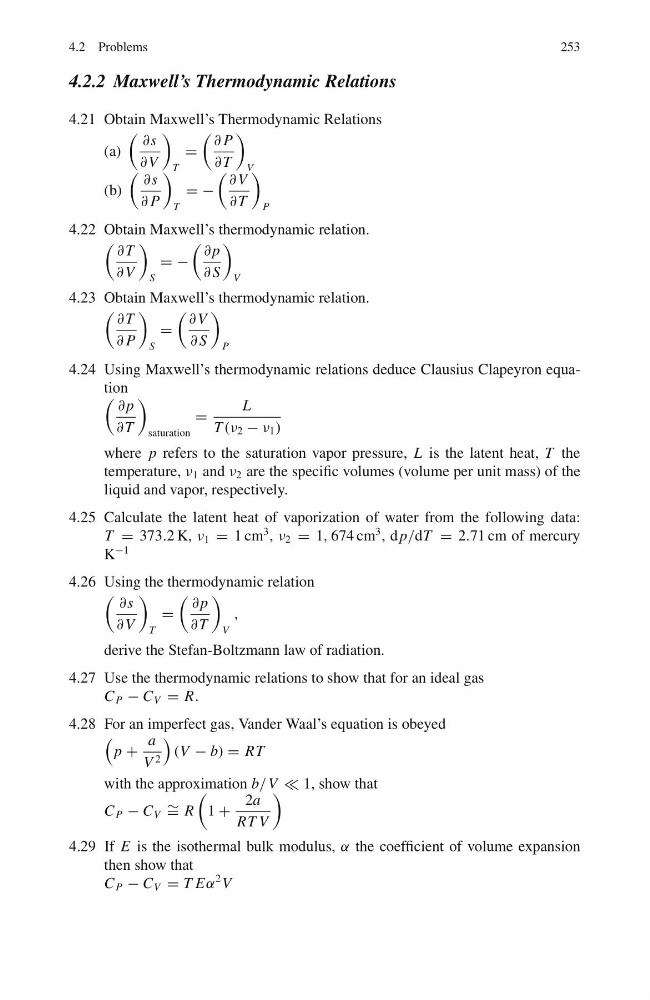
4.21 Obtain Maxwell’s Thermodynamic Relations
(a)
∂s
∂ V
T
=
∂ P
∂ T
V
(b)
∂s
∂ P
T
= −
∂ V
∂ T
P
4.22 Obtain Maxwell’s thermodynamic relation.
∂ T
∂ V
S
= −
∂ p
∂ S
V
4.23 Obtain Maxwell’s thermodynamic relation.
∂ T
∂ P
S
=
∂ V
∂ S
P
4.24 Using Maxwell’s thermodynamic relations deduce Clausius Clapeyron equation ∂ p
∂ T
saturation
=
L
T (ν 2 − ν 1 )
where p refers to the saturation vapor pressure, L is the latent heat, T the
temperature, ν 1 and ν 2 are the specific volumes (volume per unit mass) of the
liquid and vapor, respectively.
4.25 Calculate the latent heat of vaporization of water from the following data:
T = 373.2 K, ν 1 = 1 cm
3 , ν 2 = 1, 674 cm
3 , dp/dT = 2.71 cm of mercury
K
−1
4.26 Using the thermodynamic relation
∂s
∂ V
T
=
∂ p
∂ T
V
,
derive the Stefan-Boltzmann law of radiation.
4.27 Use the thermodynamic relations to show that for an ideal gas
C P − C V = R.
4.28 For an imperfect gas, Vander Waal’s equation is obeyed
p +
a
V 2
(V − b) = RT
with the approximation b/V 1, show that
C P − C V ∼ = R
1 +
2a
RT V
4.29 If E is the isothermal bulk modulus, α the coefficient of volume expansion
then show that
C P − C V = T Eα
2 V
253
4.2.2 Maxwell’s Thermodynamic Relations
4.21 Obtain Maxwell’s Thermodynamic Relations
(a)
∂s
∂ V
T
=
∂ P
∂ T
V
(b)
∂s
∂ P
T
= −
∂ V
∂ T
P
4.22 Obtain Maxwell’s thermodynamic relation.
∂ T
∂ V
S
= −
∂ p
∂ S
V
4.23 Obtain Maxwell’s thermodynamic relation.
∂ T
∂ P
S
=
∂ V
∂ S
P
4.24 Using Maxwell’s thermodynamic relations deduce Clausius Clapeyron equation ∂ p
∂ T
saturation
=
L
T (ν 2 − ν 1 )
where p refers to the saturation vapor pressure, L is the latent heat, T the
temperature, ν 1 and ν 2 are the specific volumes (volume per unit mass) of the
liquid and vapor, respectively.
4.25 Calculate the latent heat of vaporization of water from the following data:
T = 373.2 K, ν 1 = 1 cm
3 , ν 2 = 1, 674 cm
3 , dp/dT = 2.71 cm of mercury
K
−1
4.26 Using the thermodynamic relation
∂s
∂ V
T
=
∂ p
∂ T
V
,
derive the Stefan-Boltzmann law of radiation.
4.27 Use the thermodynamic relations to show that for an ideal gas
C P − C V = R.
4.28 For an imperfect gas, Vander Waal’s equation is obeyed
p +
a
V 2
(V − b) = RT
with the approximation b/V 1, show that
C P − C V ∼ = R
1 +
2a
RT V
4.29 If E is the isothermal bulk modulus, α the coefficient of volume expansion
then show that
C P − C V = T Eα
2 V