

1.1 Basic Concepts and Formulae
9
to have a stationary value (maximum or minimum). The integrand is taken to be
a function of the dependent variable y as well as the independent variable x and
y
= dy/dx. The limits x 1 and x 2 are fixed and at each of the limits y has definite
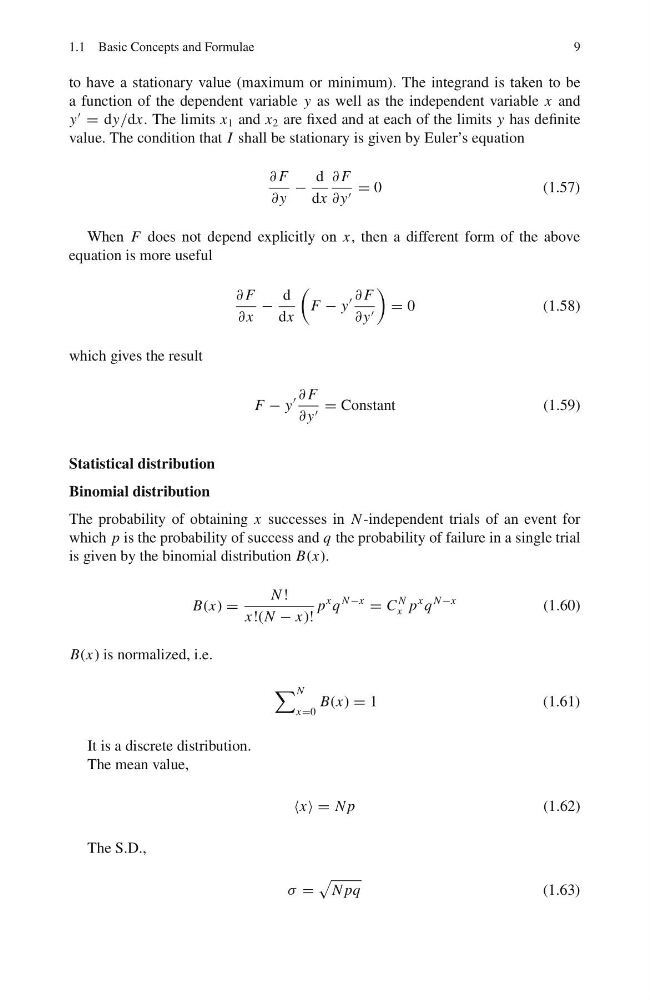
value. The condition that I shall be stationary is given by Euler’s equation
∂ F
∂ y
−
d
dx
∂ F
∂ y = 0
(1.57)
When F does not depend explicitly on x, then a different form of the above
equation is more useful
∂ F
∂ x
−
d
dx
F − y
∂ F
∂ y
= 0
(1.58)
which gives the result
F − y
∂ F
∂ y = Constant
(1.59)
Statistical distribution
Binomial distribution
The probability of obtaining x successes in N -independent trials of an event for
which p is the probability of success and q the probability of failure in a single trial
is given by the binomial distribution B(x).
B(x) =
N !
x!(N − x)!
p
x q
N −x
= C
N
x p
x q
N −x
(1.60)
B(x) is normalized, i.e.
N
x=0
B(x) = 1
(1.61)
It is a discrete distribution.
The mean value,
x = N p
(1.62)
The S.D.,
σ =
N pq
(1.63)
9
to have a stationary value (maximum or minimum). The integrand is taken to be
a function of the dependent variable y as well as the independent variable x and
y
= dy/dx. The limits x 1 and x 2 are fixed and at each of the limits y has definite
value. The condition that I shall be stationary is given by Euler’s equation
∂ F
∂ y
−
d
dx
∂ F
∂ y = 0
(1.57)
When F does not depend explicitly on x, then a different form of the above
equation is more useful
∂ F
∂ x
−
d
dx
F − y
∂ F
∂ y
= 0
(1.58)
which gives the result
F − y
∂ F
∂ y = Constant
(1.59)
Statistical distribution
Binomial distribution
The probability of obtaining x successes in N -independent trials of an event for
which p is the probability of success and q the probability of failure in a single trial
is given by the binomial distribution B(x).
B(x) =
N !
x!(N − x)!
p
x q
N −x
= C
N
x p
x q
N −x
(1.60)
B(x) is normalized, i.e.
N
x=0
B(x) = 1
(1.61)
It is a discrete distribution.
The mean value,
x = N p
(1.62)
The S.D.,
σ =
N pq
(1.63)