

3.3 Solutions
241
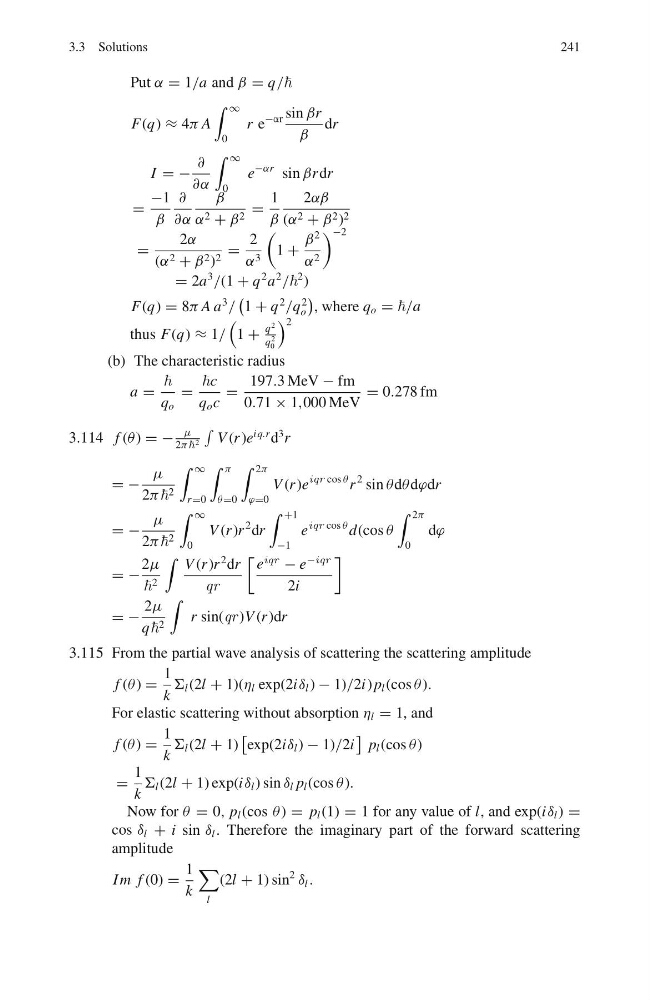
Put α = 1/a and β = q/
F(q) ≈ 4π A
∞
0
r e
−αr sin βr
β
dr
I = −
∂
∂α
∞
0
e
−αr sin βr dr
=
−1
β
∂
∂α
β
α 2 + β 2 =
1
β
2αβ
(α 2 + β 2 ) 2
=
2α
(α 2 + β 2 ) 2 =
2
α 3
1 +
β
2
α 2
−2
= 2a
3
/(1 + q
2 a
2
/
2 )
F(q) = 8π A a
3
/
1 + q
2
/q
2
o
, where q o = /a
thus F(q) ≈ 1/
1 +
q
2
q
2
0
2
(b) The characteristic radius
a =
q o
=
c
q o c
=
197.3 MeV − fm
0.71 × 1,000 MeV
= 0.278 fm
3.114 f (θ ) = −
μ
2π 2
V (r )e
iq.r d
3 r
= −
μ
2π 2
∞
r=0
π
θ=0
2π
ϕ=0
V (r )e
iqr cos θ r
2 sin θ dθ dϕdr
= −
μ
2π 2
∞
0
V (r )r
2 dr
+1
−1
e
iqr cos θ d(cos θ
2π
0
dϕ
= −
2μ
2
V (r )r
2 dr
qr
e
iqr
− e
−iqr
2i
= −
2μ
q 2
r sin(qr )V (r )dr
3.115 From the partial wave analysis of scattering the scattering amplitude
f (θ ) =
1
k
Σ l (2l + 1)(η l exp(2iδ l ) − 1)/2i) p l (cos θ ).
For elastic scattering without absorption η l = 1, and
f (θ ) =
1
k
Σ l (2l + 1)
exp(2iδ l ) − 1)/2i
p l (cos θ )
=
1
k
Σ l (2l + 1) exp(iδ l ) sin δ l p l (cos θ).
Now for θ = 0, p l (cos θ) = p l (1) = 1 for any value of l, and exp(iδ l ) =
cos δ l + i sin δ l . Therefore the imaginary part of the forward scattering
amplitude
I m f (0) =
1
k
l
(2l + 1) sin
2
δ l .
241
Put α = 1/a and β = q/
F(q) ≈ 4π A
∞
0
r e
−αr sin βr
β
dr
I = −
∂
∂α
∞
0
e
−αr sin βr dr
=
−1
β
∂
∂α
β
α 2 + β 2 =
1
β
2αβ
(α 2 + β 2 ) 2
=
2α
(α 2 + β 2 ) 2 =
2
α 3
1 +
β
2
α 2
−2
= 2a
3
/(1 + q
2 a
2
/
2 )
F(q) = 8π A a
3
/
1 + q
2
/q
2
o
, where q o = /a
thus F(q) ≈ 1/
1 +
q
2
q
2
0
2
(b) The characteristic radius
a =
q o
=
c
q o c
=
197.3 MeV − fm
0.71 × 1,000 MeV
= 0.278 fm
3.114 f (θ ) = −
μ
2π 2
V (r )e
iq.r d
3 r
= −
μ
2π 2
∞
r=0
π
θ=0
2π
ϕ=0
V (r )e
iqr cos θ r
2 sin θ dθ dϕdr
= −
μ
2π 2
∞
0
V (r )r
2 dr
+1
−1
e
iqr cos θ d(cos θ
2π
0
dϕ
= −
2μ
2
V (r )r
2 dr
qr
e
iqr
− e
−iqr
2i
= −
2μ
q 2
r sin(qr )V (r )dr
3.115 From the partial wave analysis of scattering the scattering amplitude
f (θ ) =
1
k
Σ l (2l + 1)(η l exp(2iδ l ) − 1)/2i) p l (cos θ ).
For elastic scattering without absorption η l = 1, and
f (θ ) =
1
k
Σ l (2l + 1)
exp(2iδ l ) − 1)/2i
p l (cos θ )
=
1
k
Σ l (2l + 1) exp(iδ l ) sin δ l p l (cos θ).
Now for θ = 0, p l (cos θ) = p l (1) = 1 for any value of l, and exp(iδ l ) =
cos δ l + i sin δ l . Therefore the imaginary part of the forward scattering
amplitude
I m f (0) =
1
k
l
(2l + 1) sin
2
δ l .