

222
3 Quantum Mechanics – II
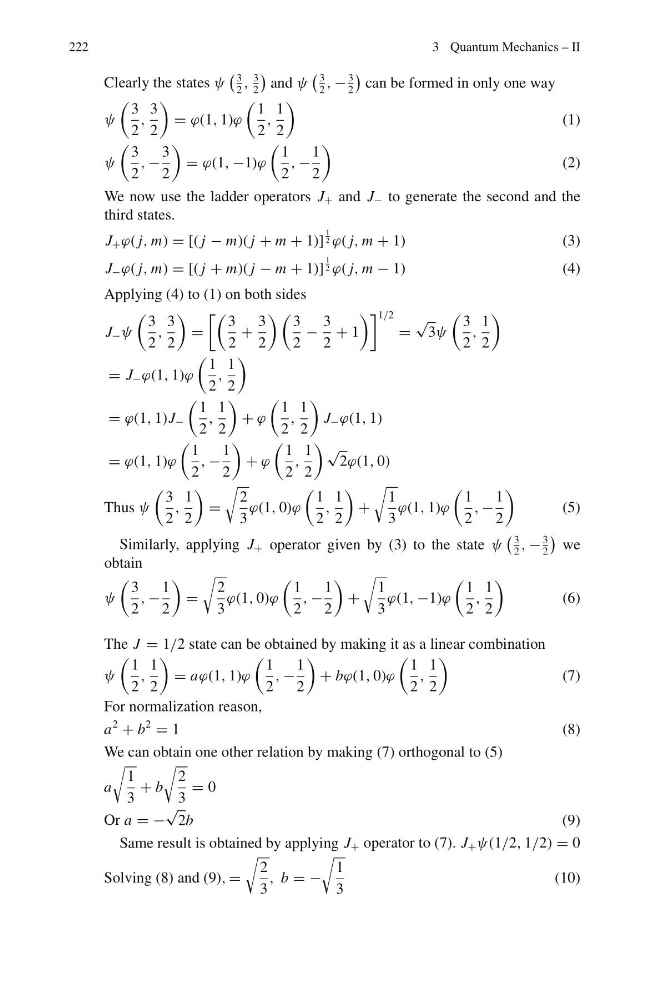
Clearly the states ψ
3
2
,
3
2
and ψ
3
2
, −
3
2
can be formed in only one way
ψ
3
2
,
3
2
= ϕ(1, 1)ϕ
1
2
,
1
2
(1)
ψ
3
2
, −
3
2
= ϕ(1, −1)ϕ
1
2
, −
1
2
(2)
We now use the ladder operators J + and J − to generate the second and the
third states.
J + ϕ( j, m) = [( j − m)( j + m + 1)]
1
2 ϕ( j, m + 1)
(3)
J − ϕ( j, m) = [( j + m)( j − m + 1)]
1
2 ϕ( j, m − 1)
(4)
Applying (4) to (1) on both sides
J − ψ
3
2
,
3
2
=
3
2
+
3
2
3
2
−
3
2
+ 1
1/2
=
√
3ψ
3
2
,
1
2
= J − ϕ(1, 1)ϕ
1
2
,
1
2
= ϕ(1, 1)J −
1
2
,
1
2
+ ϕ
1
2
,
1
2
J − ϕ(1, 1)
= ϕ(1, 1)ϕ
1
2
, −
1
2
+ ϕ
1
2
,
1
2
√
2ϕ(1, 0)
Thus ψ
3
2
,
1
2
=
2
3
ϕ(1, 0)ϕ
1
2
,
1
2
+
1
3
ϕ(1, 1)ϕ
1
2
, −
1
2
(5)
Similarly, applying J + operator given by (3) to the state ψ
3
2
, −
3
2
we
obtain
ψ
3
2
, −
1
2
=
2
3
ϕ(1, 0)ϕ
1
2
, −
1
2
+
1
3
ϕ(1, −1)ϕ
1
2
,
1
2
(6)
The J = 1/2 state can be obtained by making it as a linear combination
ψ
1
2
,
1
2
= aϕ(1, 1)ϕ
1
2
, −
1
2
+ bϕ(1, 0)ϕ
1
2
,
1
2
(7)
For normalization reason,
a
2
+ b
2
= 1
( 8 )
We can obtain one other relation by making (7) orthogonal to (5)
a
1
3
+ b
2
3
= 0
Or a = −
√
2b
(9)
Same result is obtained by applying J + operator to (7). J + ψ(1/2, 1/2) = 0
Solving (8) and (9), =
2
3
, b = −
1
3
(10)
3 Quantum Mechanics – II
Clearly the states ψ
3
2
,
3
2
and ψ
3
2
, −
3
2
can be formed in only one way
ψ
3
2
,
3
2
= ϕ(1, 1)ϕ
1
2
,
1
2
(1)
ψ
3
2
, −
3
2
= ϕ(1, −1)ϕ
1
2
, −
1
2
(2)
We now use the ladder operators J + and J − to generate the second and the
third states.
J + ϕ( j, m) = [( j − m)( j + m + 1)]
1
2 ϕ( j, m + 1)
(3)
J − ϕ( j, m) = [( j + m)( j − m + 1)]
1
2 ϕ( j, m − 1)
(4)
Applying (4) to (1) on both sides
J − ψ
3
2
,
3
2
=
3
2
+
3
2
3
2
−
3
2
+ 1
1/2
=
√
3ψ
3
2
,
1
2
= J − ϕ(1, 1)ϕ
1
2
,
1
2
= ϕ(1, 1)J −
1
2
,
1
2
+ ϕ
1
2
,
1
2
J − ϕ(1, 1)
= ϕ(1, 1)ϕ
1
2
, −
1
2
+ ϕ
1
2
,
1
2
√
2ϕ(1, 0)
Thus ψ
3
2
,
1
2
=
2
3
ϕ(1, 0)ϕ
1
2
,
1
2
+
1
3
ϕ(1, 1)ϕ
1
2
, −
1
2
(5)
Similarly, applying J + operator given by (3) to the state ψ
3
2
, −
3
2
we
obtain
ψ
3
2
, −
1
2
=
2
3
ϕ(1, 0)ϕ
1
2
, −
1
2
+
1
3
ϕ(1, −1)ϕ
1
2
,
1
2
(6)
The J = 1/2 state can be obtained by making it as a linear combination
ψ
1
2
,
1
2
= aϕ(1, 1)ϕ
1
2
, −
1
2
+ bϕ(1, 0)ϕ
1
2
,
1
2
(7)
For normalization reason,
a
2
+ b
2
= 1
( 8 )
We can obtain one other relation by making (7) orthogonal to (5)
a
1
3
+ b
2
3
= 0
Or a = −
√
2b
(9)
Same result is obtained by applying J + operator to (7). J + ψ(1/2, 1/2) = 0
Solving (8) and (9), =
2
3
, b = −
1
3
(10)